


Radical Tragedy
Religion, Ideology and Power in the Drama of Shakespeare and His Contemporaries
3rd Edition
Published on 9. April 2010
419 pages
978-1-137-08640-2 (ISBN)
Available for download
Description

When it was first published, Radical Tragedy was hailed as a groundbreaking reassessment of the drama of Shakespeare and his contemporaries. An engaged reading of the past with compelling contemporary significance, Radical Tragedy remains a landmark study of Renaissance drama and a classic of cultural materialist criticism. The corrected and reissued third edition of this critically acclaimed work includes a candid new Preface by the author and features a Foreword by Terry Eagleton.
More details
Edition
3rd edition
Language
English
Place of publication
London
United Kingdom
Publishing group
Bloomsbury Publishing PLC
ISBN-13
978-1-137-08640-2 (9781137086402)
Copyright in bibliographic data and cover images is held by Nielsen Book Services Limited or by the publishers or by their respective licensors: all rights reserved.
Schweitzer Classification
Other editions
Additional editions
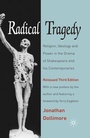
Jonathan Dollimore
Radical Tragedy
Religion, Ideology and Power in the Drama of Shakespeare and his Contemporaries, Third Edition
Book
04/2010
3rd Edition
Red Globe Press
€51.70
Shipment within 15-20 days
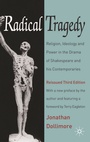
Jonathan Dollimore
Radical Tragedy
Religion, Ideology and Power in the Drama of Shakespeare and his Contemporaries, Third Edition
Book
04/2010
3rd Edition
Red Globe Press
€153.80
Shipment within 15-20 days
Content
- Cover
- Title
- Copyright
- Contents
- Acknowledgements
- Foreword by Terry Eagleton
- Preface to the reissued Third Edition
- Introduction to the Third Edition
- i September 1914
- ii September 2001
- iii September 1939
- iv Art and Humanism
- v Humanism and Materialism
- vi Returns
- vii Knowledge and Desire
- Notes
- Bibliography
- Introduction to the Second Edition
- i Tragedy and Politics
- ii Containment/Subversion
- iii Reading Contradictions
- iv Marginality (1)
- v Subjectivity or Writing of/f the Unitary Self
- vi God and Man
- vii Feminism, Sexualities and Gender Critique
- viii The Return to History: Marginality (2)
- ix History Reading Theory
- x Reproducing Shakespeare
- xi Shakespeare and Statecraft
- Notes
- PART I: RADICAL DRAMA: ITS CONTEXTS AND EMERGENCE
- 1 Contexts
- i Literary Criticism: Order versus History
- ii Ideology, Religion and Renaissance Scepticism
- iii Ideology and the Decentring of Man
- iv Secularism versus Nihilism
- v Censorship
- vi Inversion and Misrule
- 2 Emergence: Marston's Antonio Plays (c. 1599-1601) and Shakespeare's Troilus and Cressida (c. 1601-2)
- i Discontinuous Identity (1)
- ii Providence and Natural Law (1)
- iii Discontinuous Identity (2)
- iv Providence and Natural Law (2)
- v Ideology and the Absolute
- vi Social Contradiction and Discontinuous Identity
- vii Renaissance Man versus Decentred Malcontent
- PART II: STRUCTURE, MIMESIS, PROVIDENCE
- 3 Structure: From Resolution to Dislocation
- i Bradley
- ii Archer and Eliot
- iii Coherence and Discontinuity
- iv Brecht: A Different Reality
- 4 Renaissance Literary Theory: Two Concepts of Mimesis
- i Poetry versus History
- ii The Fictive and the Real
- 5 The Disintegration of Providentialist Belief
- i Atheism and Religious Scepticism
- ii Providentialism and History
- iii Organic Providence
- iv From Mutability to Cosmic Decay
- v Goodman and Elemental Chaos
- vi Providence and Protestantism
- vii Providence, Decay and the Drama
- 6 Dr Faustus (c. 1589-92): Subversion Through Transgression
- i Limit and Transgression
- ii Power and the Unitary Soul
- 7 Mustapha (c. 1594-6): Ruined Aesthetic, Ruined Theology
- i Tragedy, Theology and Cosmic Decay
- ii Mustapha: Tragedy as Dislocation
- 8 Sejanus (1603): History and Realpolitik
- i History, Fate, Providence
- 9 The Revenger's Tragedy (c. 1606): Providence, Parody and Black Camp
- i Providence and Parody
- ii Desire and Death
- PART III: MAN DECENTRED
- 10 Subjectivity and Social Process
- i Tragedy, Humanism and the Transcendent Subject
- ii The Jacobean Displacement of the Subject
- iii The Essentialist Tradition: Christianity, Stoicism and Renaissance Humanism
- iv Internal Tensions
- v Anti-Essentialism in Political Theory and Renaissance Scepticism
- vi Renaissance Individualism?
- 11 Bussy D'Ambois (c. 1604): A Hero at Court
- i Shadows and Substance
- ii Court Power and Native Noblesse
- 12 King Lear (c. 1605-6) and Essentialist Humanism
- i Redemption and Endurance: Two Sides of Essentialist Humanism
- ii King Lear: A Materialist Reading
- iii The Refusal of Closure
- 13 Antony and Cleopatra (c. 1607): Virtus under Erasure
- i Virtus and History
- ii Virtus and Realpolitik (1)
- iii Honour and Policy
- iv Sexuality and Power
- 14 Coriolanus (c. 1608): The Chariot Wheel and its Dust
- i Virtus and Realpolitik (2)
- ii Essentialism and Class War
- 15 The White Devil (1612): Transgression Without Virtue
- i Religion and State Power
- ii The Virtuous and the Vicious
- iii Sexual and Social Exploitation
- iv The Assertive Woman
- v The Dispossessed Intellectual
- vi Living Contradictions
- PART IV: SUBJECTIVITY: IDEALISM VERSUS MATERIALISM
- 16 Beyond Essentialist Humanism
- i Origins of the Transcendent Subject
- ii Essence and Universal: Enlightenment Transitions
- iii Discrimination and Subjectivity
- iv Formative Literary Influences: Pope to Eliot
- v Existentialism
- vi Lawrence, Leavis and Individualism
- vii The Decentred Subject
- Notes
- Bibliography of Work Cited
- Index of Names and Texts
- Index of Subjects

