

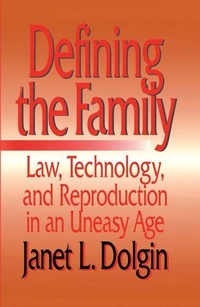
Defining the Family
Law, Technology, and Reproduction in an Uneasy Age
1st Edition
Published on 1. January 1997
277 pages
978-0-8147-4423-9 (ISBN)
Description

Defining the Family: Law, Technology, and Reproduction in an Uneasy Age provides a sweeping portrait of the family in American law from the nineteenth century to the present. The family today has come to be defined by individuality and choice. Pre-nuptial agreements, non-marital cohabitation, gay and lesbian marriages have all profoundly altered our ideas about marriage and family. In the last few years, reproductive technology and surrogacy have accelerated this process of change at a breathtaking rate. Once simple questions have taken on a dizzying complexity: Who are the real parents of a child? What are the relationships and responsibilities between a child, the woman who carried it to term, and the egg donor? Between viable sperm and the wife of a dead donor?
The courts and the law have been wildly inconsistent and indecisive when grappling with these questions. Should these cases be decided in light of laws governing contracts and property? Or it is more appropriate to act in the best interests of the child, even if that child is unborn, or even unconceived? No longer merely settling disputes among family members, the law is now seeing its own role expand, to the point where it is asked to regulate situations unprecedented in human history. Janet L. Dolgin charts the response of the law to modern reproductive technology both as it transforms our image of the family and is itself transformed by the tide of social forces.
The courts and the law have been wildly inconsistent and indecisive when grappling with these questions. Should these cases be decided in light of laws governing contracts and property? Or it is more appropriate to act in the best interests of the child, even if that child is unborn, or even unconceived? No longer merely settling disputes among family members, the law is now seeing its own role expand, to the point where it is asked to regulate situations unprecedented in human history. Janet L. Dolgin charts the response of the law to modern reproductive technology both as it transforms our image of the family and is itself transformed by the tide of social forces.
Reviews / Votes
"Janet Dolgin provides an overview of clashing conceptions of family as revealed in the struggle of courts to deal with the impact of various forms of reproductive technology." (Hypathia) "The best book for lawyers to read on the problems of assisted reproduction." (Jurimetrics) "Carefully researched . . . In Professor Dolgin's view, the family carried forward the feudal structure of hierarchy, mutual loyalty and lack of individual autonomy into the modern era until, like other institutions, it came under stress from the overriding reality of modern life: marketplace economics." (New York Law Journal) "Dolgin argues that [surrogacy and reproductive technologies] have only accelerated a clash in visions of the family that have uneasily coexisted for more than a century." (Choice)More details
Language
English
Place of publication
New York
United States
Target group
Professional and scholarly
File size
127,02 MB
ISBN-13
978-0-8147-4423-9 (9780814744239)
Copyright in bibliographic data and cover images is held by Nielsen Book Services Limited or by the publishers or by their respective licensors: all rights reserved.
Schweitzer Classification
Other editions
Additional editions
Book
08/1999
New York University Press
€39.50
Shipment within 15-20 days

Book
01/1997
New York University Press
€83.99
Shipment within 15-20 days
Person
Janet L. Dolgin is the Maurice A. Deane Distinguished Professor of Constitutional Law at Hofstra University School of Law in New York.
Content
- Cover
- Title Page
- Copyright Page
- CONTENTS
- PREFACE
- ACKNOWLEDGMENTS
- Introduction
- ONE The Transformation of the Family
- TWO Family Law in Transition
- THREE Status and Contract in Surrogate Motherhood
- FOUR Unwed Fathers and Surrogate Mothers
- FIVE Social Implications of Biological Transformations
- SIX The "Intent" of Reproduction
- SEVEN Suffer the Children
- Conclusion
- NOTES
- BIBLIOGRAPHY
- INDEX
