

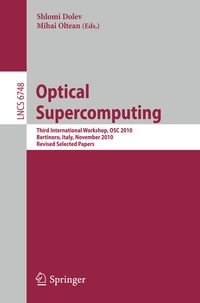
Optical Supercomputing
Third International Workshop, OSC 2010, Bertinoro, Italy, November 17-19, 2010, Revised Selected Papers
Published on 12. July 2011
X, 131 pages
978-3-642-22494-2 (ISBN)
Description

This book constitutes the thoroughly refereed post-conference proceedings of the Third International Workshop on Optical SuperComputing, OSC 2010, held in Bertinoro, Italy, in November 2010.
The 13 papers presented were carefully reviewed and selected for inclusion in this book. Being an annual forum for research presentations on all facets of optical computing for solving hard computation tasks, OCS addresses the following topics of interest: designs or demonstrations of optical computing devices, algorithmics and complexity issues of optical computing, computation representation by photons and holograms, neural and brain inspired architectures, electro-optic devices for interacting with optical computing devices, practical implementations, analysis of existing devices and case studies, optical photonics and laser switching technologies, optical and photonic memories, optical signal processing subsystems, optical networks for high-performance computing, optical interconnections, quantum optical systems, applications and algorithms for optical devices, Alpha particles, X-rays, and nano-technologies for optical computing.
More details
Other editions
Additional editions
Shlomi Dolev | Mihai Oltean
Optical Supercomputing
Third International Workshop, OSC 2010, Bertinoro, Italy, November 17-19, 2010, Revised Selected Papers
Book
07/2011
1st Edition
Springer
€53.49
Shipment within 7-9 days
Persons
Content
- Title
- Preface
- Organization
- Table of Contents
- Integrated Photonic Micro Logic Gate
- Introduction
- Operation Principle
- Fabrication
- Experimental Testing
- Conclusions
- References
- An Optical System for Prime Factorization Based on Parallel Processing
- Introduction
- Prime Factorization with Modulo Exponentiation
- Optical Parallel Processing with Amplitude Modulation
- Numerical Analysis
- Discussions
- Comments and Summary
- References
- Optical Graph 3-Colorability
- Introduction
- The Graph 3-Colorability Problem
- The Optical Solution
- Graph 3-Colorings as Binary Sequences
- Finding Proper Binary Sequences
- Solving the Problem Instances
- Complexity
- Conclusion
- References
- Solving a Generalized Version of the Exact Cover Problem with a Light-Based Device
- Introduction
- Exact Cover Problem
- Example
- The Device
- Previously Proposed Device
- The Basic Idea of the System
- The Modified Device
- Physical Implementation
- Analysis of the Proposed Device
- Precision
- Hardware Complexity
- Runtime Complexity
- Problem Size
- Power Decrease
- Technical Difficulties
- Improving the Device
- Conclusion and Future Work
- References
- All-Optical Reconfigurable Logic Unit with Optically Controlled Microcavity Switches
- Introduction
- All-Optical Bacteriorhodopsin Protein Coated Microcavity Switch
- BR-Coated Microcavity Switch as a Four-Port Resonant Coupler
- Design of BR-Based All-Optical Reconfigurable Logic Unit
- Results and Discussion
- Conclusion
- References
- Simulation and Optimized Design of High Density Optical Crossconnect Systems for Massively Parallel Computing Architectures
- Introduction
- Clos Networks
- Mathematical Modeling of PIFSO n × n Cross Connects
- Optimizing PIFSO Clos Networks with Evolutionary Algorithms
- Evolutionary Algorithms
- Optimizing n × n Clos Networks
- Conclusions for the Design
- Outlook
- References
- An Optical Solution for the SAT Problem
- Introduction
- Related Work
- Delay-Based Systems
- The SAT Problem
- The Device
- The Delaying System
- How the System Works
- Reconstructing the Solution
- Weaknesses
- Conclusion
- References
- Compressive Sensing of Object-Signature
- Introduction
- Compressive Sampling
- Compressive Sensing and Compressive Imaging
- Object-Signature
- Shape-Representation Using Object-Signature
- Compression and Compressive Sensing of Object-Signature
- Experiments, Results, and Results Evaluation
- Conclusions and Proposals for Further Research
- References
- Optics Goes Where No Electronics Can Go: Zero-Energy-Dissipation Logic
- Introduction
- Correcting the Errors We All Made
- Why We (and Others) Failed for So Many Decades
- Remaining Problems
- Summary Diagram
- Conclusions
- References
- Nanotechnology Based Optical Solution for NP-Hard Problems
- Introduction
- Optical Solutions for Hamiltonian-cycle and Permanent Problems
- Optical Considerations
- Preprocessing Techniques
- Hamiltonian-Cycle
- The Permanent Problem
- Nano Based Optical Computer Design
- Optical Computation Architectures
- Selection Mechanism
- Nano Based Masks Performance Simulation
- Simulation Model Setup
- Concluding Remarks
- References
- Holographic Computation of Balanced Succinct Permanent Instances
- Introduction
- Complexity of the Succinct Permanent Problem
- Circuits as Inputs
- Preprocessing Unit
- Preprocessing by Holography
- An Optical Architecture for Succinct Permanent Problem
- Discussion
- References
- Being Analog
- Big Artificial Intelligence
- The Analog Shell
- Physical Beings, Physical Computation
- The Drawbacks
- Moving Forward
- References
- Exceeding the Diffraction and the Geometric Limits of Imaging Systems: A Review
- Introduction
- SW Adaptation Process
- Diffractive Type of Super Resolution
- Geometrical Type of Super Resolution
- Sensing with Light
- Conclusions
- References
- Author Index
