

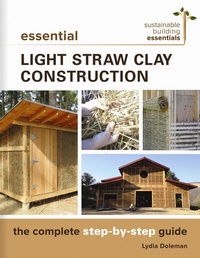
Essential Light Straw Clay Construction
Description

Build High-performance, Low-impact Walls with Light Straw Clay Part of the Sustainable Building Essentials series, Essential Light Straw Clay Construction is the first fully illustrated, step-by-step guide to using light straw clay?a durable, energy-efficient, and environmentally friendly wall material. Learn how to create beautiful, code-compliant walls that combine centuries-old wisdom with modern high-performance building science.
What You'll Learn
- Sustainable, Low-carbon Construction: Uses straw "waste" mixed with clay for a high-insulation, low-impact material that reduces embodied energy.
- Thermally Efficient and Moisture-resistant: Naturally regulates indoor humidity, buffers temperature swings, and improves comfort year-round.
- Durable and Code-compliant: Proven long-lasting in historical and modern buildings, meeting US building codes for safety and performance.
- Step-by-step Guidance: Illustrated instructions for mixing, installation, and variations such as slip-chip, plus detail drawings for stud, timber, pole framing, Larsen trusses, and retrofits.
- Project Planning Made Simple: Material selection, quantity estimation, budgeting, sourcing, and best practices for a successful build.
- Finishing and Maintenance: Learn techniques to ensure long-term durability, aesthetics, and minimal upkeep.
Written by Lydia Doleman, licensed contractor and natural building expert, this guide combines hands-on experience, practical instruction, and building science to give DIYers and professionals the confidence to use light straw clay in a variety of construction and renovation projects.
Explore the full Sustainable Building Essentials series for practical, illustrated guidance on natural building techniques, sustainable wall systems, and high-performance construction
More details
Other editions
Additional editions
Person
Lydia Doleman is a licensed contractor with two decades of experience as a natural and sustainable builder, cabinet maker, and trainer. She has taught carpentry and natural building at Solar Energy International in Colorado and was lead ecological builder for Portland's City Repair project from 2002-09. Aiming to merge three converging passions in her life - art, ecology and social justice - Lydia has created beautiful, high-performance, low-impact buildings across Oregon and Washington, including Portland's first permitted straw bale home, The Rebuilding Center's cob entryway, and a 3,300-sq.f light straw clay brewery. She's written articles for The Last Straw Journal and Permaculture Design and appeared on NBC News and HGTV's Off Beat America on the topic of tiny homes, featuring a small-scale light straw clay timber frame home. Lydia lives in southern Oregon.
Content
Acknowledgments
Chapter 1: Introduction
Chapter 2: Rationale
Chapter 3: Appropriate Use
Chapter 4: Building Science Notes
Chapter 5 : Material Specifications
Chapter 6: Design Options: Framing Systems and Form Options
Chapter 7: Design Notes, Details, and Budgeting
Chapter 8: Construction Procedures
Chapter 9: Finishes
Chapter 10: Maintenance and Renovation
Chapter 11: Building Codes
Chapter 12: Tools
Appendix 1: APPENDIX R - Light Straw Clay Construction, from 2015 IRC
Index
About the Author
