

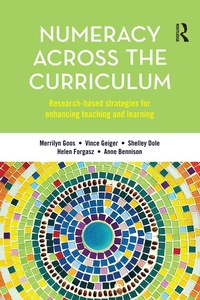
Numeracy Across the Curriculum
Research-based strategies for enhancing teaching and learning
1st Edition
Published on 16. July 2020
272 pages
978-1-000-24666-7 (ISBN)
Description

Being numerate involves more than mastering basic mathematics. Numeracy connects the mathematics learned at school with out-of-school situations that require capabilities such as problem solving, critical judgment, and sense-making related to non-mathematical contexts. This book provides prospective and practising teachers with practical, research-based strategies for embedding numeracy across the primary and secondary school curriculum.
Based on the authors' ten-year research program, the text explains what numeracy is and how numeracy has developed as an educational goal. It describes in detail the five dimensions of the authors' model: attention to real-life contexts; application of mathematical knowledge; use of physical, representational and digital tools; the promotion of positive dispositions towards the use of mathematics to solve problems encountered in day-to-day life; and a critical orientation to interpreting mathematical results and making evidence-based judgements. There is guidance on how to embed numeracy across all subjects within the curriculum, how to assess numeracy learning and how to deal with challenges and dilemmas including working with discipline boundaries and developing support resources.
Featuring practical examples and case studies throughout, this book will build pre-service teacher confidence, demystify common misconceptions and grounds theory into practice in this vital area of student competency.
'The authors of this text are recognised authorities on numeracy. They have engaged heavily in numeracy research over many years and this text reflects the depth of their understanding and knowledge.' - Geoff Hilton, University of Queensland
Based on the authors' ten-year research program, the text explains what numeracy is and how numeracy has developed as an educational goal. It describes in detail the five dimensions of the authors' model: attention to real-life contexts; application of mathematical knowledge; use of physical, representational and digital tools; the promotion of positive dispositions towards the use of mathematics to solve problems encountered in day-to-day life; and a critical orientation to interpreting mathematical results and making evidence-based judgements. There is guidance on how to embed numeracy across all subjects within the curriculum, how to assess numeracy learning and how to deal with challenges and dilemmas including working with discipline boundaries and developing support resources.
Featuring practical examples and case studies throughout, this book will build pre-service teacher confidence, demystify common misconceptions and grounds theory into practice in this vital area of student competency.
'The authors of this text are recognised authorities on numeracy. They have engaged heavily in numeracy research over many years and this text reflects the depth of their understanding and knowledge.' - Geoff Hilton, University of Queensland
More details
Edition
1. Auflage
Language
English
Place of publication
London
United Kingdom
Publishing group
Taylor & Francis Ltd
Target group
College/higher education
Product notice
Reflowable
ISBN-13
978-1-000-24666-7 (9781000246667)
Copyright in bibliographic data and cover images is held by Nielsen Book Services Limited or by the publishers or by their respective licensors: all rights reserved.
Schweitzer Classification
Other editions
Additional editions
Shelley Dole | Vince Geiger
Numeracy Across the Curriculum
Research-based strategies for enhancing teaching and learning
Book
03/2021
1st Edition
Routledge
€179.51
Shipment within 15-20 days
Shelley Dole | Vince Geiger
Numeracy Across the Curriculum
Research-based strategies for enhancing teaching and learning
Book
11/2018
1st Edition
Allen & Unwin
€49.00
Shipment within 3-4 weeks
Persons
Merrilyn Goos is Professor of STEM Education, University of Limerick, Ireland and is an internationally recognized mathematics educator.
Vince Geiger is Professor of Mathematics Education and STEM program director within the Learning Sciences Institute Australia at Australian Catholic University.
Shelley Dole is Professor and Head of the School of Education at the University of the Sunshine Coast.
Helen Forgasz is a Professor Emerita in the Faculty of Education, Monash University.
Anne Bennison is a Lecturer in the School of Education at the University of the Sunshine Coast and recently completed her doctoral studies identifying ways to support teachers to embed numeracy across the curriculum.
Vince Geiger is Professor of Mathematics Education and STEM program director within the Learning Sciences Institute Australia at Australian Catholic University.
Shelley Dole is Professor and Head of the School of Education at the University of the Sunshine Coast.
Helen Forgasz is a Professor Emerita in the Faculty of Education, Monash University.
Anne Bennison is a Lecturer in the School of Education at the University of the Sunshine Coast and recently completed her doctoral studies identifying ways to support teachers to embed numeracy across the curriculum.
Content
About the authors
List of figures, tables and case studies
1. Understanding numeracy
2. Towards numeracy across the curriculum
3. Numeracy in the 21st century
4. Numeracy demands
5. Numeracy opportunities
6. Planning for numeracy across the curriculum
7. Whole-school approaches to numeracy
8. Assessing numeracy learning
9. Challenges in enhancing numeracy
Acknowledgements
References
Index
List of figures, tables and case studies
1. Understanding numeracy
2. Towards numeracy across the curriculum
3. Numeracy in the 21st century
4. Numeracy demands
5. Numeracy opportunities
6. Planning for numeracy across the curriculum
7. Whole-school approaches to numeracy
8. Assessing numeracy learning
9. Challenges in enhancing numeracy
Acknowledgements
References
Index
