
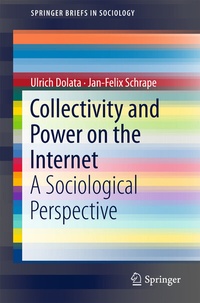
Collectivity and Power on the Internet
Description
Alles über E-Books | Antworten auf Fragen rund um E-Books, Kopierschutz und Dateiformate finden Sie in unserem Info- & Hilfebereich.
This book provides a comprehensive overview of the manifestations and interrelations of collectivity and power on the internet from a sociological point of view. It addresses questions on how different forms of internet-based collectivities (masses, crowds, movements, communities ) could be understood and differentiated from one another. It presents analyses on the role technical infrastructures of the web play for their formation, how the mobilization and organization of social movements and social protests has changed through social media, how work and decision-making processes are organized in open source communities and why the essential segments of the commercial internet are today concentrated in the hands of a few corporations who dispose over significant economic, infrastructural and rule-setting power.
More details
Other editions
Additional editions
Persons
Prof. Dr. Ulrich Dolata is Professor of Organizational Sociology and Innovation Studies at the University of Stuttgart (Germany).
Dr. Jan-Felix Schrape is Senior Researcher at the Department of Organizational Sociology and Innovation Studies, University of Stuttgart (Germany).

Content
System requirements
File format: PDF
Copy protection: Watermark-DRM (Digital Rights Management)
System requirements:
- Computer (Windows; MacOS X; Linux): Use the free software Adobe Reader, Adobe Digital Editions, or any other PDF viewer of your choice (see eBook Help).
- Tablet/Smartphone (Android; iOS): Install the free app Adobe Digital Editions or another reading app for eBooks, e.g., PocketBook (see eBook Help).
- E-reader: Bookeen, Kobo, Pocketbook, Sony, Tolino and many more (only limited: Kindle).
The file format PDF always displays a book page identically on any hardware. This makes PDF suitable for complex layouts such as those used in textbooks and reference books (images, tables, columns, footnotes). Unfortunately, on the small screens of e-readers or smartphones, PDFs are rather annoying, requiring too much scrolling.
This eBook uses Watermark-DRM, a „soft” copy protection. This means that there are no technical restrictions to prevent illegal distribution. However, there is a personalised watermark embedded in the eBook that can be used to identify the purchaser of the eBook in the event of misuse and to provide evidence for legal purposes.
For more information, see our eBook Help page.