

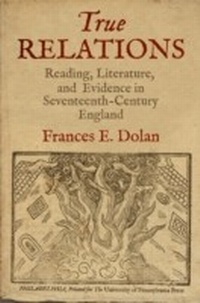
True Relations
Reading, Literature, and Evidence in Seventeenth-Century England
1st Edition
Published on 27. March 2013
344 pages
978-0-8122-0779-8 (ISBN)
Description

In the motley ranks of seventeenth-century print, one often comes upon the title True Relation. Purportedly true relations describe monsters, miracles, disasters, crimes, trials, and apparitions. They also convey discoveries achieved through exploration or experiment. Contemporaries relied on such accounts for access to information even as they distrusted them; scholars today share both their dependency and their doubt. What we take as evidence, Frances E. Dolan argues, often raises more questions than it answers. Although historians have tracked dramatic changes in evidentiary standards and practices in the period, these changes did not solve the problem of how to interpret true relations or ease the reliance on them. The burden remains on readers.
Dolan connects early modern debates about textual evidence to recent discussions of the value of seventeenth-century texts as historical evidence. Then as now, she contends, literary techniques of analysis have proven central to staking and assessing truth claims. She addresses the kinds of texts that circulated about three traumatic events-the Gunpowder Plot, witchcraft prosecutions, and the London Fire-and looks at legal depositions, advice literature, and plays as genres of evidence that hover in a space between fact and fiction. Even as doubts linger about their documentary and literary value, scholars rely heavily on them. Confronting and exploring these doubts, Dolan makes a case for owning up to our agency in crafting true relations among the textual fragments that survive.
Dolan connects early modern debates about textual evidence to recent discussions of the value of seventeenth-century texts as historical evidence. Then as now, she contends, literary techniques of analysis have proven central to staking and assessing truth claims. She addresses the kinds of texts that circulated about three traumatic events-the Gunpowder Plot, witchcraft prosecutions, and the London Fire-and looks at legal depositions, advice literature, and plays as genres of evidence that hover in a space between fact and fiction. Even as doubts linger about their documentary and literary value, scholars rely heavily on them. Confronting and exploring these doubts, Dolan makes a case for owning up to our agency in crafting true relations among the textual fragments that survive.
Reviews / Votes
"This is a richly provocative book packed with stimulating insights, a work from which every early modernist can learn. Dolan's subject is as much the methodology of historians as it is the mentalities of historical subjects. She is a reassuring guide to issues that have vexed historians for the last thirty years." (American Historical Review) "[E]very scholar of early modern England ought to read this book. Dolan deftly cuts through the muddle that allows all of us, literary critics and historians, to acknowledge the limitations of our sources with one side of our mouths, while on the other side proceeding to read them however most suits our needs." (Shakespeare Studies) "At a time when the value of literature-and literary analysis-is a matter of public debate, True Relations is a carefully constructed and ultimately persuasive argument for the importance of literary critical methods." (Modern Philology) "A thoughtful and provocative essay on method as much as it is a set of readings of early modern texts. . . . Dolan's insistence that there are significant correspondences between the scholarly endeavours of historically minded critics (and critically minded historians) and the reading practices of their early modern subjects is a beguiling idea. True Relations is the kind of book that will make all its readers reflect on their own methods and responsibilities as practitioners of academic disciplines." (Review of English Studies) "Frances Dolan exhibits a heightened literary, historiographical, and methodological selfconsciousness, and invites other scholars to share and enjoy it. True Relations explores the ways historical actors in the early modern era presented information, in text or testimony, and how readers four centuries later render or interpret that material as evidence. It is concerned, suggestively and sometimes brilliantly, with the relatedness of relations, and the bases for supposing a story to be true." (Journal of British Studies) "True Relations pairs a methodological inquiry with historical analysis of specific case histories connecting fact to fiction in the early modern period. No other book to date has traced the particular way that scholars of the early modern period devise a practice of reading once they affirm the axiom that the 'real' is constructed. Dolan offers an unusually lucid and crisp tour of the social stakes involved in reading strategies and evidentiary standards." (Wendy Wall, Northwestern University)More details
Language
English
Place of publication
Pennsylvania
United States
Target group
College/higher education
Illustrations
10 illus.
10 illus.
File size
3,10 MB
ISBN-13
978-0-8122-0779-8 (9780812207798)
Copyright in bibliographic data and cover images is held by Nielsen Book Services Limited or by the publishers or by their respective licensors: all rights reserved.
Schweitzer Classification
Other editions
Additional editions
Book
02/2013
University of Pennsylvania Press
€70.00
Shipment within 10-20 days
Person
Frances E. Dolan is Professor of English at the University of California, Davis. She is also author of Marriage and Violence: The Early Modern Legacy, available from the University of Pennsylvania Press, as well as Dangerous Familiars: Representations of Domestic Crime in England, 1550-1700 and Whores of Babylon: Catholicism, Gender, and Seventeenth-Century Print Culture.
Content
Note on Spelling
Introduction
PART I. CRISES OF EVIDENCE
Chapter 1. True and Perfect Relations: Henry Garnet, Confessional Identity, and Figuration
Chapter 2. Sham Stories and Credible Relations: Witchcraft and Narrative Conventions
Chapter 3. A True and Faithful Account? The London Fire, Blame, and Partisan Proof
PART II. GENRES OF EVIDENCE
Chapter 4. First-Person Relations: Reading Depositions
Chapter 5. The Rule of Relation: Domestic Advice Literature and Its Readers
Chapter 6. Relational Truths: Dramatic Evidence, All Is True, and Double Falsehood
Notes
Index
Acknowledgments
Introduction
PART I. CRISES OF EVIDENCE
Chapter 1. True and Perfect Relations: Henry Garnet, Confessional Identity, and Figuration
Chapter 2. Sham Stories and Credible Relations: Witchcraft and Narrative Conventions
Chapter 3. A True and Faithful Account? The London Fire, Blame, and Partisan Proof
PART II. GENRES OF EVIDENCE
Chapter 4. First-Person Relations: Reading Depositions
Chapter 5. The Rule of Relation: Domestic Advice Literature and Its Readers
Chapter 6. Relational Truths: Dramatic Evidence, All Is True, and Double Falsehood
Notes
Index
Acknowledgments
