

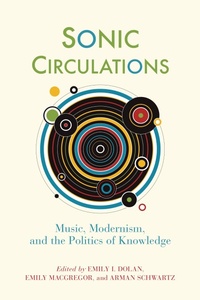
Sonic Circulations
Music, Modernism, and the Politics of Knowledge
1st Edition
Published on 2. September 2025
332 pages
978-1-5128-2804-7 (ISBN)
Description

The role music, sound, and voice played in modern knowledge production in the early twentieth century
Derived from the Latin words circum (round) and ire (to go), a circuit can refer to any bounded area. For contemporary readers, it might evoke the course of an electric current, as well as the flow of global capital. Yet sound-an inherently temporal phenomenon-can only circulate in mediated forms. Tracing the pathways through and by which sound traveled in the early twentieth century, Sonic Circulations not only proposes a new account of the role of music, sound, and voice in modern knowledge production but also poses urgent questions about technology and empire, while also foregrounding the tensions and paradoxes involved in situating the sonic within any fixed regime or system.
Exploring key moments in the development of disciplines including linguistics, sociology, and eugenics, as well as musicology itself, Sonic Circulations explores the many ways that sound has functioned as evidence and information, as both an object and an agent of scientific mastery. Contributors explore the processes by which sound has moved through a variety of conceptual, as well as physical domains, highlighting the richness of historical contingency. This volume shows that circulation happened in many spaces and through many technologies: through sound recording, but also through the trade magazine and in the classroom; through wireless broadcasting and international festivals, but also in the cozy spaces of the suburban home.
Featuring scholars working at the borders of musicology, ethnomusicology, sound studies, and music theory, this volume's ten chapters and two epilogues illuminate an alternative genealogy of modernism, emphasizing the embeddedness of even the most abstract practices in the structures of imperial modernity.
Contributors: Peter Asimov, Andrea F. Bohlman, Harriet Boyd-Bennett, Alexander W. Cowan, Emily I. Dolan, John Gabriel, Jonathan Hicks, Alexandra Kieffer, Gundula Kreuzer, Deirdre Loughridge, Emily MacGregor, Giles Masters, Arman Schwartz, Danielle Simon, John Tresch.
Derived from the Latin words circum (round) and ire (to go), a circuit can refer to any bounded area. For contemporary readers, it might evoke the course of an electric current, as well as the flow of global capital. Yet sound-an inherently temporal phenomenon-can only circulate in mediated forms. Tracing the pathways through and by which sound traveled in the early twentieth century, Sonic Circulations not only proposes a new account of the role of music, sound, and voice in modern knowledge production but also poses urgent questions about technology and empire, while also foregrounding the tensions and paradoxes involved in situating the sonic within any fixed regime or system.
Exploring key moments in the development of disciplines including linguistics, sociology, and eugenics, as well as musicology itself, Sonic Circulations explores the many ways that sound has functioned as evidence and information, as both an object and an agent of scientific mastery. Contributors explore the processes by which sound has moved through a variety of conceptual, as well as physical domains, highlighting the richness of historical contingency. This volume shows that circulation happened in many spaces and through many technologies: through sound recording, but also through the trade magazine and in the classroom; through wireless broadcasting and international festivals, but also in the cozy spaces of the suburban home.
Featuring scholars working at the borders of musicology, ethnomusicology, sound studies, and music theory, this volume's ten chapters and two epilogues illuminate an alternative genealogy of modernism, emphasizing the embeddedness of even the most abstract practices in the structures of imperial modernity.
Contributors: Peter Asimov, Andrea F. Bohlman, Harriet Boyd-Bennett, Alexander W. Cowan, Emily I. Dolan, John Gabriel, Jonathan Hicks, Alexandra Kieffer, Gundula Kreuzer, Deirdre Loughridge, Emily MacGregor, Giles Masters, Arman Schwartz, Danielle Simon, John Tresch.
More details
Series
Language
English
Place of publication
Pennsylvania
United States
Target group
Professional and scholarly
College/higher education
Product notice
Reflowable
Illustrations
18 b&w halftones, 6 musical examples
File size
8,68 MB
ISBN-13
978-1-5128-2804-7 (9781512828047)
Copyright in bibliographic data and cover images is held by Nielsen Book Services Limited or by the publishers or by their respective licensors: all rights reserved.
Schweitzer Classification
Other editions
Additional editions
Emily I. Dolan | Emily MacGregor | Arman Schwartz
Sonic Circulations
Music, Modernism, and the Politics of Knowledge
Book
09/2025
University of Pennsylvania Press
€60.50
Shipment within 3-4 weeks
Persons
Emily I. Dolan is Professor of Music at Brown University.
Emily MacGregor is Visiting Fellow in Music at King's College, London.
Arman Schwartz is Assistant Professor of Liberal Studies at the University of Notre Dame.
Emily MacGregor is Visiting Fellow in Music at King's College, London.
Arman Schwartz is Assistant Professor of Liberal Studies at the University of Notre Dame.
Content
- Cover
- Series page
- Title page
- Copyright page
- Contents
- Preface
- Introduction
- Chapter 1. Magic, Ritual, and Indigenous Song in Early Twentieth-Century French Thought: Jules Combarieu and the Sociologists
- Chapter 2. Antoine Meillet's Music Lessons: Pierre Aubry, Maurice Emmanuel, and the Search for "Indo-European" Rhythm
- Chapter 3. Early Music and Cottage Industry in London, 1885-1925
- Chapter 4. The Phonograph as Instrument of Race Betterment: Selling Psychology for American Eugenics
- Chapter 5. "Empire Radio" and Fascism's Radio Empire
- Chapter 6. Creating the Sound of Circulation: Reportage in the Radio Music Theater of Weimar Republic Germany
- Chapter 7. New Music's "World Brain": Technocratic Internationalism at the ISCM Festival
- Chapter 8. Opera, Workers, and Song: Toward a Turin Cantology
- Chapter 9. Oram's Sound Houses
- Chapter 10. Hearing Lviv Out of War, 1939: Phonetics, Sonic Evidence, and Sung Limitations
- Epilogue 1. Sonic Mediations
- Epilogue 2. Unquiet on the Western Front
- Index
- Contributors
