

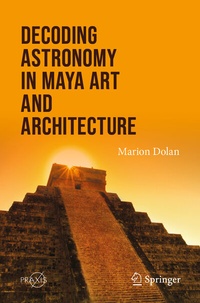
Decoding Astronomy in Maya Art and Architecture
Description

The exciting discoveries and newest revelations in the field of archeoastronomy present fascinating examples of the importance of astronomy to the ancient Maya Civilization. Through technological advancements made in the archeoastronomy community, this book will allow you to uncover a time capsule from an ancient past. In a clear and comprehensible manner you will read about art and architecture from various important Maya cities, drawn from diverse time periods and from different geographical areas of Mesoamerica. The topics covered include new findings in wide variety of fields; including the history's of astronomy, science, art, architecture, literature and religion.
You will explore in this book how the motions of the heavens were closely watched and notated by Maya astronomers and how those celestial objects determined the patterns of everyday life, religious rites, community festivals, agriculture, even birth and death!
This book will open your mind to a deeper awareness and an even greater admiration for the Maya ingenuity in preserving their astronomical knowledge and passing it on to assist future generations. These latest findings will broaden our perception of the Maya cultures of the Pre-classic and their development through the Classic period and the remarkable changes that occurred throughout their 3000 years of history.
More details
Other editions
Additional editions
Person
Marion Dolan is an adjunct professor at Florida Atlantic University; she received a BS in History and Philosophy of Science, a MA and PhD in the History of Art and Architecture at the University of Pittsburgh majoring in medieval scientific manuscripts. Her lifelong study of history of art, of astronomy and of archaeology assure a commitment to scientific accuracy in her writing. Her book, Astronomical Knowledge Transmission through Illustrated Aratea Manuscripts, was adapted from her doctoral dissertation. Her second book, Decoding Astronomy in Art and Architecture, focuses on archaeoastronomy and explains the important astronomical information hidden within ancient temples, sacred monuments and artworks around the world, such as Avebury, Borobudur and Angkor Wat. She has also written a novel on the fascinating life of Holy Roman Emperor Frederick II on Kindle and writes review for online astronomical journals. Professor Dolan has traveled extensively and visited many of the intriguing ruins that she writes about.
Content
Part I Introduction to the Maya Civilization.- Chapter 1 Uncovering a Lost Civilization.- Chapter 2 Introduction to the Ancient Maya.- Chapter 3 Maya Society.- Part II Astronomy and Architecture of the Ancient Maya.- Chapter 4 Maya Architecture and Astronomy.- Chapter 5 Astronomy of the Maya.- Part III Maya Gods and Mythology.- Chapter 6 Deities of the Maya.- Chapter 7 Maya Mythology, Cosmology and Art.- Part IV Maya Preclassic and Classic Cities.- Chapter 8 Early Cities in Mesoamerica.- Chapter 9 Early Classic Cities of the Maya.- Chapter 10 Maya City of Palenque.- Chapter 11 Maya City of Copan.- Chapter 12 Late Classic Cities of the Maya.- Part V Maya Postclassic Cities.- Chapter 13 Postclassic Cities of the Yucatan Peninsula.- Chapter 14 Maya City of Chichen Itza.- Chapter 15 Postclassic Cities of the Yucatan Peninsula.- Chapter 16 LiDAR Technology.
