

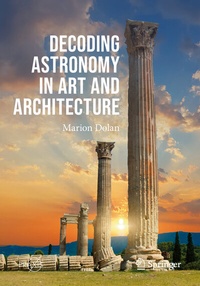
Decoding Astronomy in Art and Architecture
Description

For centuries, our ancestors carefully observed the movements of the heavens and wove that astronomical knowledge into their city planning, architecture, mythology, paintings, sculpture, and poetry. This book uncovers the hidden messages and advanced science encoded within these sacred spaces, showing how the rhythmic motions of the night sky played a central role across many different cultures.
Our astronomical tour transports readers through time and space, from prehistoric megaliths to Renaissance paintings, Greco-Roman temples to Inca architecture. Along the way, you will investigate unexpected findings at Lascaux, Delphi, Petra, Angkor Wat, Borobudur, and many more archaeological sites both famous and little known. Through these vivid examples, you will come to appreciate the masterful ways that astronomical knowledge was incorporated into each society's religion and mythology, then translated into their physical surroundings.
The latest archaeoastronomical studies and discoveries are recounted through a poetic and nontechnical narrative, revealing how many longstanding beliefs about our ancestors are being overturned. Through this celestial journey, readers of all backgrounds will learn the basics about this exciting field and share in the wonders of cultural astronomy.
Reviews / Votes
"I enjoyed reading this book. I revelled in the ancient art, I was amazed by many of the old buildings, I was pleased to see the extensive lists of references to the hard work of archaeologists and archaeoastronomers. But I was left wondering whether the town planners, the artists, or the architects . knew much about astronomy. . The reader needs convincing before trying to decode something that might not even be present." (David W. Hughes, The Observatory,June, 2022)"This book is certainly the most accessible survey of worldwide archaeo-astronomy that has been published of late. It is enhanced by scores of photographs, all in colour . . Dolan has done a tremendous service to the oft-maligned and misunderstood study of archaeoastronomy. And with its broad remit in both time and space, this will remain for many years a valuable planet-wide survey of sites from the prehistoric to the Renaissance." (Clifford Cunningham, Journal of Astronomical History and Heritage, VOl. 24 (4), 2021)
More details
Other editions
Additional editions
Person
Dr. Dolan has studied astronomical manuscripts in the libraries of Europe, specializing in the surviving Aratea manuscripts. Her research was published in the book Astronomical Knowledge Transmission Through Illustrated Aratea Manuscripts (Springer, 2017).
Content
Part I: History of Cosmic Symbolism in Art and Architecture.- Chapter 1: Introduction to the Book Topics.- Chapter 2: Basics of Astronomy and Archaeoastronomy.- Chapter 3: World's Earliest Art and Astronomy.- Chapter 4: Neolithic Art, Architecture and Astronomy.- Chapter 5: Art, Architecture and Astronomy in Ireland.- Chapter 6: Art, Architecture and Astronomy in England.- Part II: Astronomical Art and Architecture of Southeast Asia.- Chapter 7: Hinduism and Cosmology in India.- Chapter 8: Art, Architecture and Astronomy at Angkor Wat Temple.- Chapter 9: Art, Architecture and Astronomy of Buddhism.- Part III: Astronomical Art and Architecture of China.- Chapter 10 Art, Architecture and Astronomy in China.- Part IV: Astronomical Art and Architecture of the Classical World.- Chapter 11: Art, Architecture and Astronomy in Classical Greece.- Chapter 12: Art, Architecture and Astronomy of Petra.- Chapter 13: Art, Architecture and Astronomy in the Roman Empire.- Part V: Astronomical Art and Architecture of Early Europe.- Chapter 14: Art. Architecture and Astronomy during the Middle Ages.- Chapter 15: Art, Architecture and Astronomy during the Renaissance.- Part VI: Astronomical Art and Architecture of the New World.- Chapter 16: Art, Architecture and Astronomy at Teotihuacan.- Chapter 17: Art, Architecture and Astronomy in South America.- Index.
