

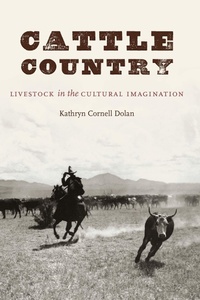
Cattle Country
Livestock in the Cultural Imagination
1st Edition
Published on 1. June 2021
342 pages
978-1-4962-2701-0 (ISBN)
Description

As beef and cattle production progressed in nineteenth-century America, the cow emerged as the nation's representative food animal and earned a culturally prominent role in the literature of the day. In Cattle Country Kathryn Cornell Dolan examines the role cattle played in narratives throughout the century to show how the struggles within U.S. food culture mapped onto society's broader struggles with colonization, environmentalism, U.S. identity, ethnicity, and industrialization.
Dolan examines diverse texts from Native American, African American, Mexican American, and white authors that showcase the zeitgeist of anxiety surrounding U.S. identity as cattle gradually became an industrialized food source, altering the country's culture while exacting a high cost to humans, animals, and the land. From Henry David Thoreau's descriptions of indigenous cuisines as a challenge to the rising monoculture, to Washington Irving's travel narratives that foreshadow cattle replacing American bison in the West, to MarIa Amparo Ruiz de Burton's use of cattle to connect race and imperialism in her work, authors' preoccupations with cattle underscored their concern for resource depletion, habitat destruction, and the wasteful overproduction of a single breed of livestock.
Cattle Country offers a window into the ways authors worked to negotiate the consequences of the development of this food culture and, by excavating the history of U.S. settler colonialism through the figure of cattle, sheds new ecocritical light on nineteenth-century literature.
Dolan examines diverse texts from Native American, African American, Mexican American, and white authors that showcase the zeitgeist of anxiety surrounding U.S. identity as cattle gradually became an industrialized food source, altering the country's culture while exacting a high cost to humans, animals, and the land. From Henry David Thoreau's descriptions of indigenous cuisines as a challenge to the rising monoculture, to Washington Irving's travel narratives that foreshadow cattle replacing American bison in the West, to MarIa Amparo Ruiz de Burton's use of cattle to connect race and imperialism in her work, authors' preoccupations with cattle underscored their concern for resource depletion, habitat destruction, and the wasteful overproduction of a single breed of livestock.
Cattle Country offers a window into the ways authors worked to negotiate the consequences of the development of this food culture and, by excavating the history of U.S. settler colonialism through the figure of cattle, sheds new ecocritical light on nineteenth-century literature.
Reviews / Votes
"Dolan's book . . . should become a foundational resource for future scholarship on the subject as it shines a light on the too-hungry forces of such an industry by the people who witnessed it and wrote back in complicated celebration and protest."-Tom Hertweck, Western American Literature "If you are interested . . . in seeing how livestock (particularly, cattle) have played into the larger narrative of Manifest Destiny and the homogenization of American cuisine-and, ultimately, American culture-then this book has many useful insights."-Dan Holtz, Nebraska History "A well-researched book."-Randi Samuelson-Brown, Denver Westerners RoundUp "A refreshing and unique take on not only what cattle meant to settlers but also how cattle were used as instruments for developing notions of race and American identity. In an Anthony Bourdain-like journey across the country, this book gives you a sense of regional food history in America. You can really taste the food by the end. It is important for scholarship and historical understanding of the United States."-Karen Piper, author of The Price of Thirst: Global Water Inequality and the Coming Chaos "A critical contribution to its field, both in its individual arguments about literature and food and also in its modeling of a comparative methodology attuned to region, indigeneity, and global migration."-Catherine Keyser, author of Artificial Color: Modern Food and Racial FictionsMore details
Series
Language
English
Place of publication
Lincoln
United States
Target group
Professional and scholarly
Illustrations
8 photographs, 12 illustrations, index
File size
14,07 MB
ISBN-13
978-1-4962-2701-0 (9781496227010)
Copyright in bibliographic data and cover images is held by Nielsen Book Services Limited or by the publishers or by their respective licensors: all rights reserved.
Schweitzer Classification
Other editions
Additional editions
Book
06/2021
University of Nebraska Press
€58.00
Shipment within 15-20 days
Person
Kathryn Cornell Dolan is an associate professor of English and technical communication at Missouri University of Science and Technology. She is the author of Beyond the Fruited Plain: Food and Agriculture in U.S. Literature, 1850-1905 (Nebraska, 2014).
Content
- Cover
- Title Page
- Copyright Page
- Contents
- List of Illustrations
- Acknowledgments
- Introduction
- 1. Washington Irving, Cattle, and Indian Territory
- 2. Civilizing Cattle in the Writings of James and Susan Fenimore Cooper
- 3. Henry David Thoreau, Regional Cuisine, and Cattle
- 4. Cattle and Sovereignty in the Work of Sarah Winnemucca Hopkins
- 5. The Cowboys Are Indians in The Squatter and the Don
- 6. Southern Cuisine without Cattle in Charles Chesnutt's Conjure Stories
- 7. Industrial-Global Cattle in Upton Sinclair and Winnifred Eaton
- Conclusion
- Notes
- Bibliography
- Index
