

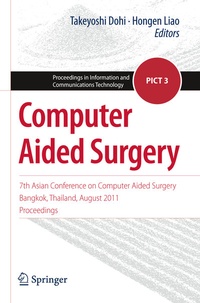
Computer Aided Surgery
7th Asian Conference on Computer Aided Surgery, Bangkok, Thailand, August 2011, Proceedings
1st Edition
Published on 9. April 2012
XII, 155 pages
978-4-431-54094-6 (ISBN)
Description

The aim of computer-aided surgery (CAS) is to advance the utilization of computers in the development of new technologies for medical services. The Asian Conference on Computer Aided Surgery (ACCAS) series provides a forum for academic researchers, clinical scientists, surgeons, and industrial partners to exchange new ideas, techniques, and the latest developments in the field. The ACCAS brings together researchers from all fields related to medical activity visualization, simulation and modeling, virtual reality for CAS, image-guided diagnosis and therapies, CAS for minimally invasive intervention, medical robotics and instrumentation, surgical navigation, clinical application of CAS, telemedicine and telesurgery, and CAS education. The ACCAS is also interested in promoting collaboration among people from different disciplines and different countries in Asia and the world. This volume helps to achieve that goal and is a valuable resource for researchers and clinicians in the field.
More details
Other editions
Additional editions
Takeyoshi Dohi | Hongen Liao
Computer Aided Surgery
7th Asian Conference on Computer Aided Surgery, Bangkok, Thailand, August 2011, Proceedings
Book
04/2012
1st Edition
Springer
€53.49
Shipment within 10-15 days
Content
- Title Page
- Preface
- Organization
- Table of Contents
- Medical Robotics and Instruments
- Nonmetallic Guide Sheath with Negative Pressure Shapelocking Mechanism for Minimally Invasive Image-Guided Surgery
- Introduction
- Outer Sheath Prototype
- Results
- Evaluation of Mechanical Performance
- Evaluation of MR Compatible
- Discussion
- Conclusion
- References
- Study of Design Method for Surgical Robot Using Surgeon's Operation Manner
- Introduction
- Background
- Problems
- Objectives
- System
- Master Manipulator
- Slave Simulator
- Experiments
- Method
- Results
- Discussion
- Conclusion
- References
- Prototype Design of Robotic Surgical Instrument for Minimally Invasive Robot Surgery
- Introduction
- Description of Mechanism
- PrototypeDesign
- Discussion
- References
- Polarizing Beam Splitter Endoscope for Simultaneously Observing Front and Lateral View
- Introduction
- Methods
- Mechanism
- Optical Improvement of Polarization Degree
- Light Source Control
- Image Processing to Remove Overlap Effect
- Experiment
- Evaluation of Viewing Angles and Image Quality
- Optical Improvement of Polarization Degree
- Light Source Control
- Image Processing to Remove Overlap Effect
- Discussions and Conclusions
- References
- CAS for Minimally Invasive Intervention
- Clipping Device with a Clear Liquid-Flushing Endoscope Equipping Wide View Coaxial Nozzle for Edge-to-Edge Repair Surgery without Heart-Lung Machine
- Introduction
- Method
- System Configuration of Clear Liquid-Flushing Endoscope
- Wide View Coaxial Nozzle
- Fluid Analysis
- Experiment and Results
- In Vitro Experiment
- Clipping Device with Clear Liquid-Flushing Endoscope
- Operational Procedure
- In Vivo Experiment
- Discussions and Conclusion
- References
- Cooling Effect of the Ligamentum Flavum for Preventing Dural Puncture during the Epidural Anesthesia
- Introduction
- Methods
- Results
- Discussion
- Conclusion
- References
- An Algorithm for Control of Flexing Instruments for Single-Incision Laparoscopic Surgery
- Introduction
- Methods
- Master-Slave Robot System for SILS
- Flexing Machinery
- Calculation Algorithm
- Evaluation Experiment
- Simulation Experiments
- Physical Experiments
- Results
- Discussion
- Conclusions
- References
- A Laser Steering Endoscope with High Laser Transmission Efficiency
- Introduction
- Laser Endoscope System
- Miniaturization of Laser Endoscope
- Improvement in Size and Transmission Efficiency
- Laser Source for Thin Endoscope
- Prototype of Thin Endoscope
- Prototype of Laser Endoscope Unit
- Experiment
- Laser Transmission Efficiency of Endoscope
- Laser Steering Range
- Maximum Laser Power
- Laser Beam Shape
- Discussion
- Laser Transmission Efficiency
- Thermal Change during Laser Irradiation
- Laser Steering Range
- Maximum Laser Power
- Laser Beam Shape
- Conclusion
- References
- Image Guided Diagnosis and Therapies
- Video Information Management System for Information Guided Neurosurgery
- Introduction
- Method
- Remote Information Control Center
- On-Site Information Control Center
- Results
- Discussion
- Conclusion
- References
- Development of a Laparoscopic Surgical Training System with Simulation Open Framework Architecture (SOFA)
- Introduction
- Methods
- Simulation Software Development Using SOFA
- Development of a Haptic Device for Laparoscopic Surgical Training
- Results and Discussion
- Conclusion
- References
- Intuitive Touch Panel Navigation System through Kyoto Digital Sosui Network
- Introduction
- Methods
- Touch Panel Navigation System
- Touch Panel Navigation System for Stanching in Animal Model
- Remote Control of the Robot
- Kyoto Digital Sosui Network
- Through Kyoto Digital Sosui Network between two hospitals
- Results
- Discussion
- Conclusion
- References
- EEG-Based Acute Pain Control System
- Introduction
- Experimental Designs
- Data Acquisition
- Experimental Procedure
- Experimental Results
- Conclusions
- References
- Medical Image Computing
- High-Quality Intra-operative Ultrasound Reconstruction Based on Catheter Path
- Introduction
- Methods
- Catheter Navigation System
- Preliminary Reconstruction
- Center Line Extraction
- Registration from Center Line to Path
- Segmentation of Vessel Cross Section
- High-Quality Reconstruction
- Experiments and Results
- Discussion
- Conclusion
- References
- Nonlinear Reaction Force Analysis for Characterization of Breast Tissues
- Introduction
- Method
- In Vivo Experiment
- Simulation
- Result
- Discussion
- Feasibility of Our Concept
- Two Dimensional Analysis and Model Shape
- Tissue Limitation
- Summary and Future Work
- References
- MRI Based Sulcal Pattern Analysis for Diagnosis and Clinical Application in Neurosurgery
- Introduction
- Materials and Methods
- Healthy Subjects
- Patients with Focal Cortical Dysplasia and Glioma
- MRI Data Analysis Procedure
- Results
- Healthy Subjects
- Sulci Analysis of FCD
- Sulci Analysis of Glioma
- Comparison of Relations: Between Normal and Abnormal Brains
- Discussion
- Morphometric Characteristics of PoC
- Sulci Analysis in Brain Structure
- Conclusion
- References
- Adaptive Rendering Method for Low Resolution Auto-stereoscopic 3-D Medical Images
- Introduction
- Method
- Technical Illustration Method
- Feature Line Definition
- Construct IV Images
- Results
- Discussions
- Conclusions
- References
- Author Index
