

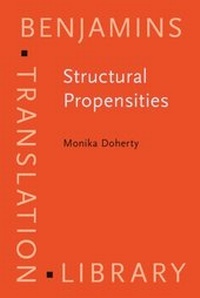
Structural Propensities
Translating nominal word groups from English into German
1st Edition
Published on 27. April 2006
XXII, 196 pages
978-90-272-9384-8 (ISBN)
Description

This book focuses on the translation of English academic texts into German, closely analysing the structural and discourse properties of original sentences and their possible translations. It consists of six chapters, with more than a hundred carefully discussed examples, and presents the author's results of a series of research projects which have successively dealt with the typologically determined conditions for discourse-appropriate uses of word order, case, voice (perspective) and structural explicitness in simple and complex sentences or sequences of sentences. The theoretical and methodological assumptions of the book follow a basically generative approach in studying the interaction between semantic-pragmatic and phonological-syntactic properties of the linguistic forms as they are involved in the perception of written language. The linguistic and psycholinguistic models accessed are also introduced in detail to promote comprehension for the interested reader with an alternative theoretical background, whether scholar, student or translator.
More details
Other editions
Additional editions
Book
04/2006
John Benjamins Publishing Co
€103.88
Shipment within 10-15 days
Person
Content
- Structural Propensities
- Editorial page
- Title page
- LCC data
- Table of contents
- Preface
- Introduction
- Idolatry
- Theoretical and methodological aspects of basic concepts
- 1.1. The subjectivity problem
- 1.2. Language processing
- 1.3. Basic linguistic assumptions
- 1.4. Information structures
- 1.5. Language-specific aspects of balanced information distribution
- Discourse-appropriate distribution of information in different classes of English and German sentences
- 2.1. Discourse-appropriate word order in German and English
- 2.2. Reframing
- 2.3. Structural explicitness
- 2.4. Redundancy and dummy phrases
- 2.5. Incremental parsimony: Linking sentences
- 2.6. Separation of clauses into independent sentences
- The translation of nominal word groups
- 3.1. The internal structure of NPs
- 3.2. `Weak' verbs
- 3.3. CP or VP attributes in English
- 3.4. VP or CP attributes in the German translation
- 3.5. Prenominal and postnominal verbless attributes
- Reorganizing dependencies
- 4.1. Extraction from clause-final NPs
- 4.2. Extraction from initial noun phrases
- 4.3. NP-external restructuring of sentences with `there'
- 4.4. Clefts and pseudo-clefts
- 4.5. Cleft-like sentences
- Cross-sentential restructuring of NPs and prospective relevance
- 5.1. Separation of clauses into independent sentences
- 5.2. Sentence linking using attachment to an NP-internal position
- 5.3. Backward or forward shifting of sentence borders
- 5.4. Appositions and the strategy of prospective appropriateness
- 5.5. Cross-sentential restructuring involving appositions
- Retrospective and prospective aspects of structural propensities
- 6.1. The subjectivity problem revisited
- 6.2. Idols of the academic theatre
- 6.3. Information structure and rhetorical figures
- 6.4. Typological peculiarities
- 6.5. Summary and outlook
- References
- Sources
- Articles from New Scientist (Berlin corpus of translation)
- Author index
- Subject index
- The series Benjamins Translation Library
