

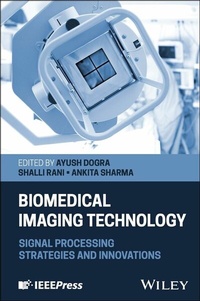
Biomedical Imaging Technology
Description

Explore emerging applications for AI, machine learning, and deep learning in biomedical imaging technologies
In Biomedical Imaging Technology, a team of distinguished researchers deliver an expert discussion on the application of imaging and signal processing techniques to healthcare technologies like X-ray, MRI, CT, ultrasound, and others. Beginning with an introduction to biomedical imaging, the book goes on to explain more advanced imaging technologies, such as molecular and optical imaging.
This book provides a blend of theory and practical applications, exploring the role of AI and AI algorithms in enhancing diagnostic accuracy. It discusses machine and deep learning approaches for improving computer-aided diagnosis systems and the integration of signal processing within various imaging modalities.
Readers will also find:
- A thorough introduction to contemporary approaches to optical imaging, including fluorescence imaging, photoacoustic imaging, and Optical Coherence Tomography (OCT)
- Comprehensive explorations of image-guided interventions, theranostics in cancer treatment, and advancements in surgical navigation
- Practical discussions of emerging trends in the field and up-and-coming innovations
- Case studies and practical examples from real-world locations
Perfect for researchers in biomedical engineering, imaging, and signal processing, Biomedical Imaging Technology will also benefit undergraduate and graduate students studying electrical engineering subjects, such as biomedical imaging and signal processing.
More details
Other editions
Additional editions
Persons
Ayush Dogra, PhD, is an Assistant Director at Chitkara University, Punjab, India. His research areas include image fusion, image enhancement, image registration, and image denoising.
Shalli Rani, PhD, is a Professor and Director at Chitkara University, Punjab, India. She is a Senior Member of the IEEE and her research interests include Internet of Things, WSN, cloud computing, network security, and machine learning.
Ankita Sharma, PhD, is an Assistant Professor at Chitkara University, Punjab, India. She has authored numerous national and international publications in peer-reviewed journals.
Content
List of Contributors xix
About the Editors xxii
Preface xxv
Acknowledgments xxvi
1 Historical Evolution and Technological Advancements in Biomedical Imaging 1
Shubham Gupta and Suhaib Ahmed
1.1 Introduction 1
1.2 Early Milestones in Biomedical Imaging 5
1.2.1 Pre-Imaging Era: Anatomy and Physical Diagnosis 5
1.2.2 Discovery of X-Rays and Birth of Radiography 7
1.2.3 Development of Radioisotope Imaging (Nuclear Medicine) 7
1.3 Signal Processing Strategies in Biomedical Imaging 8
1.3.1 Data Acquisition and Preprocessing 8
1.3.2 Image Reconstruction Algorithms 9
1.3.3 Feature Extraction and Enhancement 10
1.3.4 Real-Time Processing Strategies 11
1.4 Innovations in Signal Processing for Biomedical Imaging 11
1.4.1 Machine Learning and AI-Driven Techniques 12
1.4.2 Quantum Signal Processing in Imaging 12
1.4.3 Multimodal Imaging and Data Fusion 13
1.4.4 Emerging Trends in Signal Processing Hardware 13
1.5 Case Studies 14
1.5.1 Innovations in Signal Processing for MRI 14
1.5.2 Deep Learning in Ultrasound Imaging 15
1.5.3 Hybrid Imaging Modalities 16
1.6 Challenges and Future Directions 17
1.6.1 Ethical and Regulatory Concerns 17
1.6.2 Scalability and Cost Effectiveness of Signal Processing Techniques 18
1.6.3 Future Trends in Biomedical Signal Processing 18
1.6.3.1 Image Systems at the Crossroads of Edge AI and IoT 18
1.6.3.2 Signal Processing for Personalized Imaging 19
1.7 Advancements in Signal Processing Techniques and Innovations 19
1.7.1 Future Perspectives on Biomedical Imaging 20
1.8 Conclusion 21
References 22
2 Deep Learning Techniques for Biomedical Imaging 25
Vandana and Chetna Sharma
2.1 Introduction 25
2.2 Overview of DL Architecture in Biomedical Imaging 26
2.3 CNN Architecture 28
2.4 Basic Concepts in Biomedical Imaging 29
2.4.1 Data Representation in Imaging 29
2.4.2 Image Reconstruction with dl 29
2.4.2.1 Concept of Image Reconstruction 30
2.4.3 Image Segmentation 31
2.4.3.1 Traditional Image Segmentation Techniques 31
2.4.3.2 dl Image Segmentation Models 32
2.4.4 Image Registration 32
2.4.5 Diagnosis and Classification 33
2.4.5.1 Types of Image Classification 33
2.4.5.2 Working of Image Classification 34
2.4.6 Functional and Molecular Imaging 36
2.4.7 Explainability and Interpretability 37
2.4.7.1 Significance of Interpretability and Explainability 37
2.5 Future Study and Application of Image Processing in Biomedical 38
2.6 Conclusion 39
References 39
3 Advanced Methods and Approaches in Image Reconstruction 45
Navneet Kaur and Gurbinder Singh Brar
3.1 Introduction 45
3.1.1 Fundamental Principles of Image Reconstruction 47
3.1.2 Forward and Inverse Problems in Image Reconstruction 47
3.1.2.1 Forward Problems 47
3.1.2.2 Inverse Problems 48
3.2 Classical Analytical Methods 49
3.2.1 Filtered Back Projection (FBP) 49
3.2.2 Fourier-Based Methods 50
3.2.3 Algebraic and Iterative Techniques 51
3.2.3.1 Algebraic Reconstruction Techniques (ARTs) 51
3.2.3.2 Simultaneous Algebraic Reconstruction Technique (SART) 51
3.3 Convergence and Computational Challenges 52
3.4 Signal Processing for Noise and Artifact Management 52
3.4.1 Sources of Noise and Artifacts 54
3.4.2 Sources of Noise 55
3.4.3 Sources of Artifacts 57
3.5 Denoising Techniques 59
3.5.1 Spatial Domain Filtering 59
3.5.2 Transform Domain Approaches 59
3.6 Artifact Correction Methods 60
3.6.1 Model-Based Correction Techniques 60
3.6.2 Deep Learning Approaches for Artifact Reduction 61
3.6.3 Advanced Signal Processing Strategies 61
3.7 Compressed Sensing in Imaging 62
3.7.1 Sparse Representation and Sampling 62
3.7.2 Applications in MRI and CT 62
3.7.3 Model-Based Reconstruction Techniques 63
3.7.4 Bayesian Inference Models 63
3.8 Statistical Methods for Noise Modeling 64
3.8.1 Machine Learning and Neural Networks 64
3.8.2 Supervised vs Unsupervised Approaches 64
3.8.3 Deep Learning for Artifact Removal and Reconstruction 64
3.8.4 Emerging Innovations in Image Reconstruction 65
3.9 Hybrid Computational Methods 65
3.9.1 Optimization-Based Deep Networks 66
3.9.2 Multimodal and Multiresolution Techniques 66
3.9.3 Super-Resolution Approaches for Enhanced Detail 67
3.10 Quantum Signal Processing 68
3.10.1 Quantum Imaging and Sensing 68
3.11 AI-Assisted Real-Time Reconstruction 69
3.12 Conclusion 70
References 71
4 Integrative Approaches in Image Analysis and Signal Interpretation 75
Tanishq Soni, Deepali Gupta, and Mudita Uppal
4.1 Introduction 75
4.2 Related Work 78
4.3 Materials and Methodology 81
4.3.1 Description of Dataset 81
4.3.2 Proposed Methodology 82
4.3.2.1 Input Dataset and Pre-Processing 82
4.3.2.2 Designing of Deep Learning Models 84
4.4 Results and Discussion 88
4.4.1 Analysis Based on Confusion Matrix 88
4.4.2 Analysis Based on Accuracy 88
4.4.3 Analysis Based on Loss 88
4.5 Conclusion and Future Scope 93
References 93
5 Multimodal Imaging: Combining Molecular and Optical Approaches 97
Haewon Byeon, Azzah AlGhamdi, Ismail Keshta, Mukesh Soni, Mohammad Shabaz, and Mohammed Wasim Bhatt
5.1 Introduction 97
5.2 Network Model 100
5.2.1 Dataset Selection 103
5.2.2 Image Patches for Classification and Regression Localization 104
5.2.3 Candidate Block Screening Network 106
5.2.4 Verification Module-Task-Guided Radial Basis Network 107
5.2.5 Loss Function 110
5.3 Evaluation and Results from Experiments 111
5.3.1 Experimental Setting 111
5.3.2 Performance Evaluation Metrics 112
5.3.3 The Impact of Picture Block Size on the Efficiency of the Model 112
5.3.4 The Impact of Deep Supervision and Attention Mechanism on Model Performance 113
5.3.5 The Impact of the Number of Cluster Centers on Model Performance 114
5.3.6 Experiments on ICPR 2014 Dataset 114
5.3.7 Experiments on the AMIDA 2013 Dataset 116
5.4 Conclusion 118
References 118
6 Advancements in Biomedical Imaging Using Fluorescence and Bioluminescence 123
Ashish Kashyap, Manju Jakhar, Nidhi Rani, and Thakur Gurjeet Singh
6.1 Introduction 123
6.2 Advancements in Imaging Bioluminescence 124
6.2.1 Advances in Bioluminescence Imaging 124
6.2.2 Fluorescence Imaging Challenges 124
6.2.3 Recent Innovations in Imaging Technologies 124
6.3 Key Innovations in Bioluminescence Imaging (BLI) 125
6.3.1 Recent Advances 125
6.3.1.1 Luciferase-Loaded Nanoparticles 125
6.3.1.2 Synthetic Bioluminescent Reactions 125
6.3.1.3 Bioluminescent Reporters 125
6.3.1.4 Bacterial Bioluminescence 125
6.3.1.5 Applications and Future Directions 126
6.4 Limitations of Bioluminescence Imaging (BLI) 126
6.4.1 Depth Limitations 126
6.4.2 Variation in Outputs 126
6.4.3 Limitations to Quantitative Precision 127
6.4.4 Other Major Limitations 127
6.5 Evolution of BLI Technology 127
6.5.1 Enhanced Luminescent Units 128
6.5.2 Advanced Imaging Methods 128
6.5.3 Improvements in Photon Detection 129
6.5.3.1 High-Sensitivity Photon Detectors 129
6.6 Applications of Bioluminescence Imaging 129
6.6.1 Gene Expressions and Protein Localizations 129
6.6.1.1 Multicolor Auto-Bioluminescence Systems 129
6.6.2 Tumor Imaging 130
6.6.2.1 Long-Term Imaging with Nanoparticles 130
6.6.3 Optogenetic Biosensing 130
6.6.3.1 Bioluminescence-Induced Optogenetic Biosensors 130
6.6.4 Biomedical Research and Diagnostics 131
6.6.4.1 Studies of Infectious Disease and Compounds for Treatment 131
6.6.4.2 Challenges and Direction for the Future 131
6.7 Innovations in Fluorescence Imaging 131
6.7.1 Miniaturized Fluorescent Probes 131
6.7.2 Computational Photography in Surgery 132
6.7.3 Advanced Imaging Methods 132
6.7.3.1 Challenges and Future Directions 132
6.7.3.2 Fluorescence Imaging: Limitations 133
6.8 Advances in Fluorescence Imaging Technology 133
6.8.1 From Computational Photography to Fluorescence Imaging 133
6.8.2 Near-Infrared Fluorescence Imaging in Cancer Diagnosis 134
6.8.3 Advances in Fluorescence Molecular Tomography (FMT) 134
6.8.4 Small-Molecule Probes in Bioimaging 134
6.8.5 Light Sheet Fluorescence Microscopy (LSFM) 134
6.9 Comparative Analysis of Bioluminescence and Fluorescence Imaging 135
6.9.1 Sensitivity and the Strength of the Signal 135
6.9.2 Application and Versatility 135
6.9.3 Hybrid Methods 135
6.10 Emerging Trends in Imaging Technological Development 136
6.10.1 Challenges and Suggestions 136
6.11 Conclusion 137
References 137
7 Innovative Diagnostic Imaging Techniques and Protocols 147
Kamini Lamba, Shalli Rani, Ayush Dogra, and Ankita Sharma
7.1 Introduction 147
7.1.1 Evolution of Multi-Modal and Hybrid Imaging 147
7.1.2 AI-Driven Image Analysis and Explainability in Medical Imaging 148
7.1.3 Advancement in Molecular and Functional Imaging 148
7.1.4 Radiomics and Predictive Analytics in Imaging 149
7.1.5 Standardized Imaging Protocols and Future Trends 149
7.2 Diagnosing Imaging Methods 149
7.2.1 Conventional Diagnostic Imaging Techniques 150
7.2.1.1 X-Ray Radiography and Its Limitations 150
7.2.1.2 Pneumoencephalography (PEG): A Historical Perspective and Its Limitations 150
7.2.1.3 Cerebral Angiography: Detecting Tumor-Related Vascular Abnormalities 150
7.2.2 Advanced Imaging Modalities in Brain Tumor Detection 151
7.2.2.1 Computed Tomography (CT) and Its Advancements 151
7.2.2.2 Magnetic Resonance Imaging (MRI) and Functional Variants 151
7.2.2.3 Positron Emission Tomography (PET) and Hybrid Imaging 151
7.3 Comparison of Innovative Diagnostic Imaging Techniques and Protocols 152
7.4 Challenges in Innovative Diagnostic Imaging 153
7.4.1 Data Heterogeneity and Standardization Issues 153
7.4.2 High Computational and Infrastructural Cost 153
7.4.3 Lack of Explainability and Trust in Artificial-Intelligence Models 156
7.4.4 Privacy and Ethical Concerns in Medical Data Sharing 157
7.4.5 Clinical Validation and Regulatory Challenges 157
7.4.6 Dataset Imbalance and Limited Availability of Rare Tumor Cases 157
7.4.7 Ethical Biases and Fairness in AI Models 158
7.4.8 Real-Time Processing and Latency Issues 158
7.4.9 Vulnerability to Adversarial Attacks in Medical AI 158
7.5 Future Directions in Innovative Diagnostic Imaging for Brain Tumor Detection 158
7.5.1 Explainable AI (XAI) in Imaging 159
7.5.2 Multimodal Imaging and Data Fusion 159
7.5.3 Low-Cost and Portable Imaging Solutions 160
7.5.4 AI and Quantum Computing in Medical Imaging 160
7.5.5 Non-Invasive Tumor Monitoring and Early Detection 160
7.6 Conclusion 160
References 161
8 Applications and Clinical Impacts of Biomedical Imaging 165
Divya Gupta, Jaspreet Kaur, and Sheenam Middha
8.1 Introduction 165
8.2 Essential Techniques in Biomedical Imaging 166
8.2.1 Computed Tomography (CT) 166
8.2.2 Ultrasound Imaging 168
8.2.3 Magnetic Resonance Imaging (MRI) 168
8.2.4 Positron Emission Tomography (PET) 169
8.3 Applications of Biomedical Imaging 169
8.3.1 Diagnostic Imaging 170
8.3.1.1 Detection of Disease 170
8.3.1.2 Radiology and Pathology 171
8.3.2 Treatment Planning 171
8.3.2.1 Surgical Planning 171
8.3.2.2 Radiation Therapy 172
8.3.3 Monitoring and Evaluation 172
8.3.3.1 Disease Monitoring 172
8.3.3.2 Chronic Disease Management 172
8.4 Clinical Impacts of Biomedical Imaging 173
8.4.1 Early Diagnosis 173
8.4.2 Improved Treatment Planning 174
8.4.3 Monitoring and Assessment 175
8.4.4 Minimizing Invasive Procedures 175
8.4.5 Accelerating Research and Innovation 176
8.4.6 Cost Efficiency 176
8.5 Case Studies 177
8.5.1 Advanced PET/CT Imaging for Tracking Cancer Metastases 177
8.5.2 High-Resolution MRI for the Prompt Identification of Alzheimer's Disease 178
8.5.3 Breast Shape Analysis 179
8.6 Conclusion 180
References 180
9 Emerging Technologies and Innovations in Medical Imaging 183
Puneet Bawa and Manisha Rajput
9.1 Introduction 183
9.1.1 Background 184
9.1.2 Contribution 186
9.1.3 Organization 186
9.2 Methodology 187
9.3 Analysis 188
9.3.1 Research Dynamics 188
9.3.1.1 Publication Trends 188
9.3.1.2 Publication Types 189
9.3.1.3 Country Impact Analysis 190
9.3.2 Key Contributors 190
9.3.2.1 Most Cited Papers 191
9.3.2.2 Author Impact Analysis 191
9.3.2.3 Journal Impact Analysis 192
9.3.2.4 Institutional Impact Analysis 193
9.3.3 Research Focus and Emerging Topics 194
9.3.3.1 Keyword Co-occurrence Analysis 194
9.3.3.2 Hot Topics and Emerging Trends 195
9.3.4 Collaboration Patterns 197
9.3.4.1 Author Collaboration Network Analysis 197
9.3.4.2 Regional Collaboration Network Analysis 198
9.4 Discussions and Limitations 199
9.5 Conclusion 200
References 200
10 Therapeutic Interventions Guided by Advanced Imaging Modalities 205
Manisha Pathania and Chander Partap Singh
10.1 Introduction 205
10.1.1 The Role of AR in Medical Training and Imaging-Guided Therapeutic Interventions 206
10.1.2 Educational Theories Underpinning AR Use 206
10.1.3 Evidence of AR's Impact on Learning Outcomes 207
10.1.4 Evidence of AR's Impact on Learning Outcomes 207
10.1.5 Future Perspectives 208
10.2 Background and Significance 208
10.2.1 The Current Landscape of Medical Education 208
10.2.2 Augmented Reality as a Solution 209
10.2.3 Historical Development of AR in Medical Training 209
10.2.4 Addressing the Gap Between Theory and Practice 209
10.2.5 Accessibility and Scalability 210
10.2.6 Enhancing Learner Engagement and Retention 210
10.2.7 Challenges in AR Adoption 210
10.3 Core Applications of AR in Medical Training 211
10.3.1 Anatomy Education 211
10.3.2 Surgical Training 211
10.3.3 Emergency Medicine and Trauma Training 212
10.3.4 Medical Imaging and Diagnostics 212
10.3.5 Procedural Simulations and Skill Training 213
10.3.6 Patient Communication and Empathy Training 213
10.3.7 Remote and Collaborative Learning 213
10.4 Bridging Theory and Practice 214
10.4.1 Challenges in Traditional Medical Education 214
10.4.2 AR as a Link Between Theory and Application 215
10.4.3 Enhancing Skill Acquisition and Retention 215
10.4.4 Bridging Cognitive and Procedural Learning 216
10.4.5 Collaboration and Remote Learning 216
10.4.6 Industry and Academic Partnerships 216
10.4.7 Future Directions 217
10.5 Challenges and Limitations 217
10.5.1 Technological Constraints 217
10.5.1.1 Hardware Limitations 217
10.5.1.2 Software Challenges 218
10.5.1.3 Latency and Real-Time Interactivity 218
10.5.2 Pedagogical and Integration Challenges 218
10.5.2.1 Lack of Faculty Training 218
10.5.2.2 Curriculum Design and Overcrowding 218
10.5.2.3 Learning Curve for Students 219
10.5.3 Financial and Accessibility Barriers 219
10.5.3.1 High Costs of Implementation 219
10.5.3.2 Maintenance and Updates 219
10.5.3.3 Disparities in Accessibility 219
10.5.4 Ethical and Regulatory Concerns 219
10.5.4.1 Data Privacy and Security 219
10.5.4.2 Simulation Limitations 219
10.5.4.3 Ethical Use of Patient Data 220
10.5.5 Standardization and Accreditation Issues 220
10.5.5.1 Lack of Standardized Guidelines 220
10.5.5.2 Efficacy Validation 220
10.5.6 Cultural and Psychological Barriers 220
10.5.6.1 Resistance to Change 220
10.5.6.2 Cognitive Overload 220
10.6 Future Directions 220
10.6.1 Industry and Academic Partnerships 221
10.6.1.1 Improved Hardware Design 221
10.6.1.2 AI-Integrated AR Platforms 221
10.6.1.3 Interoperability Standards 221
10.6.2 Personalized and Collaborative Learning 221
10.6.2.1 Customized Training Modules 221
10.6.2.2 Collaborative and Remote Learning 221
10.6.2.3 Integration with Telemedicine 222
10.6.3 Expanding Access and Equity 222
10.6.3.1 Affordable AR Solutions 222
10.6.3.2 Partnerships with NGOs and Governments 222
10.6.4 Regulatory and Ethical Frameworks 222
10.6.4.1 Establishing Robust Guidelines 222
10.6.4.2 Ethical AI Integration 222
10.6.5 Enhanced Simulation Capabilities 223
10.6.5.1 Multimodal Simulations 223
10.6.5.2 Advanced Scenario Modeling 223
10.6.6 Long-Term Impact Studies 223
10.6.6.1 Measuring Outcomes 223
10.6.6.2 Working with Educational Researchers 223
10.6.7 Vision for the Future 223
10.7 Conclusion 223
10.7.1 Long-Term Vision for Medical Training Using AR 224
10.7.2 Hardware and Software 224
10.7.3 Scalability and Accessibility 225
10.7.4 Very Thorough Research and Validation 225
10.7.5 Regulation and Ethical Frameworks 225
10.7.6 The Broader Implications of AR in Healthcare 225
References 226
11 Addressing Technical and Clinical Challenges in Next-Generation Imaging 231
Jaspreet Kaur, Divya Gupta, and Sheenam Middha
11.1 Introduction 231
11.2 Technical Innovations and Challenges 233
11.2.1 Technology Innovations 233
11.2.2 Challenges Associated with Technical Innovations 234
11.3 Clinical Implications and Hurdles 235
11.3.1 Clinical Hurdles 236
11.4 Regulatory and Policy Challenges 236
11.4.1 Data Privacy and Security Regulations 236
11.4.2 AI Algorithm Certification and Approval 237
11.4.3 Interoperability Standards 237
11.4.4 Equity and Accessibility 238
11.5 Emerging Trends and Solutions 239
11.6 Real-World Applications 240
11.7 Future Perspectives and Roadmap 241
11.8 Conclusion 243
References 243
Index 245
1
Historical Evolution and Technological Advancements in Biomedical Imaging
Shubham Gupta and Suhaib Ahmed
Center for Applied AI, Model Institute of Engineering and Technology, Jammu, India
1.1 Introduction
The realm of biomedical imaging is one of the keys to modern healthcare and its multidisciplinary approach, which has transformed diagnosis, treatment, and disease monitoring. Recent developments in signal processing have opened new ways of improving image quality, extracting valuable information, and performing real-time analysis [1]. These technologies are fusing innovative algorithms and machine learning (ML) to expand the horizons of accuracy and efficiency. The chapter discusses the most recent signal processing techniques that are fueling advances in the field of biomedical imaging, with emphasis on their innovative impact on clinical and research perspectives.
1.1.1 Role of Biomedical Imaging in Modern Medicine
Biomedical imaging is the foundation of contemporary medicine and is an essential approach for the diagnosis, treatment, monitoring, and management of different diseases. It is a major medical breakthrough that can help clinicians visualize internal structures non-invasively and enables accurate and rapid clinical decision making. Imaging modalities (i.e. X-ray, computed tomography (CT), magnetic resonance imaging (MRI), ultrasound (USG)) are ubiquitous and irreplaceable tools of clinical practice worldwide.
For instance, in oncology, MRI offers higher sensitivity for detecting soft-tissue contrast in brain tumors, while positron emission tomography (PET) imaging is preferred for detecting metabolic activity related to cancer spread. In cardiovascular imaging, echocardiography and cardiac MRI are often combined to assess both function and structure. The choice of modality impacts diagnosis and prognosis and is increasingly tailored using clinical decision support systems (CDSS) driven by imaging data (Table 1.1).
Table 1.1 Biomedical imaging in modern medicine.
Aspect Description Impact on modern medicine Early detection and diagnosis Advanced imaging modalities like MRI, CT, PET, and ultrasound are used to identify abnormalities Early and accurate detection of diseases, such as cancer, cardiovascular conditions, and neurological disorders, leads to improved prognosis and timely intervention Treatment planning Provides detailed anatomical and functional insights for planning surgeries or therapies Enables precise localization of tumors, identification of surgical pathways, and assessment of treatment targets, reducing risks and improving treatment outcomes Real-time monitoring Facilitates intraoperative imaging and real-time guidance during surgeries or minimally invasive procedures Enhances surgical precision and ensures effective execution of interventions, such as tumor resections or catheter placements Personalized medicine Integrates patient-specific data to customize imaging protocols and treatment plans Improves diagnostic accuracy and patient outcomes by tailoring imaging techniques and therapies to individual needs Disease progression Monitoring tracks changes in disease states using longitudinal imaging studies Enables clinicians to evaluate the effectiveness of treatments and adjust therapeutic strategies as neededBiomedical imaging serves other purposes beyond diagnostics. It plays a basic part in influencing therapeutic interventions, including picture-guided medical procedures and, for example, radiotherapy [2]. Interventional radiology uses imaging to apply treatments as carefully as possible to tumors or other targets to minimize damage to nearby tissue. In addition, imaging plays a critical role in assessing therapeutic efficacy, such as monitoring the reduction in tumor volume after chemotherapy or the status of wound healing.
It would provide new knowledge of biological kinetics at the molecular and cellular scales for medical research in biomedical imaging. in vivo techniques, including functional imaging (fMRI, PET), enable researchers to investigate dynamic brain activation, metabolic processes, and more general disease mechanisms. This has pioneered new territories in neuroscience, oncology, cardiology, and beyond. Furthermore, integrating imaging with artificial intelligence (AI) and ML has been essential in precision medicine, enabling the use of individualized treatment strategies based on a given patient's unique imaging findings.
1.1.2 Historical Context of Imaging Techniques
Over the last few centuries, biomedical imaging has evolved to what we see today, an intermediate between several critical discoveries and breakthroughs that have redefined our perspective of the human body. It all began with the discovery of X-rays by Wilhelm Roentgen back in 1895. With this breakthrough, doctors could view the human body for the first time and provide the basis of diagnostic radiology. X-ray imaging rapidly established itself as a staple of diagnosis, changing the diagnosis of all types of fractures, infections, pulmonary diseases, etc.
Several imaging modalities were invented during the mid-20th century. Accordingly, in the 1950s, USG imaging was developed as a safe tool to assess soft tissue and organ systems by taking inspiration from sonar imaging [3]. This was especially groundbreaking in the field of obstetrics, where fetal development can now be monitored safely. Concurrently, the origination of nuclear imaging techniques like single-photon emission computed tomography (SPECT) and PET made possible the visualization of physiologic processes and functional imaging to complement anatomical imaging.
Another advancement came with CT, invented in the 1970s by Godfrey Hounsfield and Allan Cormack as shown in Figure 1.1. CT, on the other hand, combined X-ray exposure (CT stands for computed tomography) with advanced computer algorithms to generate images of the body in cross-section, with much more detail than was possible through traditional
Figure 1.1 Historical context of imaging techniques.
X-ray scans. Around then, MRI came along, providing high-contrast imaging of soft tissues. Based on the principles of nuclear magnetic resonance, MRI quickly became utilized in the fields of neurology, orthopedics, and oncology. Optical imaging methods, including fluorescence microscopy and confocal microscopy, have also diversified and expanded the possibilities for biomedical imaging. Those methods allowed visualization with cellular and subcellular resolution, which has resulted in major advances in molecular biology and pathology.
1.1.3 Objectives and Scope of the Chapter
This chapter aims to serve as a comprehensive synthesis of traditional, modern, and emerging signal processing methods used in biomedical imaging, grounded in both theoretical concepts and practical applications. It is particularly relevant for clinicians, researchers, and policymakers seeking to understand the multidisciplinary evolution of biomedical imaging. By integrating current research, AI-driven innovation, and challenges related to regulation and accessibility, we aim to contribute to evidence-based and ethically responsible advancements in healthcare.
1.2 Early Milestones in Biomedical Imaging
Following centuries of development and discovery, biomedical imaging has played a crucial role in the progress of modern medicine. Before the availability of imaging technologies, physicians depended on narrow diagnostic instruments and observational methods. The path from rudimentary anatomical studies to advanced nuclear imaging captures humanity's unflagging desire to comprehend the human body and its diseases [4]. This chapter covers the early days of biomedical imaging, along with the pre-imaging period, the epoch-making discovery of X-ray, followed by radioisotope imaging as shown in Figure 1.2.
Figure 1.2 Early milestones in biomedical imaging.
1.2.1 Pre-Imaging Era: Anatomy and Physical Diagnosis
Earlier, physicians were dependent on anatomy and physical diagnosis. Physicians had to rely on external telltales, probing with their fingers or with the stethoscope to identify internal infirmities. Ancient Egypt and Greece are two examples of classical civilizations that made substantial contributions to early anatomical knowledge, with their people having studied human remains extensively. Without imaging tools, medicine was built on the pioneering work of anatomists such as Hippocrates and Galen. Their scale of bodily functions and pathologies were primitive by later standards, but they emphasized the crucial role of observation. However, these methods had a limited scope. While invaluable, autopsies were often hampered by cultural and religious taboos, limiting anatomical investigation.
From the Renaissance onward, systematic dissections resulted in major improvements in anatomical knowledge. The Great Andreas Vesalius...
