

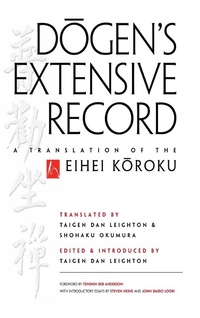
Dogen's Extensive Record
A Translation of the Eihei Koroku
Published on 10. March 2010
824 pages
978-0-86171-942-6 (ISBN)
Description

Eihei Dogen, the thirteenth-century Zen master who founded the Japanese Soto School of Zen, is renowned as one of the world's most remarkable religious thinkers. As Shakespeare does with English, Dogen utterly transforms the language of Zen, using it in novel and extraordinarily beautiful ways to point to everything important in the religious life.
He is known for two major works. The first work, the massive Shobogenzo (Treasury of the True Dharma Eye), represents his early teachings and exists in myriad English translations; the second work, the Eihei Koroku, is a collection of all his later teachings, including short formal discourses to the monks training at his temple, longer informal talks, and koans with his commentaries, as well as short appreciatory verses on various topics. The Shobogenzo has received enormous attention in Western Zen and Western Zen literature, and with the publication of this watershed volume, the Eihei Koroku will surely rise to commensurate stature.
Dogen's Extensive Record is the first-ever complete and scholarly translation of this monumental work into English and this edition is the first time it has been available in paperback. This edition contains extensive and detailed research and annotation by scholars, translators and Zen teachers Taigen Dan Leighton and Shohaku Okumura, as well as forewords by the eighteenth-century poet-monk Ryokan and Tenshin Reb Anderson, former abbot of the San Francisco Zen Center - plus introductory essays from Dogen scholar Steven Heine, and the prominent, late American Zen master John Daido Loori.
He is known for two major works. The first work, the massive Shobogenzo (Treasury of the True Dharma Eye), represents his early teachings and exists in myriad English translations; the second work, the Eihei Koroku, is a collection of all his later teachings, including short formal discourses to the monks training at his temple, longer informal talks, and koans with his commentaries, as well as short appreciatory verses on various topics. The Shobogenzo has received enormous attention in Western Zen and Western Zen literature, and with the publication of this watershed volume, the Eihei Koroku will surely rise to commensurate stature.
Dogen's Extensive Record is the first-ever complete and scholarly translation of this monumental work into English and this edition is the first time it has been available in paperback. This edition contains extensive and detailed research and annotation by scholars, translators and Zen teachers Taigen Dan Leighton and Shohaku Okumura, as well as forewords by the eighteenth-century poet-monk Ryokan and Tenshin Reb Anderson, former abbot of the San Francisco Zen Center - plus introductory essays from Dogen scholar Steven Heine, and the prominent, late American Zen master John Daido Loori.
More details
Other editions
Additional editions
Book
03/2010
Wisdom Publications,U.S.
€33.00
Article not available at the moment
Persons
Eihei Dogen founded the Japanese Soto School of Zen, and is renowned as one of the world's most remarkable religious thinkers. As Shakespeare does with English, Dogen utterly transforms the language of Zen, using it in novel and extraordinarily beautiful ways in his voluminous writings. Born in 1200 to an aristocratic background, he was ordained a monk in the Japanese Tendai School in his early teens, but became dissatisfied with Japanese Buddhism. After traveling in China from 1223 to 1227, he returned to introduce to Japan the Soto lineage and the large body of Chan teaching stories, or koans, which he had thoroughly mastered. From 1233 to 1243 he taught near the cultural capital of Kyoto, then in 1243 moved to the remote northern mountains and founded the temple Eiheiji, still one of the headquarter temples of Soto Zen. There, until his illness and death in 1253, he trained a core group of monks who spread Soto Zen throughout the Japanese countryside. Dogen's writings are noted for their poetic and philosophic depth, though aimed at spiritual practitioners. His two major, massive works are Shobogenzo (True Dharma Eye Treasury) and Eihei Koroku (Dogen's Extensive Record). Although not studied for many centuries aside from Soto scholars, in modern times Dogen's writings, through translation, have become an important part of the spread of Buddhism in the West.
Shohaku Okumura is a Soto Zen priest and Dharma successor of Kosho Uchiyama Roshi. He is a graduate of Komazawa University and has practiced in Japan at Antaiji, Zuioji, and the Kyoto Soto Zen Center, and in Massachusetts at the Pioneer Valley Zendo. He is the former director of the Soto Zen Buddhism International Center in San Francisco. His previously published books of translation include Shobogenzo Zuimonki, Dogen Zen, Zen Teachings of Homeless Kodo, and Opening the Hand of Thought. Okumura is also editor of Dogen Zen and Its Relevance for Our Time and SotoZen. He is the founding teacher of the Sanshin Zen Community, based in Bloomington, Indiana, where he lives with his family.
Reb Anderson Roshi moved to San Francisco in 1967 to study Zen Buddhism with Shunryu Suzuki Roshi, who ordained him as a priest in 1970. Since then, he has continued to practice at the San Francisco Zen Center, where he served as abbot from 1986 to 1995 and is now a senior dharma teacher. Anderson Roshi lectures and leads retreats around the world, and is the author of Warm Smiles from Cold Mountains and Being Upright. He lives with his family and friends at Green Dragon Temple, Green Gulch Farm, near Muir Beach, in Northern California.
John Daido Loori was, until his death in 2009, the spiritual leader and abbot of Zen Mountain Monastery in Mt. Tremper, New York. Trained in koan Zen as well as in the subtle school of Master Dogen's Zen, he was the Dharma heir of Hakuyu Taizan Maezumi Roshi. Devoted to maintaining authentic Zen training, he developed a distinctive style, called the Eight Gates of Zen, based on the noble eightfold path. Drawing on his background as scientist, artist, naturalist, and Zen priest, Abbot Loori was an American master who spoke directly to students from the perspective of a common background. His books include Mountain Record of Zen Talks and The Heart of Being.
Steven Heine is an authority on Japanese religion and society, especially the history of Zen Buddhism and the life and works of Dogen. He has published two dozen books, including Did Dogen Go to China? and Zen Skin, Zen Marrow.
Shohaku Okumura is a Soto Zen priest and Dharma successor of Kosho Uchiyama Roshi. He is a graduate of Komazawa University and has practiced in Japan at Antaiji, Zuioji, and the Kyoto Soto Zen Center, and in Massachusetts at the Pioneer Valley Zendo. He is the former director of the Soto Zen Buddhism International Center in San Francisco. His previously published books of translation include Shobogenzo Zuimonki, Dogen Zen, Zen Teachings of Homeless Kodo, and Opening the Hand of Thought. Okumura is also editor of Dogen Zen and Its Relevance for Our Time and SotoZen. He is the founding teacher of the Sanshin Zen Community, based in Bloomington, Indiana, where he lives with his family.
Reb Anderson Roshi moved to San Francisco in 1967 to study Zen Buddhism with Shunryu Suzuki Roshi, who ordained him as a priest in 1970. Since then, he has continued to practice at the San Francisco Zen Center, where he served as abbot from 1986 to 1995 and is now a senior dharma teacher. Anderson Roshi lectures and leads retreats around the world, and is the author of Warm Smiles from Cold Mountains and Being Upright. He lives with his family and friends at Green Dragon Temple, Green Gulch Farm, near Muir Beach, in Northern California.
John Daido Loori was, until his death in 2009, the spiritual leader and abbot of Zen Mountain Monastery in Mt. Tremper, New York. Trained in koan Zen as well as in the subtle school of Master Dogen's Zen, he was the Dharma heir of Hakuyu Taizan Maezumi Roshi. Devoted to maintaining authentic Zen training, he developed a distinctive style, called the Eight Gates of Zen, based on the noble eightfold path. Drawing on his background as scientist, artist, naturalist, and Zen priest, Abbot Loori was an American master who spoke directly to students from the perspective of a common background. His books include Mountain Record of Zen Talks and The Heart of Being.
Steven Heine is an authority on Japanese religion and society, especially the history of Zen Buddhism and the life and works of Dogen. He has published two dozen books, including Did Dogen Go to China? and Zen Skin, Zen Marrow.
Content
- Intro
- Publisher's Acknowledgment
- Contents
- Foreword
- Introduction
- The Significane of Eihei Koroku and Its Translation
- Dogen and Koans
- On Reading Eihei Koroku
- Volume 1. Dharma Hall Discourses 1-126 (1236-1243)
- Volume 2. Dharma Hall Discourses 127-184 (1245-1246)
- Volume 3. Dharma Hall Discourses 185-257 (1246-1248)
- Volume 4. Dharma Hall Discourses 258-345 (1248-1249)
- Volume 5. Dharma Hall Discourses 346-413 (1249-1251)
- Volume 6. Dharma Hall Discourses 414-470 (1251)
- Volume 7. Dharma Hall Discourses 471-531 (1251-1252)
- Volume 8.
- Volume 9. Kßans with Verse Comments 1-90
- Volume 10. Poetry
- Chronological Index of Dharma Hall Discourses with Dates
- Index and Glossary of Names
- Pinyin Names with Japanese Transliterations and Kanji
- Index of Translators' Names of Dharma Hall Discourses
- General Index
- Selected Bibliography
- About Wisdom
