

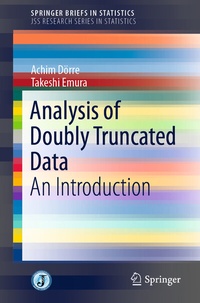
Analysis of Doubly Truncated Data
Description

This book introduces readers to statistical methodologies used to analyze doubly truncated data. The first book exclusively dedicated to the topic, it provides likelihood-based methods, Bayesian methods, non-parametric methods, and linear regression methods. These procedures can be used to effectively analyze continuous data, especially survival data arising in biostatistics and economics. Because truncation is a phenomenon that is often encountered in non-experimental studies, the methods presented here can be applied to many branches of science. The book provides R codes for most of the statistical methods, to help readers analyze their data. Given its scope, the book is ideally suited as a textbook for students of statistics, mathematics, econometrics, and other fields.
Reviews / Votes
"The aim of this book is to provide some fundamental ideas and methodologies for analysing doubly truncated data. ... The methodology of this book could be helpful to avoid a systematic bias in the contents of data due to loss of information." (Nikita E. Ratanov, zbMATH 1434.62008, 2020)
More details
Other editions
Additional editions
Persons
Achim Dörre, University of Rostock
Takeshi Emura, Chang Gung University
Content
Chapter 1: Introduction to double-truncation.- Chapter 2: Parametric inference under special exponential family.- Chapter 3: Parametric inference under location-scale family.- Chapter 4: Bayes inference.- Chapter 5: Nonparametric inference.- Chapter 6: Linear regression.- Appendix A: Data (if German company data are available).- Appendix B: R codes for inference under exponential family.- Appendix C: R codes for inference under location-scale family.- Appendix D: R codes for Bayes inference.- Appendix E: R codes for linear regression.
