

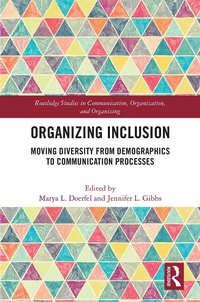
Organizing Inclusion
Moving Diversity from Demographics to Communication Processes
1st Edition
Published on 23. April 2020
318 pages
978-0-429-83387-8 (ISBN)
Description

Organizing Inclusion brings communication experts together to examine issues of inclusion and exclusion, which have emerged as a major challenge as both society and the workforce become more diverse.
Connecting communication theories to diversity and inclusion, and clarifying that inclusion is about the communication processes of organizations, institutions, and communities, the book explores how communication as an organizing phenomenon underlies systemic and institutionalized biases and generates practices that privilege certain groups while excluding or marginalizing others. Bringing a global perspective that transcends particular problems faced by Western cultures, the contributors address issues across sub-disciplines of communication studies, ranging from social and environmental activism to problems of race, gender, sexual orientation, age and ability. With these various perspectives, the chapters go beyond demographic diversity by addressing interaction and structural processes that can be used to promote inclusion. Using these multiple theoretical frameworks, Organizing Inclusion is an intellectual resource for improving theoretical understanding and practical applications that come with ever more diverse people working, coordinating, and engaging one another.
The book will be of great relevance to organizational stakeholders, human resource personnel and policy makers, as well as to scholars and students working in the fields of communication, management, and organization studies.
Connecting communication theories to diversity and inclusion, and clarifying that inclusion is about the communication processes of organizations, institutions, and communities, the book explores how communication as an organizing phenomenon underlies systemic and institutionalized biases and generates practices that privilege certain groups while excluding or marginalizing others. Bringing a global perspective that transcends particular problems faced by Western cultures, the contributors address issues across sub-disciplines of communication studies, ranging from social and environmental activism to problems of race, gender, sexual orientation, age and ability. With these various perspectives, the chapters go beyond demographic diversity by addressing interaction and structural processes that can be used to promote inclusion. Using these multiple theoretical frameworks, Organizing Inclusion is an intellectual resource for improving theoretical understanding and practical applications that come with ever more diverse people working, coordinating, and engaging one another.
The book will be of great relevance to organizational stakeholders, human resource personnel and policy makers, as well as to scholars and students working in the fields of communication, management, and organization studies.
Reviews / Votes
'This edited volume gathers leading thinkers in communication who are dedicated to being, thinking, and doing what's right...namely, getting on with the project of realizing a more just and inclusive future for modern organizations and societies.' -Ryan S. Bisel, University of Oklahoma, USAMore details
Series
Edition
1. Auflage
Language
English
Place of publication
London
United Kingdom
Publishing group
Taylor & Francis Ltd
Target group
College/higher education
Illustrations
6 Tables, black and white; 5 Line drawings, black and white; 6 Illustrations, black and white
ISBN-13
978-0-429-83387-8 (9780429833878)
Copyright in bibliographic data and cover images is held by Nielsen Book Services Limited or by the publishers or by their respective licensors: all rights reserved.
Schweitzer Classification
Other editions
Additional editions
Marya L. Doerfel | Jennifer L. Gibbs
Organizing Inclusion
Moving Diversity from Demographics to Communication Processes
Book
08/2022
1st Edition
Routledge
€67.90
Shipment within 10-20 days
Marya L. Doerfel | Jennifer L. Gibbs
Organizing Inclusion
Moving Diversity from Demographics to Communication Processes
Book
05/2020
1st Edition
Routledge
€206.90
Shipment within 10-20 days
Persons
Marya Doerfel (Professor of Communication and Director of the Network Science Lab, School of Communication and Information, Rutgers University) examines social networks, community building, and organizational and community transformation. She has been funded by the National Science Foundation with recent peer-reviewed articles including Engaging Partnerships, The Story of Collective Action, (Un)Obtrusive Control in Emergent Networks, and Digitizing the Strength of Weak Ties.
Jennifer Gibbs (Professor of Communication, Co-Editor of Communication Research) investigates collaboration in global teams and other distributed work arrangements, as well as the social and organizational impacts of new technologies. She has published over 50 peer-reviewed journal articles and book chapters, as well as a recent book entitled Distracted: Staying Connected without Losing Focus.
Jennifer Gibbs (Professor of Communication, Co-Editor of Communication Research) investigates collaboration in global teams and other distributed work arrangements, as well as the social and organizational impacts of new technologies. She has published over 50 peer-reviewed journal articles and book chapters, as well as a recent book entitled Distracted: Staying Connected without Losing Focus.
Content
1. Organizing Inclusion: Top-Down and Bottom-Up Approaches Part I Bottom-Up Approaches 2. Stigma Communication and Power: Managing Inclusion and Exclusion in the Workplace 3. Doing Engaged Scholarship: Inclusion Theory Meets Practice in the Context of a Peacebuilding Initiative in West Africa 4: Rhizomatous Dialogue, Organizational Engagement, and Inclusion 5. Non-Profit Reuse as a Solution to Reducing Digital Divides and Technology Maintenance Inequalities 6. When Pacing is a Privilege: The Time Scale of Exclusion 7. Creating the Being of Inclusion in Organizations Part II Top-Down Approaches 8. The Politics of Inclusion and Exclusion among Professions and Professionals 9. Moving Beyond Inclusion: Lessons from the Graduate Certificate in Participatory Research at the University of North Carolina at Chapel Hill 10. Organizing for Sustainability: Including and Engaging Diverse Stakeholders 11. Towards Financial Inclusion: Pitfalls in Illustrating and Discussing Financial Inclusion 12. Design of Meaningful Work in Diversity and Inclusion: Enactment of Inclusionary Engineering Design and Partnerships in Rural Ghana 13: #CommSoWEIRD: The Question of Sample Representativeness in Interpersonal Communication Research 14. Organizing as a Tension Between Tradition and Innovation: Promoting Inclusion in Academia
