

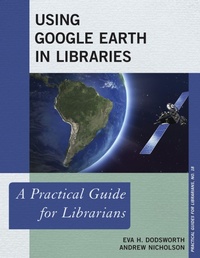
Using Google Earth in Libraries
A Practical Guide for Librarians
1st Edition
Published on 1. September 2015
122 pages
978-1-4422-5505-0 (ISBN)
Description

Google Earth is a research, mapping, and cultural exploration tool that puts the whole world in your hands, then hands over the tools to let you build your own world. The uses of Google Earth in academia, in libraries, and across disciplines are endless and each year more innovate research projects are being released. Since its launch, Google Earth has had an enormous impact on the way people think, learn, and work with geographic information. With easy access to spatial and cultural information, and with customizable map features and dynamic presentation tools, Google Earth is an attractive option for anyone wishing to host projects and to share research findings through a common online interface.
This easy-to-read, practical guide:
Demonstrates how Google Earth has been used as a resource for researchShowcases library path finders, discovery tools, and collections built with Google EarthDiscusses how Google Earth can be embedded into various library services Highlights effectives uses of Google Earth in specific-discipline education, and provide step-by-step sample classroom activitiesIntroduces Google Earth features, data, and map making capabilitiesDescribes Google Earth-related online resources
After reading this guide, librarians will be able to easily integrate Google Earth's many facets into their services and help teachers integrate it into their classrooms. Because so many librarians are educators and subject specialists, they can customize the learning outcomes for students based on the subject being studied. This book presents a cross-disciplinary overview of how Google Earth can be used in research, in teaching and learning, and in other library services like promotion, outreach, reference and very importantly collection and resource exploration and discovery.
This comprehensive guide to using Google Earth is for public, school, academic, and special libraries serving from the elementary level through adult levels. Although articles have been written about specific subjects and specific library projects, this is the first published that offer a one-stop-shop for utilizing this online product for library-related purposes. Librarians reading this book will gain the Google Earth skills required to be able to not only use it themselves, but also teach others in how to use this online technology.
This easy-to-read, practical guide:
Demonstrates how Google Earth has been used as a resource for researchShowcases library path finders, discovery tools, and collections built with Google EarthDiscusses how Google Earth can be embedded into various library services Highlights effectives uses of Google Earth in specific-discipline education, and provide step-by-step sample classroom activitiesIntroduces Google Earth features, data, and map making capabilitiesDescribes Google Earth-related online resources
After reading this guide, librarians will be able to easily integrate Google Earth's many facets into their services and help teachers integrate it into their classrooms. Because so many librarians are educators and subject specialists, they can customize the learning outcomes for students based on the subject being studied. This book presents a cross-disciplinary overview of how Google Earth can be used in research, in teaching and learning, and in other library services like promotion, outreach, reference and very importantly collection and resource exploration and discovery.
This comprehensive guide to using Google Earth is for public, school, academic, and special libraries serving from the elementary level through adult levels. Although articles have been written about specific subjects and specific library projects, this is the first published that offer a one-stop-shop for utilizing this online product for library-related purposes. Librarians reading this book will gain the Google Earth skills required to be able to not only use it themselves, but also teach others in how to use this online technology.
More details
Series
Edition
1. Auflage
Language
English
Place of publication
New York
United States
Publishing group
Bloomsbury Publishing Plc
Illustrations
23 BW Photos, 10 Tables
ISBN-13
978-1-4422-5505-0 (9781442255050)
Copyright in bibliographic data and cover images is held by Nielsen Book Services Limited or by the publishers or by their respective licensors: all rights reserved.
Schweitzer Classification
Other editions
Additional editions
Book
09/2015
Rowman & Littlefield Publishers
€148.20
Shipment within 10-20 days
Persons
Eva (Hobot) Dodsworth is the Geospatial Data Services Librarian at the University of Waterloo library where is specializes in teaching GIS and map-related content to the university community. Eva's interests include historical cartographic research, teaching geoweb applications and historical GIS. Eva is also a part-time online instructor for a number of library schools, and continuing education organizations where she teaches the use of GIS technology in libraries. Eva has also written Getting Started with GIS : A LITA Guide, as well as has co-written Discovering and Using Historical Geographic Resources on the Web.
Andrew Nicholson is the GIS/Data Librarian at the University of Toronto Mississauga. In this role, he collaborates closely with teaching faculty to develop course assignments based around map-related research questions, geospatial literacy, and experiential learning. Almost from the time of Google Earth's launch in 2005, Andrew has been promoting its use in libraries and in the classroom as a research and teaching tool, overseeing its application in courses across the disciplines including Anthropology, Biology, Classical Studies, Forensic Science, Geography, Language Studies, among many others.
Andrew Nicholson is the GIS/Data Librarian at the University of Toronto Mississauga. In this role, he collaborates closely with teaching faculty to develop course assignments based around map-related research questions, geospatial literacy, and experiential learning. Almost from the time of Google Earth's launch in 2005, Andrew has been promoting its use in libraries and in the classroom as a research and teaching tool, overseeing its application in courses across the disciplines including Anthropology, Biology, Classical Studies, Forensic Science, Geography, Language Studies, among many others.
Content
Preface
Chapter 1. Google Earth: A World Resource for Research
Chapter 2. Discovering Library Resources with Google Earth
Chapter 3. Google Earth: A Technological Tool for Teaching and Learning
Chapter 4. Google Earth for Mapping and Sharing
Chapter 5. Google Earth in Practice: Self-Guided Tutorials
Index
About the Authors
Chapter 1. Google Earth: A World Resource for Research
Chapter 2. Discovering Library Resources with Google Earth
Chapter 3. Google Earth: A Technological Tool for Teaching and Learning
Chapter 4. Google Earth for Mapping and Sharing
Chapter 5. Google Earth in Practice: Self-Guided Tutorials
Index
About the Authors
