

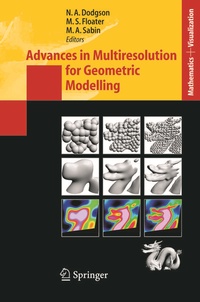
Advances in Multiresolution for Geometric Modelling
Description

Multiresolution methods in geometric modelling are concerned with the generation, representation, and manipulation of geometric objects at several levels of detail. Applications include fast visualization and rendering as well as coding, compression, and digital transmission of 3D geometric objects.
This book marks the culmination of the four-year EU-funded research project, Multiresolution in Geometric Modelling (MINGLE). The book contains seven survey papers, providing a detailed overview of recent advances in the various fields within multiresolution modelling, and sixteen additional research papers. Each of the seven parts of the book starts with a survey paper, followed by the associated research papers in that area. All papers were originally presented at the MINGLE 2003 workshop held at Emmanuel College, Cambridge, UK, 9-11 September 2003.
More details
Other editions
Additional editions
Persons
Neil Dodgson took his BSc in Computer Science and Physics at Massey University in New Zealand (1988) and his PhD in image processing at the University of Cambridge (1992). He is a Senior Lecturer in the Computer Laboratory at the University of Cambridge and is co-leader of the Rainbow Research Group. He has over fifty refereed publications in the areas of modelling for 3D computer graphics, human-figure animation, 3D displays, and image processing.
Malcolm Sabin worked on representation of aircraft shapes at British Aircraft Corporation in the late 1960s, there developing one of the earliest modern surface systems. He has been active in CAD, CAM and CAE ever since, especially in the field of surface representations and in subdivision in particular. He is employed by his own company, Numerical Geometry Ltd. which sells his time as a consultant, and maintains close contact with the Computer Laboratory and the Department of Applied Mathematics at the University of Cambridge.
