

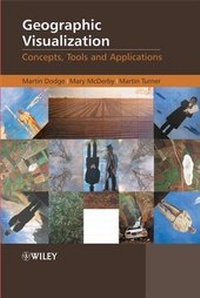
Geographic Visualization
Description

More details
Other editions
Additional editions
Persons
Content
Acknowledgements.
Authors' Biographies.
1. The Power of Geographical Visualizations (Martin Dodge, Mary McDerby and Martin Turner).
1.1 Aims.
1.2 The nature of geographic visualization.
1.3 The visualization process.
1.4 Digital transition and geographic visualization.
1.5 The politics of visualization.
1.6 The utility of geographic visualization.
1.7 Conclusions.
References.
2. What does Google Earth mean for the Social Sciences (Michael F. Goodchild).
2.1 Introduction.
2.2 Major features of Google Earth.
2.3 Fundamental spatial concepts.
2.4 The social perspective.
2.5 Research challenges.
2.6 Conclusions.
References.
3. Coordinated Multiple Views for Exploratory GeoVisualization (Jonathan C. Roberts).
3.1 Introduction.
3.2 Data preparation.
3.3 Informative visualizations.
3.4 Interaction and manipulation.
3.5 Tools and toolkits.
3.6 Conclusions.
References.
4. The Role of Map Animation for Geographic Visualization (Mark Harrower and Sara Fabrikant).
4.1 Introduction.
4.2 Types of time.
4.3 The nature of animated maps.
4.4 Potential pitfalls of map animation.
4.5 Conclusions.
References.
5. Telling an Old Story with New Maps (Anna Barford and Danny Dorling).
5.1 Introduction: re-visualizing our world.
5.2 Method and content.
5.3 The champagne glass of income distribution.
References.
6. Re-visiting the Use of Surrogate Walks for Exploring Local Geographies Using Non-immersive Multimedia (William Cartwright).
6.1 Introduction.
6.2 Queenscliff Video Atlas.
6.3 GeoExploratorium.
6.4 Townsville GeoKnowledge Project.
6.5 Jewell Area prototype.
6.6 Melbourne Historical Buildings Demonstration Product.
6.7 Testing the user's perception of space and place.
6.8 Further development work.
6.9 Conclusion.
Acknowledgements.
References.
7. Visualization with High-resolution Aerial Photography in Planning-related Property Research (Scott Orford).
7.1 Introduction.
7.2 Applications of aerial photography in planning-related property research.
7.3 Aerial photography, property and surveillance.
7.4 Conclusion.
References.
8. Towards High-resolution Self-organizing Maps of Geographic Features (André Skupin and Aude Esperbé).
8.1 Introduction.
8.2 Self-organizing maps.
8.3 High-resolution SOM.
8.4 High-resolution SOM for Climate Attributes.
8.5 Summary and outlook.
Acknowledgements.
References.
9. The Visual City (Andy Hudson-Smith).
9.1 The development of digital space.
9.2 Creating place and space.
9.3 Visual cities and the visual Earth.
9.4 The development of virtual social space.
9.5 The future: the personal city.
References.
10. Travails in the Third Dimension: a Critical Evaluation of Three-dimensional Geographical Visualization (Ifan D H Shepherd).
10.1 Introduction.
10.2 What is gained by going from 2D to 3D?.
10.3 Some problems with 3D views.
10.4 Conclusions.
Acknowledgements.
References.
11. Experiences of Using State of the Art Immersive Technologies for Geographic Visualization (Martin Turner and Mary McDerby).
11.1 Introduction.
11.2 The human visual system.
11.3 Constructing large-scale visualization systems.
11.4 Rules and recommendations.
11.5 The future - a better and cheaper place.
References.
12. Landscape Visualization: Science and Art (Gary Priestnall and Derek Hampson).
12.1 Landscape visualization: contexts of use.
12.2 The need for ground truth.
12.3 Outcomes from fieldwork exercises.
12.4 Broadening the context.
12.5 The Chat Moss case study.
12.6 Discussion.
12.7 Conclusion.
Acknowledgements.
References.
13. Visualization, Data Sharing and Metadata (Humphrey Southall).
13.1 Introduction.
13.2 The data documentation initiative and the aggregate data extension.
13.3 Implementing the DDI within the GB Historical GIS.
13.4. Driving visualization in Vision of Britain.
13.5 Conclusion.
Acknowledgements.
References.
14. Making Uncertainty Usable: Approaches for Visualizing Uncertainty Information (Stephanie Deitrick and Robert Edsall).
14.1 Introduction: the need for representations of uncertainty.
14.2 The complexity of uncertainty.
14.3 Uncertainty visualization: a user-centred research agenda.
14.4 Conclusion.
References.
15. Geovisualization and Time - New Opportunities for the Space-Time Cube (Menno-Jan Kraak).
15.1 Introduction.
15.2 Hägerstrand's time geography and the space-time cube.
15.3 Basics of the space-time cube.
15.4 The space-time cube at work.
15.5. Discussion.
References.
16. Visualizing Data Gathered by Mobile Phones (Michael A. E. Wright, Leif Oppermann and Mauricio Capra).
16.1 Introduction.
16.2 What are we visualizing?
16.3 How can we visualize this data?
16.4 Case studies.
16.5 Discussion.
16.6 Conclusion.
References.
Index.
