

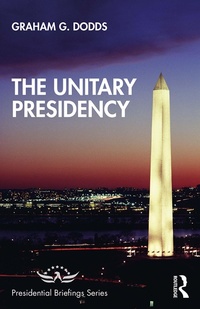
The Unitary Presidency
1st Edition
Published on 5. August 2019
130 pages
978-1-351-05276-4 (ISBN)
Description

The theory of the unitary executive is one of the most controversial and significant constitutional doctrines of the past several decades. It holds that the U.S. president alone embodies all executive power and therefore has unlimited ability to direct the many people and institutions within the federal government's vast executive branch. It thus justifies the president's prerogative to organize the executive branch and to direct its activities, to tell executive personnel what to do and to fire them if desired, to control the flow of information, and to issue signing statements that make judgments about constitutionality and determine the extent to which laws will be implemented. In some versions, it also endorses implied or inherent powers and permits the president to completely control foreign policy and military action.
Proponents say this conception of the presidential office is faithful to the Constitution, facilitates the sort of energetic executive that Alexander Hamilton argued for, and enhances administrative efficacy and political accountability for governance. Critics say this arrangement is constitutionally inaccurate, is belied by historical practice and legal precedents, and is dangerously close to the monarchical power that provoked the American Revolution - and can be especially threatening in the era of Donald Trump.
This book examines how controversies about unitary executive power have played out from the founding era to the present day with a focus on recent presidents, it explores arguments both for and against the unitary executive theory, and it looks ahead to future implications for American politics.
Proponents say this conception of the presidential office is faithful to the Constitution, facilitates the sort of energetic executive that Alexander Hamilton argued for, and enhances administrative efficacy and political accountability for governance. Critics say this arrangement is constitutionally inaccurate, is belied by historical practice and legal precedents, and is dangerously close to the monarchical power that provoked the American Revolution - and can be especially threatening in the era of Donald Trump.
This book examines how controversies about unitary executive power have played out from the founding era to the present day with a focus on recent presidents, it explores arguments both for and against the unitary executive theory, and it looks ahead to future implications for American politics.
Reviews / Votes
"Dodds provides an essential discussion for understanding today's battles - and tomorrow's headlines - over the scope of presidential power, concisely mapping the contours of unitary executive theory and practice across American history. The unitary executive is 'neither a fiction nor a fact,' he argues, but a political instrument. Enforcing the Constitution's constraints on unilateralism will thus come not from toying with textual definitions but from political will." Andrew Rudalevige, Bowdoin College, USA"Dodds's book represents the best comprehensive study to date on the unitary executive theory in American politics. This work is not only relevant for scholars seeking to understand the exercise of presidential power during the recent George W. Bush, Barack Obama, and Donald Trump administrations, but it assesses the unitary executive in relation to the evolving American presidency since George Washington. More importantly, it helps to clear the muddy waters in presidential research by demonstrating how the theory of the unitary executive is distinct from scholarly notions of the administrative and unilateral presidencies." Adam L. Warber, Clemson University, USA
"What a very fine book this is! To come to grips with the unitary presidency is no easy task. Professor Dodds marshals historic examples, weighs normative claims, and evaluates empirical evidence in his treatment of this important topic. He skillfully demonstrates that supporters as well as opponents of the unitary presidency have reason to be simultaneously cheered and unsettled. I would use this text in an upper-level undergraduate political science course, but Professor Dodds's cogent writing makes this text accessible to an even broader audience." Barry L. Tadlock, Ohio University, USA
"In The Unitary Presidency, Graham Dodds has provided scholars with a concise summary of one of the more interesting normative issues in the study of the American presidency: the unitary executive theory. . . . Dodds outlines arguments both for and against the viability of the unitary executive theory from two perspectives: a normative perspective and an empirical one. Here the author's concise writing and presentation style shine, as he succinctly outlines arguments that have been made from constitutional, historical, and practical vantage points either to bolster or to detract from the theory. . . . There remain fundamental limitations to what presidents can practically accomplish, and in spite of the aggrandizement of presidential power that has occurred over the last century, Dodds has reminded us that it is an office that is in no sense truly unitary."
--Joshua B. Kennedy, Georgia Southern University, in Congress & the Presidency
More details
Series
Edition
1. Auflage
Language
English
Place of publication
London
United Kingdom
Publishing group
Taylor & Francis Ltd
Target group
College/higher education
Product notice
Reflowable
ISBN-13
978-1-351-05276-4 (9781351052764)
Copyright in bibliographic data and cover images is held by Nielsen Book Services Limited or by the publishers or by their respective licensors: all rights reserved.
Schweitzer Classification
Other editions
Additional editions
Graham Dodds
The Unitary Presidency
Book
08/2019
1st Edition
Routledge
€62.60
Shipment within 10-20 days
Graham Dodds
The Unitary Presidency
Book
08/2019
1st Edition
Routledge
€205.40
Shipment within 10-20 days
Person
Graham G. Dodds is an Associate Professor of Political Science at Concordia University in Montreal. He has also taught at the University of Pennsylvania and in France and has worked at the Brookings Institution and for a Member of Congress. He is the author of the book Take Up Your Pen: Unilateral Presidential Directives in American Politics and is frequently interviewed by journalists about U.S. politics.
Content
Introduction: The Theory of the Unitary Executive; 1. Nearly Two Centuries of Unitary Precedents; 2. Explicit Unitary Battles in the 1980s and 1990s; 3. The Unitary Executive in the Twenty-First Century; 4. Normative Assessment of the Unitary Executive; 5. Empirical Assessment of the Unitary Executive; Conclusion: Unitary Politics; Epilogue
