

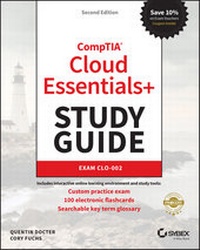
CompTIA Cloud Essentials+ Study Guide
Description

The latest title in the popular Sybex Study Guide series, CompTIA Cloud Essentials+ Study Guide helps candidates prepare for taking the NEW CompTIA Cloud Essentials+ Exam (CLO-002). Ideal for non-technical professionals in IT environments, such as marketers, sales people, and business analysts, this guide introduces cloud technologies at a foundational level. This book is also an excellent resource for those with little previous knowledge of cloud computing who are looking to start their careers as cloud administrators.
The book covers all the topics needed to succeed on the Cloud Essentials+ exam and provides knowledge and skills that any cloud computing professional will need to be familiar with. This skill set is in high demand, and excellent careers await in the field of cloud computing.
* Gets you up to speed on fundamental cloud computing concepts and technologies
* Prepares IT professionals and those new to the cloud for the CompTIA Cloud Essentials+ exam objectives
* Provides practical information on making decisions about cloud technologies and their business impact
* Helps candidates evaluate business use cases, financial impacts, cloud technologies, and deployment models
* Examines various models for cloud computing implementation, including public and private clouds
* Identifies strategies for implementation on tight budgets
Inside is everything candidates need to know about cloud concepts, the business principles of cloud environments, management and technical operations, cloud security, and more. Readers will also have access to Sybex's superior online interactive learning environment and test bank, including chapter tests, practice exams, electronic flashcards, and a glossary of key terms.
More details
Other editions
Additional editions
Persons
Quentin Docter, Cloud Essentials+, A+, Network+, IT Fundamentals+, MCSE, CNE, CCNA, SCSA, is an IT consultant and author who started in the industry in 1994. Since then, he's worked as a tech and network support specialist, trainer, consultant, and web developer.
Cory Fuchs, Cloud essentials+, A+, Network+, MCSE, CCNA, RHNA, AWS CP, AWS SAA, AWS SAPro, is a Cloud Architect working for several Fortune 500 companies. He has worked in IT for over 25 years as a systems administrator, network engineer, trainer, and consultant.
Content
Introduction
Shortly after the Internet exploded in popularity, it was common to hear people joke that "maybe this isn't just a fad." Looking back, it's hard to believe that anyone would have ever seriously thought that it was, given its omnipresence in our lives today. The same things can be said about the cloud. What might have seemed like a novelty in the late 2000s is now mainstream. Most of us use cloud-based services every day, whether we realize it or not.
It's safe to say that the cloud has transformed our Internet experience as users. It's also had a massive impact on the way that companies and other organizations conduct business. The cloud has the potential to save organizations money and time, but only if it's implemented properly. Of course, that takes some technical expertise. But it also takes business knowledge. The intersection of business acumen and technical knowledge is where this book focuses.
Why Certify for Cloud Business Skills?
There is a major need in the market today for people who understand both the technical side and the business side of an organization. Indeed, all of the following are reasons to become certified in cloud business skills:
- The largest skills gap in IT workers is business acumen.
- IT employees are now expected to weigh in on business decisions.
- Certification empowers both technical and nontechnical employees to make data-driven cloud recommendations.
- Certification demonstrates readiness for promotional opportunities to management-level positions.
- Certification ensures understanding of personnel working for cloud product and services organizations.
The CompTIA Cloud Essentials+ exam is a great certification for a few reasons. First, it's job-focused and aligned with the needs of employers. Second, it's current with today's cloud environment-the technology and how it's used. Third, it's the only vendor-neutral cloud-specific business certification. It's a great stepping stone for IT and business professionals who want to become certified in specific cloud technologies such as Amazon AWS or Microsoft Azure.
As noted, this certification focuses on the intersection of business and technology. If you're interested in the more technical side of cloud management, consider the CompTIA Cloud+ certification. To help prepare for it, look for Sybex CompTIA Cloud+ Study Guide, Second Edition, by Todd Montgomery and Stephen Olson.
Who Should Read This Book?
This book is a great resource as a primer to cloud technologies, with a practical focus. We don't get into too much deep technical theory. We want people who read this book to understand cloud terms and basic technologies and be able to apply that knowledge to business situations.
The Cloud Essentials+ cert, and therefore this book, is for IT and business professionals who:
- Want to move into management and leadership roles
- Work for cloud product and services companies
- Have a strong technical or data background, but do not have a business degree
- Have good general business acumen, but do not have validation of their competency in cloud-specific situations
- Are responsible for providing recommendations on cloud-related decisions
- Wish to understand why their company makes the cloud-related decisions they do
- Want to remain relevant to their employers by demonstrating professional growth, in an area of unmet need
If any of these apply to you, then this book can help you out!
What Does This Book Cover?
This book covers everything you need to know to pass the CompTIA Cloud Essentials+ exam. Official objectives are available here:
https://certification.comptia.org/certifications/cloud-essentials
Chapter 1: Cloud Principles and Design This chapter introduces basic cloud principles. Included are service models, or what the cloud can deliver, deployment models, or how the cloud can be executed, and several characteristics that make the cloud valuable to a business.
Chapter 2: Cloud Networking and Storage The cloud is perhaps best known for its storage capabilities, so this chapter covers different features of cloud storage such as compression, deduplication, and capacity on demand, as well as hot versus cold storage, storage types, and software-defined storage and content delivery networks.
Accessing the cloud is also of high importance, so this chapter also discusses cloud connectivity and access types and popular networking tools such as load balancers, DNS, and firewalls.
Chapter 3: Assessing Cloud Needs Every organization has slightly different cloud needs. This chapter starts with assessing company needs to determine how the cloud will provide benefits. Then, it moves into looking into some specific types of benefits in detail, including access management, data analytics, digital marketing, the Internet of Things, blockchain, and more.
Chapter 4: Engaging Cloud Vendors After an organization has analyzed the technical side and decided to move to the cloud, it's time to find the right cloud provider. This chapter looks at financial and business aspects of engaging cloud providers. We talk about types of expenditures, licensing models, requests for information, statements of work, service level agreements, evaluations, and contracts and billing.
Chapter 5: Management and Technical Operations Continuing with some of the technical aspects of operating in the cloud, we discuss data management, availability, disposable resources, monitoring, and visibility. These are a precursor and are used when starting DevOps and a CICD pipeline. Testing and configuration management are critical aspects of DevOps, and we walk through a few examples. Finally, we discuss financials and reporting on usage when using resources in the cloud.
Chapter 6: Governance and Risk Organizations will have to manage risk whenever they use cloud resources. In this chapter we introduce the concept of risk and the responses. We discuss some risks that are different when using the cloud versus on-premises data centers. We introduce policies and procedures and some of the organization management needed for cloud initiatives. We finish with policies that are specific to security, access, and control.
Chapter 7: Compliance and Security in the Cloud Cloud security will be a critical piece for any organization wanting to implement resources in the cloud. This chapter looks at regulations and standards that may be required for an organization to use the cloud. We take a deeper dive into data security and processes for securing the data. We give examples of security assessments that any organization should be performing. Finally, we discuss applications and infrastructure security.
What's Included in This Book?
We've included the following study tools throughout the book:
Assessment Test At the end of this introduction is an assessment test that you can use to check your readiness for the exam. Take this test before you start reading the book; it will help you determine the areas where you might need to brush up. The answers to the assessment test questions appear on a separate page after the last question of the test. Each answer includes an explanation and a note telling you the chapter in which the material appears.
Objective Map and Opening List of Objectives Just before the assessment test, you'll find a detailed exam objective map, showing you where each of the CompTIA exam objectives is covered in this book. In addition, each chapter opens with a list of the exam objectives it covers. Use these to see exactly where each of the exam topics is covered.
Exam Essentials Each chapter, just after the summary, includes a number of exam essentials. These are the key topics that you should take from the chapter in terms of areas to focus on when preparing for the exam.
Written Labs Each chapter includes a written lab to test your knowledge. These labs map to the exam objectives. You can find the answers to those questions in Appendix A.
Chapter Review Questions To test your knowledge as you progress through the book, there are 20 review questions at the end of each chapter. As you finish each chapter, answer the review questions and then check your answers-the correct answers and explanations are in Appendix B. You can go back to reread the section that deals with each question you got wrong in order to ensure that you answer correctly the next time you're tested on the material.
Interactive Online Learning Environment and Test Bank
Studying the material in the CompTIA Cloud Essentials+ Study Guide is an important part of preparing for the Cloud Essentials+ certification exam, but we provide additional tools to help you prepare. The online Test Bank will help you understand the types of questions that will appear on the certification exam.
The sample tests in the Test Bank include all the questions in each chapter as well as the questions from the Assessment test. In addition, there is one more practice exam...
