

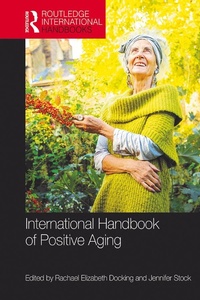
International Handbook of Positive Aging
Published on 14. July 2017
270 pages
978-1-317-39213-2 (ISBN)
Description

As our global demographic shifts towards an increasingly aging population, we have an opportunity to transform how we experience and think about getting older and embrace the diversity and contribution that this population can bring to society. The International Handbook of Positive Aging showcases the latest research and theory into aging, examining the various challenges faced by older adults and the ways in which we can bring a much-needed positive focus towards dealing with these.
The handbook brings together disparate research from medical, academic, economic and social community fields, with contributions from NHS partners, service users, universities across the United Kingdom and collaborations with international research leaders in the field of aging. Divided into sections, the first part of the book focuses on introducing the concept of positive aging before going on to cover the body over the life course, well-being and care delivery. All contributors recognise the fact that we are living longer, which is providing us with a tremendous opportunity to enjoy and flourish in healthy and fulfilling later lives, and this focus on the importance of patient empowerment is integral to the book.
This is a valuable reference source for those working in developmental psychology, clinical psychology, mental health, health sciences, medicine, neuropsychological rehabilitation, sociology, anthropology, social policy and social work. It will help encourage researchers, professionals and policymakers to make the most of opportunities and innovations to promote a person's sense of independence, dignity, well-being, good health and participation in society as they get older.
The handbook brings together disparate research from medical, academic, economic and social community fields, with contributions from NHS partners, service users, universities across the United Kingdom and collaborations with international research leaders in the field of aging. Divided into sections, the first part of the book focuses on introducing the concept of positive aging before going on to cover the body over the life course, well-being and care delivery. All contributors recognise the fact that we are living longer, which is providing us with a tremendous opportunity to enjoy and flourish in healthy and fulfilling later lives, and this focus on the importance of patient empowerment is integral to the book.
This is a valuable reference source for those working in developmental psychology, clinical psychology, mental health, health sciences, medicine, neuropsychological rehabilitation, sociology, anthropology, social policy and social work. It will help encourage researchers, professionals and policymakers to make the most of opportunities and innovations to promote a person's sense of independence, dignity, well-being, good health and participation in society as they get older.
Reviews / Votes
'Although a central reality of our time, aging remains framed within negative societal constructs that glamourise youth, and conflate age with burden. By inculcating a view of inevitable decline, such attitudes may beget the burden they anticipate. The International Handbook of Positive Aging challenges this complacency through a comprehensive survey of the latest research and theory into aging and commands a fresh approach from state, society and the individual that looks beyond ill-health, embraces the diversity and contribution that this population can bring to society, and challenges us to see physical, emotional and sexual health as positive components of long lives well-lived.', Hugh F McIntyre, Consultant Physician East Sussex Healthcare Trust, Hon Clinical Reader Brighton and Sussex Medical School'There has never been a more appropriate time to explore what is meant by Positive Aging. This text addresses false assumptions about notions of burden, dependency, deficit and the whole range of current negative narratives and attitudes about aging across the international landscape. The text is a great introduction and Docking and Stock have provided a Handbook which is highly accessible, critical and engaging without sacrificing it's academic underpinning.', Dr Mervyn Eastman FRSA, Co-Founder and Director, Change AGEnts Co-operative
More details
Series
Language
English
Place of publication
London
United Kingdom
Publishing group
Taylor & Francis Ltd
Target group
College/higher education
Professional and scholarly
Illustrations
9 s/w Tabellen, 7 s/w Photographien bzw. Rasterbilder, 3 s/w Zeichnungen
9 Tables, black and white; 3 Line drawings, black and white; 7 Halftones, black and white
File size
2,09 MB
ISBN-13
978-1-317-39213-2 (9781317392132)
Copyright in bibliographic data and cover images is held by Nielsen Book Services Limited or by the publishers or by their respective licensors: all rights reserved.
Schweitzer Classification
Other editions
Additional editions
Rachael E. Docking | Jennifer Stock
International Handbook of Positive Aging
Book
12/2019
1st Edition
Routledge
€73.60
Shipment within 15-20 days
Rachael E. Docking | Jennifer Stock
International Handbook of Positive Aging
Book
06/2017
1st Edition
Routledge
€349.69
Shipment within 10-20 days
Persons
Dr Rachael E. Docking is Senior Evidence Manager at the Centre for Ageing Better and Research Fellow at Anglia Ruskin University. Her research background is in the disciplines of psychology and epidemiology. Rachael's specific interests are in attitudes to aging, chronic and/or disabling pain in older adults, risk factors for pain onset and methods for self-management of pain. Additionally, she has an interest in dementia and pain, particularly in how accurately pain can be assessed in those with dementia. In her work at the Centre for Ageing Better, an independent charitable foundation working to help everybody enjoy a good later life, Rachael leads their programme on 'Homes and neighbourhoods'. As Senior Evidence Manager she works on their evidence work stream and identifying evidence needs.
Dr Jennifer Stock was a Senior Research Fellow at Anglia Ruskin University at the time of submission. Jennifer's background is in psychology and she has lead on a number of aging-related research projects. Jennifer's doctoral thesis investigated the role of psychosocial factors in the relationship between physical activity and cognitive ability in older adults. Jennifer's post-doctoral research interests have included psychological resilience with aging, improving attitudes towards aging amongst young people and healthcare staff, dementia, lifestyle interventions, innovative use of technology to improve the lives of older adults, psychosocial aspects to living with long-term conditions, and end-of-life care. Jennifer is currently undertaking her doctorate in Clinical Psychology at the Institute of Psychiatry, Psychology and Neuroscience, Kings College London.
Dr Jennifer Stock was a Senior Research Fellow at Anglia Ruskin University at the time of submission. Jennifer's background is in psychology and she has lead on a number of aging-related research projects. Jennifer's doctoral thesis investigated the role of psychosocial factors in the relationship between physical activity and cognitive ability in older adults. Jennifer's post-doctoral research interests have included psychological resilience with aging, improving attitudes towards aging amongst young people and healthcare staff, dementia, lifestyle interventions, innovative use of technology to improve the lives of older adults, psychosocial aspects to living with long-term conditions, and end-of-life care. Jennifer is currently undertaking her doctorate in Clinical Psychology at the Institute of Psychiatry, Psychology and Neuroscience, Kings College London.
Content
Part I: Introduction to positive aging 1. Introduction 2. What is positive aging? 3. Epidemiology and aging 4. Positive aging, positive dying: intersectional and daily communicational issues surrounding palliative and end-of-life care services in minority groups in the United Kingdom and the United States Part II: The body over the life course 5. Cancer 6. Heart failure 7. Exploring experiences of aging with Type 2 Diabetes (T2D): the case for a whole-system approach 8. Dementia 9. Falls 10. Pain management and assessment Part III: Well-being 11. Physical activity and healthy eating 12. Sexual health for older adults 13. Cognitive aging 14. Environment, housing, health, and social care 15. Social lives, social engagement, and work 16. Digital technologies and aging Part IV: Care delivery 17. Quality of life of elderly residents of UK care homes: a systematic review 18. Advance care planning for older adults at the end of life Part V: Conclusions 19. Conclusion
