

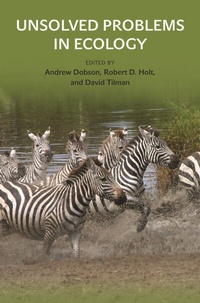
Unsolved Problems in Ecology
1st Edition
Published on 7. September 2020
408 pages
978-0-691-19532-2 (ISBN)
Description

Leading ecologists discuss some of the most compelling open questions in the field today
Unsolved Problems in Ecology brings together many of the world's leading ecologists to discuss the most fundamental research questions confronting the field today. This diverse and thought-provoking collection of essays spans virtually all of the key subfields of the discipline, from behavioral and evolutionary ecology to population biology, community ecology, ecosystem ecology, disease ecology, and conservation biology. These essays are intended to stoke curiosity, challenge prevailing wisdom, and provoke new ways of thinking about ecology in light of new technologies and unprecedented environmental challenges brought on by climate and land-use change. Authoritative and accessible, Unsolved Problems in Ecology is ideal for graduate students in the early stages of their scientific careers and an essential resource for seasoned ecologists looking for exciting new directions to take their research.
- Sheds light on modern ecology's most important and compelling open questions
- Features thought-provoking contributions from more than two dozen world-class ecologists
- Covers behavior, evolution, communities, ecosystems, resource management, and more
- Discusses ways to raise the financial and intellectual profile of the discipline
- An invaluable resource for graduate students as well as seasoned ecologists
Unsolved Problems in Ecology brings together many of the world's leading ecologists to discuss the most fundamental research questions confronting the field today. This diverse and thought-provoking collection of essays spans virtually all of the key subfields of the discipline, from behavioral and evolutionary ecology to population biology, community ecology, ecosystem ecology, disease ecology, and conservation biology. These essays are intended to stoke curiosity, challenge prevailing wisdom, and provoke new ways of thinking about ecology in light of new technologies and unprecedented environmental challenges brought on by climate and land-use change. Authoritative and accessible, Unsolved Problems in Ecology is ideal for graduate students in the early stages of their scientific careers and an essential resource for seasoned ecologists looking for exciting new directions to take their research.
- Sheds light on modern ecology's most important and compelling open questions
- Features thought-provoking contributions from more than two dozen world-class ecologists
- Covers behavior, evolution, communities, ecosystems, resource management, and more
- Discusses ways to raise the financial and intellectual profile of the discipline
- An invaluable resource for graduate students as well as seasoned ecologists
More details
Language
English
Place of publication
Princeton, NJ
United States
Publishing group
De Gruyter
Target group
Professional and scholarly
Edition type
Digital original
Product notice
Reflowable
Illustrations
28 b/w illus. 10 tables. 1 map.
ISBN-13
978-0-691-19532-2 (9780691195322)
Schweitzer Classification
Other editions
Additional editions
Andrew Dobson | David Tilman | Robert D. Holt
Unsolved Problems in Ecology
Book
06/2020
Princeton University Press
€180.99
Shipment within 10-20 days
Andrew Dobson | David Tilman | Robert D. Holt
Unsolved Problems in Ecology
Book
06/2020
Princeton University Press
€49.50
Article not available at the moment
Persons
Andrew Dobson is professor of ecology and evolutionary biology at Princeton University. His books include Conservation and Biodiversity. Robert D. Holt is Eminent Scholar and Arthur R. Marshall, Jr., Chair in Ecological Studies at the University of Florida. His books include Metacommunities. David Tilman is Regents Professor and McKnight Presidential Chair in Ecology at the University of Minnesota. His books include The Functional Consequences of Biodiversity (Princeton).
Content
- Cover
- Contents
- Preface
- List of Contributors
- PART I: Populations, Variability, and Scaling
- Ecological Scaling in Space and Time: A New Tool in Plain Sight?
- How Will Organisms Respond to Complex, Novel Environments?
- Variance-Explicit Ecology: A Call for Holistic Study of the Consequences of Variability at Multiple Scales
- Why Does Intra-Genotypic Variance Persist?
- Population Dynamics of Species with Complex Life Cycles
- What Determines Population Density?
- PART II: Population Biology and the Ecology of Individuals
- Neglected Problems in Ecology: Interdependence and Mutualism
- Ecology "through the Looking Glass": What Might Be the Ecological Consequences of Stopping Mutation?
- Ecology and Evolution Is Hindered by the Lack of Individual-Based Data
- Do Temperate and Tropical Birds Have Different Mating Systems?
- Leaf Structure and Function
- PART III: Coexistence
- The Dimensions of Species Coexistence
- Evolution, Speciation, and the Persistence Paradox
- What Is the Species Richness Distribution?
- Two Sides of the Same Coin: High Non-Neutral Diversity and High-Dimensional Trait Space in Pathogen Populations and Ecological Communities
- PART IV: Ecological Communities and Ecosystems
- What Regulates Growth across Levels of Organization?
- The Ecosystem: Superorganism, or Collection of Individuals?
- Untangling Food Webs
- What Determines the Abundance of Lianas and Vines?
- The World Beneath Us: Making Soil Biodiversity and Ecosystem Functioning Central to Environmental Policy
- PART V: Ecology and Health
- Ecology and Medicines
- Six Wedges to Curing Disease
- PART VI: Conservation Biology and Natural Resource Management
- Collective Cooperation: From Ecological Communities to Global Governance and Back
- Keeping the Faith: The Case for Very-Large Terrestrial and Marine Protected Areas
- How Does Biodiversity Relate to Ecosystem Functioning in Natural Ecosystems?
- PART VII: Final Thoughts
- A Science Business Model for Answering Important Questions
- Going Big
- Index
