

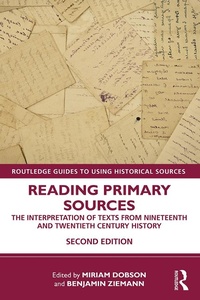
Reading Primary Sources
The Interpretation of Texts from Nineteenth and Twentieth Century History
2nd Edition
Published on 1. June 2020
304 pages
978-0-429-68731-0 (ISBN)
Description

Now in its second edition, Reading Primary Sources explores the varied traditions in source criticism and, through specific examples, illustrates how primary sources can be read and used in historical research.
Part I of this two-part volume begins by establishing the reader's understanding of source criticism with an overview of both traditional and new methodological approaches to the use of primary documents. Taking into account the huge expansion in the range of primary sources used by historians, Part II includes chapters on surveillance reports, testimony and court files, in addition to more traditional genres such as letters, memoranda, diaries, novels, newspapers, political speeches and autobiography. For the new edition, each chapter now includes a checklist that suggests an easy-to-follow sequence of steps for interpreting a specific source genre, enabling students to understand how the sources should be read, what they have to offer, and the pitfalls of their interpretation. In addition to new discussions about the availability of digitised source materials, a new chapter on social surveys unlocks the potential of these widely used primary sources.
Taking examples of sources from many European countries and the United States, and providing up-to-date information on the most widely used textual sources, this book is the perfect companion for every student of history who wants to engage with primary sources.
Part I of this two-part volume begins by establishing the reader's understanding of source criticism with an overview of both traditional and new methodological approaches to the use of primary documents. Taking into account the huge expansion in the range of primary sources used by historians, Part II includes chapters on surveillance reports, testimony and court files, in addition to more traditional genres such as letters, memoranda, diaries, novels, newspapers, political speeches and autobiography. For the new edition, each chapter now includes a checklist that suggests an easy-to-follow sequence of steps for interpreting a specific source genre, enabling students to understand how the sources should be read, what they have to offer, and the pitfalls of their interpretation. In addition to new discussions about the availability of digitised source materials, a new chapter on social surveys unlocks the potential of these widely used primary sources.
Taking examples of sources from many European countries and the United States, and providing up-to-date information on the most widely used textual sources, this book is the perfect companion for every student of history who wants to engage with primary sources.
More details
Series
Edition
2nd edition
Language
English
Place of publication
London
United Kingdom
Publishing group
Taylor & Francis Ltd
Target group
College/higher education
Illustrations
1 Halftones, black and white
ISBN-13
978-0-429-68731-0 (9780429687310)
Copyright in bibliographic data and cover images is held by Nielsen Book Services Limited or by the publishers or by their respective licensors: all rights reserved.
Schweitzer Classification
Other editions
Additional editions
Miriam Dobson | Benjamin Ziemann
Reading Primary Sources
The Interpretation of Texts from Nineteenth and Twentieth Century History
Book
06/2020
2nd Edition
Routledge
€206.80
Shipment within 10-20 days
Miriam Dobson | Benjamin Ziemann
Reading Primary Sources
The Interpretation of Texts from Nineteenth and Twentieth Century History
Book
06/2020
2nd Edition
Routledge
€61.70
Shipment within 10-20 days
Persons
Miriam Dobson is Reader in Modern History at the University of Sheffield. Her first book Khrushchev's Cold Summer: Gulag Returnees, Crime, and the Fate of Reform after Stalin was published in 2009 and she is currently completing a monograph, provisionally entitled Unorthodox Communities in the Cold War: Protestants, Secularisation, and Soviet Atheism, 1945-1985.
Benjamin Ziemann is Professor of Modern German History at the University of Sheffield. His most recent publications include Contested Commemorations: Republican War Veterans and Weimar Political Culture (2013) and Violence and the German Soldier in the Great War: Killing, Dying, Surviving (2017).
Benjamin Ziemann is Professor of Modern German History at the University of Sheffield. His most recent publications include Contested Commemorations: Republican War Veterans and Weimar Political Culture (2013) and Violence and the German Soldier in the Great War: Killing, Dying, Surviving (2017).
Content
Part 1: Reading primary sources: contexts and approaches 1. Understanding history: hermeneutics and source-criticism in historical scholarship 2. Reading tests after the linguistic turn: approaches from literary studies and their implications Part 2: Varieties of primary sources and their interpretation 3. Letters 4. Surveillance reports 5. Court files 6. Social surveys 7. Memoranda 8. Diaries 9. Novels 10. Autobiography 11. Newspapers 12. Speeches 13. Testimony
