

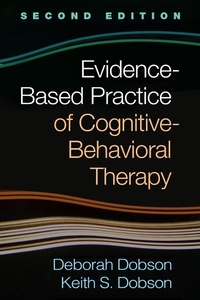
Evidence-Based Practice of Cognitive-Behavioral Therapy
2nd Edition
Published on 31. October 2016
354 pages
978-1-4625-2847-9 (ISBN)
Description

Clinical psychologists, psychiatrists, clinical social workers, counselors, and psychiatric nurses; graduate students and trainees. Serves as a supplemental text in graduate-level courses.
More details
Other editions
Additional editions
Deborah Dobson | Keith S. Dobson
Evidence-Based Practice of Cognitive-Behavioral Therapy, Second Edition
Book
08/2018
2nd Edition
Guilford Press
€39.00
Shipment within 15-20 days
Deborah Dobson | Keith S. Dobson
Evidence-Based Practice of Cognitive-Behavioral Therapy, Second Edition
Book
01/2017
2nd Edition
Guilford Press
€66.00
Shipment within 15-20 days
Persons
Deborah Dobson, PhD, is a psychologist in private practice in Calgary, Alberta, Canada, and Adjunct Professor in the Department of Psychology at the University of Calgary. She has served as Director of Clinical Training for the Calgary Clinical Psychology Residency program and began the first certificate program in CBT in Western Canada in 2014. Dr. Dobson served on the Board of Directors of the Canadian Association of Cognitive and Behavioural Therapies from 2010 to 2016. She is a recipient of the Governor General's Caring Canadian Award for her advocacy work with the Canadian Mental Health Association-Calgary Region. Dr. Dobson's professional interests include client advocacy and access to empirically supported treatments, clinical training and supervision, and CBT for anxiety disorders.
Keith S. Dobson, PhD, is Professor of Clinical Psychology at the University of Calgary, Alberta, Canada, and a Principal Investigator for the Opening Minds program of the Mental Health Commission of Canada, with a focus on stigma reduction in the workplace. His research has focused on both cognitive models and CBT for depression. Dr. Dobson has published over 230 articles and chapters, 13 books, two DVDs, and one DVD series. He is a past president of the Canadian Psychological Association, the Academy of Cognitive and Behavioral Therapies, and the International Association for Cognitive Psychotherapy. Dr. Dobson is a recipient of the Award for Distinguished Contributions to the Profession of Psychology and the Donald O. Hebb Award for Distinguished Contributions to the Science of Psychology from the Canadian Psychological Association, among other honors.
Content
1. Introduction and the Context of Cognitive-Behavioral Interventions
2. Assessment for Cognitive-Behavioral Therapy
3. Integration and Case Formulation
4. Setting the Stage for Cognitive-Behavioral Therapy through Building Alliance and Planning Ahead
5. Beginning Treatment: Structuring Cognitive-Behavioral Therapy
6. Behavioral Work: Increasing Skills
7. Behavioral Work: Decreasing Avoidance
8. Cognitive Work: Identifying Targets
9. Cognitive Work: Addressing Negative Thinking
10. Cognitive Work: Working with Core Beliefs and Schemas
11. Completion of Treatment and Prevention of Relapse
12. Challenges in Conducting Cognitive-Behavioral Therapy
13. The Research Context of Cognitive-Behavioral Therapy
Appendix A. The Cognitive Therapy Scale
Appendix B. Review Articles Regarding the Efficacy of Cognitive-Behavioral Therapy
2. Assessment for Cognitive-Behavioral Therapy
3. Integration and Case Formulation
4. Setting the Stage for Cognitive-Behavioral Therapy through Building Alliance and Planning Ahead
5. Beginning Treatment: Structuring Cognitive-Behavioral Therapy
6. Behavioral Work: Increasing Skills
7. Behavioral Work: Decreasing Avoidance
8. Cognitive Work: Identifying Targets
9. Cognitive Work: Addressing Negative Thinking
10. Cognitive Work: Working with Core Beliefs and Schemas
11. Completion of Treatment and Prevention of Relapse
12. Challenges in Conducting Cognitive-Behavioral Therapy
13. The Research Context of Cognitive-Behavioral Therapy
Appendix A. The Cognitive Therapy Scale
Appendix B. Review Articles Regarding the Efficacy of Cognitive-Behavioral Therapy
