

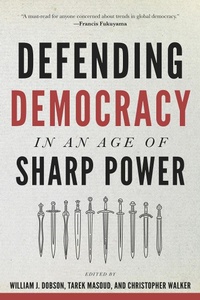
Defending Democracy in an Age of Sharp Power
Published on 25. July 2023
232 pages
978-1-4214-4805-3 (ISBN)
Description

Explores how authoritarian regimes are deploying "sharp power" to undermine democracies from within by weaponizing universities, institutions, media, technology, and entertainment industries.
The world's dictators are no longer content with shoring up control over their own populations-they are now exploiting the openness of the free world to spread disinformation, sow discord, and suppress dissent. In Defending Democracy in an Age of Sharp Power, editors William J. Dobson, Tarek Masoud, and Christopher Walker bring together leading analysts to explain how the world's authoritarians are attempting to erode the pillars of democratic societies-and what we can do about it.
Popular media, entertainment industries, universities, the tech world, and even critical political institutions are being manipulated by dictators who advance their regimes' interests by weakening democracies from within. Autocrats' use of "sharp power" constitutes one of the gravest threats to liberal, representative government today. The optimistic, early twenty-first-century narrative of how globalization, the spread of the internet, and the rise of social media would lead to liberalization everywhere is now giving way to the realization that these same forces provide inroads to those wishing to snuff out democracy at the source. And while autocrats can do much to wall their societies off from democratic and liberal influences, free societies have not yet fully grasped how they can resist the threat of sharp power while preserving their fundamental openness and freedom.
Far from offering a counsel of despair, the international contributors in this collection identify the considerable resources that democracy provides for blunting sharp power's edge. With careful case studies of successful resistance efforts in such countries as Australia, the Czech Republic, and Taiwan, this book offers an urgent message for anyone concerned with the defense of democracy in the twenty-first century.
Contributors: Ketty W. Chen, Sarah Cook, William J. Dobson, John Fitzgerald, Martin Hála, Samantha Hoffman, Aynne Kokas, Edward Lucas, Tarek Masoud, Nadège Rolland, Ruslan Stefanov, Glenn Tiffert, Martin Vladimirov, Christopher Walker
The world's dictators are no longer content with shoring up control over their own populations-they are now exploiting the openness of the free world to spread disinformation, sow discord, and suppress dissent. In Defending Democracy in an Age of Sharp Power, editors William J. Dobson, Tarek Masoud, and Christopher Walker bring together leading analysts to explain how the world's authoritarians are attempting to erode the pillars of democratic societies-and what we can do about it.
Popular media, entertainment industries, universities, the tech world, and even critical political institutions are being manipulated by dictators who advance their regimes' interests by weakening democracies from within. Autocrats' use of "sharp power" constitutes one of the gravest threats to liberal, representative government today. The optimistic, early twenty-first-century narrative of how globalization, the spread of the internet, and the rise of social media would lead to liberalization everywhere is now giving way to the realization that these same forces provide inroads to those wishing to snuff out democracy at the source. And while autocrats can do much to wall their societies off from democratic and liberal influences, free societies have not yet fully grasped how they can resist the threat of sharp power while preserving their fundamental openness and freedom.
Far from offering a counsel of despair, the international contributors in this collection identify the considerable resources that democracy provides for blunting sharp power's edge. With careful case studies of successful resistance efforts in such countries as Australia, the Czech Republic, and Taiwan, this book offers an urgent message for anyone concerned with the defense of democracy in the twenty-first century.
Contributors: Ketty W. Chen, Sarah Cook, William J. Dobson, John Fitzgerald, Martin Hála, Samantha Hoffman, Aynne Kokas, Edward Lucas, Tarek Masoud, Nadège Rolland, Ruslan Stefanov, Glenn Tiffert, Martin Vladimirov, Christopher Walker
More details
Series
Language
English
Place of publication
Baltimore
United States
Target group
Professional and scholarly
File size
1,66 MB
ISBN-13
978-1-4214-4805-3 (9781421448053)
DOI
10.56021/9781421448046
Copyright in bibliographic data and cover images is held by Nielsen Book Services Limited or by the publishers or by their respective licensors: all rights reserved.
Schweitzer Classification
Other editions
Additional editions
William J. Dobson | Tarek Masoud | Christopher Walker
Defending Democracy in an Age of Sharp Power
Book
07/2023
Johns Hopkins University Press
€33.43
Shipment within 10-20 days
Persons
William J. Dobson is a coeditor of the Journal of Democracy and the author of The Dictator's Learning Curve: Inside the Global Battle for Democracy. He previously served as the Chief International Editor at NPR, the Washington Bureau Chief of Slate magazine, and Managing Editor of Foreign Policy. Tarek Masoud is the Ford Foundation Professor of Democracy and Governance at Harvard University's John F. Kennedy School of Government and a coeditor of the Journal of Democracy. Christopher Walker is Vice President for Studies and Analysis at the National Endowment for Democracy. He is a coeditor of Authoritarianism Goes Global: The Challenge to Democracy and Sharp Power: Rising Authoritarian Influence.
Content
- Cover
- Half Title
- Title
- Copyright
- Contents
- Acknowledgments
- Introduction
- Part One: Grasping Sharp Power
- 1 The Authoritarian Assault on Knowledge
- 2 How Autocrats Undermine Media Freedom
- 3 How Beijing Runs the Show in Hollywood
- 4 The Kremlin Playbook for Latin America
- 5 China's Tech-Enhanced Authoritarianism
- 6 China's Pandemic Power Play
- Part Two: Blunting Sharp Power's Edge
- 7 Transparency Wins in Europe
- 8 Taiwan's Democracy Under Fire
- 9 How Australia's Civil Society Led the Way
- 10 Countering Beijing's Media Manipulation
- 11 Conclusion: Sharp Power and the Threat to Democracy
- About the Authors
- Index
- A
- B
- C
- D
- E
- F
- G
- H
- I
- J
- K
- L
- M
- N
- O
- P
- Q
- R
- S
- T
- U
- V
- W
- X
- Y
- Z
