

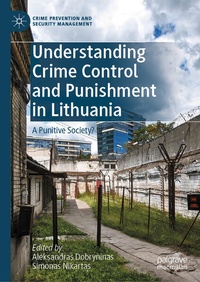
Understanding Crime Control and Punishment in Lithuania
Description

This edited book provides a comprehensive study of punitive practices in modern-day Lithuania, highlighting its significance as a democratic European state navigating the continuing consequences of its Soviet-era criminal justice system. Punitive attitudes and practices are explored through a thematic framework, examining their socio-political, cultural, and historical contexts. Part I traces the cultural, psychological, and historical origins of punishment, highlighting the influence of collective memory and transitional reforms on penal debates. Part II examines the uneven application of criminal justice, showing how it unfairly punishes marginalised and disadvantaged communities. Part III explores advancements in probation, imprisonment, crime prevention, and victim support, showing how reforms can become both symbolic and oppressive. The book offers various criminological viewpoints that contribute to policy discussions about reducing excessive punishment, exploring alternatives, and promoting meaningful justice reform. This vital resource supports the work of scholars in criminology, sociology, law, and related fields focused on social justice and democratic reform.
More details
Other editions
Additional editions
Persons
Aleksandras Dobryninas is Professor of Sociology at the Department of Criminology at the Institute of Sociology and Social Work, Faculty of Philosophy, Vilnius University, Lithuania.
Simonas Nikartas is Associate Professor at the Department of Criminology at the Institute of Sociology and Social Work, Faculty of Philosophy, Vilnius University, Lithuania.
Content
Chapter 1. Lithuania As A Punitive Society: An Introduction (Aleksandras Dobryninas And Simonas Nikartas).- Part I: Understanding Punitiveness.- Chapter 2. Psychology Of Punishment: Why Do We Punish Others? (Kristina Vanagaite And Violeta Cimalanskaite-Kazlauskiene).- Chapter 3. The Social And Cultural Context Of Punitiveness In Lithuania (Ausra Pociene).- Chapter 4. Lessons From The Abolition Of The Death Penalty In Lithuania: Looking Through A Kaleidoscope Of Professional, Political And Public Discourses (Aleksandras Dobryninas).- Chapter 5. Punitive Thinking In Different Times And Generations (Laima Zilinskiene).- Chapter 6. Punitive Attitudes Toward Difference: Bullying Perception In The 1980-2000 Generation (Goda Damaseviciute And Jovita Zekaite-Maconko).- Part II: Suitable Punishable Subjects.- Chapter 7. Disciplining The Poor: The Politics Of Responsibilizing The UnderclassInLithuania (Arunas Poviliunas And Arunas Juska).- Chapter 8. Technology And Future Trajectories Of Punitivity: Lessons Learned From Selective Persecution Of Online Offenders In Lithuania (Maryja Supa, Vytautas Kaktinas And Egle Stankeviciute).- Chapter 9. Punishing Drug Users? A Sight At Lithuanian Drug Control Policy (Mindaugas Lankauskas).- Chapter 10. Female Offender: Doubly Deviant And Hounded By The Media (Rimante Gaicevskyte).- Part III: Institutional Punitiveness.- Chapter 11. A Reform Again? Explaining Reorganisation Processes And Perspectives Of Imprisonment In Lithuania (Jolanta Alekneviciene).- Chapter 12. A Prison Without Bars: Prisonisation Of Probation Through Intensive Supervision In Lithuania (Simonas Nikartas, Loreta Mataciute And Neila Sventickyte).- Chapter 13. Crime Prevention And Victim Support: New Actors In The Field Of Criminal Justice (Algimantas Cepas).
