

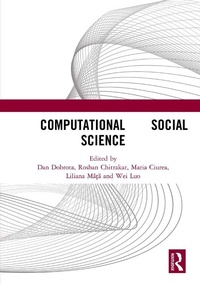
Computational Social Science
Proceedings of the 2nd International Conference on New Computational Social Science (ICNCSS 2021), October 15-17, 2021, Suzhou, Jiangsu, China
1st Edition
Published on 1. July 2022
282 pages
978-1-000-62862-3 (ISBN)
Description

The proceedings publish selected papers from the 2nd International Conference on New Computational Social Science, focusing on the following five aspects: Big data acquisition and analysis, Integration of qualitative research and quantitative research, Sociological Internet experiment research, Application of ABM simulation method in Sociology Research, Research and development of new social computing tools.
With the rapid development of information technology, especially sweeping progress in the Internet of things, cloud computing, social networks, social media and big data, social computing, as a data-intensive science, is an emerging field that leverages the capacity to collect and analyze data with an unprecedented breadth, depth and scale. It represents a new computing paradigm and an interdisciplinary field of research and application. A broad comprehension of major topics involved in social computing is important for both scholars and practitioners. This proceedings presents and discusses key concepts and analyzes the state-of-the-art of the field. The conference not only gave insights on social computing, but also affords conduit for future research in the field. Social computing has two distinct trends: One is on the social science issues, such as computational social science, computational sociology, social network analysis, etc; the other is on the use of computational techniques. Finally, some new challenges ahead are summarized, including interdisciplinary cooperation and training, big data sharing for scientific data mashups, and privacy protect.
With the rapid development of information technology, especially sweeping progress in the Internet of things, cloud computing, social networks, social media and big data, social computing, as a data-intensive science, is an emerging field that leverages the capacity to collect and analyze data with an unprecedented breadth, depth and scale. It represents a new computing paradigm and an interdisciplinary field of research and application. A broad comprehension of major topics involved in social computing is important for both scholars and practitioners. This proceedings presents and discusses key concepts and analyzes the state-of-the-art of the field. The conference not only gave insights on social computing, but also affords conduit for future research in the field. Social computing has two distinct trends: One is on the social science issues, such as computational social science, computational sociology, social network analysis, etc; the other is on the use of computational techniques. Finally, some new challenges ahead are summarized, including interdisciplinary cooperation and training, big data sharing for scientific data mashups, and privacy protect.
More details
Edition
1. Auflage
Language
English
Place of publication
London
United Kingdom
Publishing group
Taylor & Francis Ltd
Target group
College/higher education
Professional and scholarly
Product notice
Reflowable
Illustrations
62 Tables, black and white; 250 Illustrations, black and white
ISBN-13
978-1-000-62862-3 (9781000628623)
Copyright in bibliographic data and cover images is held by Nielsen Book Services Limited or by the publishers or by their respective licensors: all rights reserved.
Schweitzer Classification
Other editions
Additional editions
Dan Dobrota | Roshan Chitrakar | Maria Ciurea
Computational Social Science
Proceedings of the 2nd International Conference on New Computational Social Science (ICNCSS 2021), October 15-17, 2021, Suzhou, Jiangsu, China
Book
07/2022
1st Edition
Routledge
€206.60
Shipment within 10-20 days
Persons
Dan Dobrota is a Professor at Lucian Blaga University of Sibiu, Romania. He obtained his undergraduate degree in Machine Building Technology (1994) from University of Craiova, Romania. He received his Ph.D. in Technology of Materials field from the University of Craiova, Romania, in 1998. Also, I obtained another undergraduate degree in Finance and Assurance, at Constantin Brancusi University of Targu Jiu, Romania (2004). In year 2013 I supported the habilitation thesis at Polytechnic University of Bucharest in Industrial Engineering domain. I was promoted to Full Professor in 2007. I have published over 117 scientific articles, among which over 60 in international journals indexed Web of Science. I am reviewer for 22 Web of Science indexed journals (Journal of Cleaner Production, Materials, Polymers, etc.), 5 of which are rated Q1. I am the author of 32 books, one of which is published by the international publishing house LAMBERT. I was editor of the special volume "Design of Welded Steel Structures" of the journal Metals indexed Web of Science and now, of the special volume of the journal "Materials" entitled "Ecodesign for Composite Materials and Products" (classified Q1).
Roshan Chitrakar, born in 1967 A.D., has earned the Doctor of Engineering in Information Security from Wuhan University, China in 2015 A.D.. He started his career as a Mainframe Computer Operator at National Computer Center (NCC), Nepal in 1987 and entered the field of academics and research in the year 2004 A.D.. At present, he is an Associate Professor at Nepal College of Information Technology affiliated to Pokhara University, Nepal. He has been serving as (Chief- / Co-) Editor in a few journals and as Reviewer / TPC Member in many journals and conferences. He has published few dozens of research and review papers; a few books and book chapters; and a few articles too. He has been decorated by the President of Nepal with "Nepal Vidya Bhusan" of category "A" award (the highest award in education field) for achieving the PhD and "Nepal Vidya Bhusan" of category "B" (the second highest award in education field) for standing the top position in Master of Science in Computer Science in the year 2016 A.D. His main areas of interest include Computer Security, Data Warehousing and Mining, Real-Time and Embedded Systems, Databases and Software Engineering, Programming etc.
CIUREA Maria is an Associate Professor in University of Petrosani, Petrosani, ROMANIA. She is Carrying out teaching and research activities in the field of economic science. Her current main activity is teaching university courses and conducting seminars in the following disciplines: General Economic Theory, Basics of Economics, International Business Globalization, Public Accounting, Budget and public treasury, International Public Sector Accounting Standards (IPSAS), Scientific research methodology. Her main responsibilities are Coordinating bachelor and dissertation papers, Elaboration of scientific research papers, Participation in the teams for development and implementation of some research and development projects. She has rich academic experience of over 30 years. She has published more than 100 papers as Author or co-author in ISI journals, ISI Proceeding, International databases, participations in international conference. She also is the member of scientific committees in our journals and other prestigious international journals.
Liliana Mata is Ph.D. in Educational Sciences and Associate Professor at Teacher Training Department of "Vasile Alecsandri" University of Bacau, Romania. Recently, the most important scientific contribution was to investigate of the factors of ethical use of information technology in higher education. From 2010 to present she was involved as a research expert in national and international educational projects on topics of current interest: the introduction of the curricular innovations in the teacher training programme from primary school and preschool education; the development of the pedagogical competencies of teachers of Romanian language and communication through initial training programmes for teachers. She has published books, book chapters and articles in international journals on current issues in the domain of Educational Sciences: teacher education, curricular innovations, inclusive education, ethical use of information technology. One of the most recent coordinated volumes is "Ethical Use of Information Technology in Higher Education", published at Springer in 2021.
Wei Luo is presently working as a Professor, School of Finance and economics, Nanchang Institute of Technology, Nanchang, China. He got his Bachelor Degree from Optical Information Engineering in Huazhong University of Science and Technology in China. After completion of Graduate Degree from Huazhong University of Science and Technology, he got himself admitted to M.A. in Sociology at Wuhan University in China. And then, he done his research work leading to Ph.D. He was a Economic Sociology Doctor of Wuhan University and California Davis joint training. He was also a Finance postdoctoral in Tsinghua University. These Three University are all the famous university in China. His main research interests are computational sociology methods and technologies, trust and credit research, block chain sociology, market value management research of listed companies, transformation research of China Urban Investment Corporation. He published one paper which was titled as "New Computational Sociology: Sociological studies in the era of big data" on CSSCI journal "Sociological STUDIES". That was the first time to put forward the concept of "New Computational Sociology" in China.
Roshan Chitrakar, born in 1967 A.D., has earned the Doctor of Engineering in Information Security from Wuhan University, China in 2015 A.D.. He started his career as a Mainframe Computer Operator at National Computer Center (NCC), Nepal in 1987 and entered the field of academics and research in the year 2004 A.D.. At present, he is an Associate Professor at Nepal College of Information Technology affiliated to Pokhara University, Nepal. He has been serving as (Chief- / Co-) Editor in a few journals and as Reviewer / TPC Member in many journals and conferences. He has published few dozens of research and review papers; a few books and book chapters; and a few articles too. He has been decorated by the President of Nepal with "Nepal Vidya Bhusan" of category "A" award (the highest award in education field) for achieving the PhD and "Nepal Vidya Bhusan" of category "B" (the second highest award in education field) for standing the top position in Master of Science in Computer Science in the year 2016 A.D. His main areas of interest include Computer Security, Data Warehousing and Mining, Real-Time and Embedded Systems, Databases and Software Engineering, Programming etc.
CIUREA Maria is an Associate Professor in University of Petrosani, Petrosani, ROMANIA. She is Carrying out teaching and research activities in the field of economic science. Her current main activity is teaching university courses and conducting seminars in the following disciplines: General Economic Theory, Basics of Economics, International Business Globalization, Public Accounting, Budget and public treasury, International Public Sector Accounting Standards (IPSAS), Scientific research methodology. Her main responsibilities are Coordinating bachelor and dissertation papers, Elaboration of scientific research papers, Participation in the teams for development and implementation of some research and development projects. She has rich academic experience of over 30 years. She has published more than 100 papers as Author or co-author in ISI journals, ISI Proceeding, International databases, participations in international conference. She also is the member of scientific committees in our journals and other prestigious international journals.
Liliana Mata is Ph.D. in Educational Sciences and Associate Professor at Teacher Training Department of "Vasile Alecsandri" University of Bacau, Romania. Recently, the most important scientific contribution was to investigate of the factors of ethical use of information technology in higher education. From 2010 to present she was involved as a research expert in national and international educational projects on topics of current interest: the introduction of the curricular innovations in the teacher training programme from primary school and preschool education; the development of the pedagogical competencies of teachers of Romanian language and communication through initial training programmes for teachers. She has published books, book chapters and articles in international journals on current issues in the domain of Educational Sciences: teacher education, curricular innovations, inclusive education, ethical use of information technology. One of the most recent coordinated volumes is "Ethical Use of Information Technology in Higher Education", published at Springer in 2021.
Wei Luo is presently working as a Professor, School of Finance and economics, Nanchang Institute of Technology, Nanchang, China. He got his Bachelor Degree from Optical Information Engineering in Huazhong University of Science and Technology in China. After completion of Graduate Degree from Huazhong University of Science and Technology, he got himself admitted to M.A. in Sociology at Wuhan University in China. And then, he done his research work leading to Ph.D. He was a Economic Sociology Doctor of Wuhan University and California Davis joint training. He was also a Finance postdoctoral in Tsinghua University. These Three University are all the famous university in China. His main research interests are computational sociology methods and technologies, trust and credit research, block chain sociology, market value management research of listed companies, transformation research of China Urban Investment Corporation. He published one paper which was titled as "New Computational Sociology: Sociological studies in the era of big data" on CSSCI journal "Sociological STUDIES". That was the first time to put forward the concept of "New Computational Sociology" in China.
Content
1. Big data acquisition and analysis
2. Integration of qualitative research and quantitative research
3. Cultural Studies and Humanities
4. Law and Education
5. Management and Economics
2. Integration of qualitative research and quantitative research
3. Cultural Studies and Humanities
4. Law and Education
5. Management and Economics
