

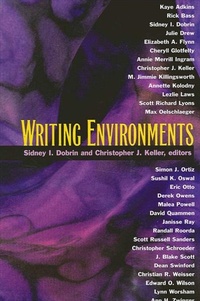
Writing Environments
Published on 1. February 2012
389 pages
978-0-7914-8389-3 (ISBN)
Description

Including interviews with several of America's leading environmental writers, this volume addresses the intersections between writing and nature.
Writing Environments addresses the intersections between writing and nature through interviews with some of America's leading environmental writers. Those interviewed include Rick Bass, Cheryll Glotfelty, Annette Kolodny, Max Oelschlaeger, Simon J. Ortiz, David Quammen, Janisse Ray, Scott Russell Sanders, Edward O. Wilson, and Ann H. Zwinger. From the standpoints of activists, scientists, naturalists, teachers, and highly visible writers, the interviewees consider how different environments have influenced them, how their writing affects environments, and the ways readers experience environments. The interviews are followed by critical responses from writing scholars. This diverse range of voices speaks lucidly and captivatingly about topics such as place, writing, teaching, politics, race, and culture, and how these overlap in many complex ways.
Sidney I. Dobrin is Associate Professor of English and Director of Writing Programs at the University of Florida. He has published many books, including (with Christian R. Weisser) Natural Discourse: Toward Ecocomposition, also published by SUNY Press. Christopher J. Keller is Assistant Professor of English at the University of Texas-Pan American.
Writing Environments addresses the intersections between writing and nature through interviews with some of America's leading environmental writers. Those interviewed include Rick Bass, Cheryll Glotfelty, Annette Kolodny, Max Oelschlaeger, Simon J. Ortiz, David Quammen, Janisse Ray, Scott Russell Sanders, Edward O. Wilson, and Ann H. Zwinger. From the standpoints of activists, scientists, naturalists, teachers, and highly visible writers, the interviewees consider how different environments have influenced them, how their writing affects environments, and the ways readers experience environments. The interviews are followed by critical responses from writing scholars. This diverse range of voices speaks lucidly and captivatingly about topics such as place, writing, teaching, politics, race, and culture, and how these overlap in many complex ways.
Sidney I. Dobrin is Associate Professor of English and Director of Writing Programs at the University of Florida. He has published many books, including (with Christian R. Weisser) Natural Discourse: Toward Ecocomposition, also published by SUNY Press. Christopher J. Keller is Assistant Professor of English at the University of Texas-Pan American.
More details
Other editions
Additional editions
Sidney I. Dobrin | Christopher J. Keller
Writing Environments
Book
02/2005
State University of New York Press
€96.00
Shipment within 10-20 days
Sidney I. Dobrin | Christopher J. Keller
Writing Environments
Book
02/2005
State University of New York Press
€36.00
Shipment within 10-20 days
Persons
Sidney I. Dobrin is Associate Professor of English and Director of Writing Programs at the University of Florida. He has published many books, including (with Christian R. Weisser) Natural Discourse: Toward Ecocomposition, also published by SUNY Press. Christopher J. Keller is Assistant Professor of English at the University of Texas-Pan American.
Content
Acknowledgments
Why Writing Environments: An Introduction
Sidney I. Dobrin and Christopher J. Keller
Taking Back the Language: An Interview with Annette Kolodny
Where Writing Takes Place: A Response to Annette KolodnyWriting Activism: An Interview with Rick Bass
Lynn Worsham
Developing Feminist-Environmental Rhetorics: A Response to Annette Kolodny
Elizabeth A. Flynn
Response to Flynn and Worsham
Annette Kolodny
Avenues of Activism: A Response to Rick BassWriting Nature, Making Connections: An Interview with David Quammen
Christian R. Weisser
The Active Voice
Sid Dobrin
Natural Diversity: A Response to David QuammenWriting with Intent: An Interview with Janisse Ray
Christopher Schroeder
Of Gardens and Classrooms, Plants and Discourse: A Response to David Quammen
Christopher J. Keller
Making Arguments: A Response to Janisse RayThe Quest for Truth: An Interview with Max Oelschlaeger
Julie Drew
Ecocomposition, Activist Writing, and Natural Ecosystems: A Response to Janisse Ray
Eric Otto
Mapping Babel: A Response to Max OelschlaegerWriting the Native American Life: An Interview with Simon Ortiz
M. Jimmie Killingsworth
In Response to Max Oelschlaeger
Derek Owens
A Reconsideration of Wild Discourse: Response to Killingsworth and Owens
Max Oelschlaeger
Rethinking Responsibility: A Response to Simon OrtizStories for the Earth: An Interview with Scott Russell Sanders
Scott Richard Lyons
Dear Simon: A Response to Simon Ortiz
Malea Powell
The Grounded Voice: A Response to Scott Russell SandersEcocriticism, Writing, and Academia: An Interview with Cheryll Glotfelty
Lezlie Laws
One Tribe among the Host of Living Tribes: A Response to Scott Russell Sanders
Sushil K. Oswal
Writing, Nature, and Composing Bridges: A Response to Cheryll GlotfeltyWriting Natural History: An Interview with Ann Zwinger
Kaye Adkins
Where the Fusang Grows: A Response to Cheryll Glotfelty
Dean Swinford
Response to Adkins and Swinford
Cheryll Glotfelty
Rambling: A Response to Ann ZwingerWriting the Scientific Life: An Interview with Edward O. Wilson
Randall Roorda
The Mud Puddle and the Rose: A Response to Ann Zwinger
Annie Merrill Ingram
Response to Roorda and Ingram
Ann Zwinger
Contradictory Stances toward Interdisciplinarity: A Response to E. O. Wilson from a Rhetorician of ScienceContributors
J. Blake Scott
Science, the Humanities, and the Public Intellectual: A Response to E. O. Wilson
Christian R. Weisser
Index
