

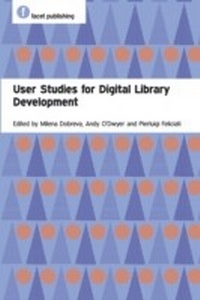
User Studies for Digital Library Development
Description

This landmark text captures a global cross-section of leading voices and provides a clear and coherent overview of the user studies domain and user issues in digital libraries.
As the information environment becomes increasingly electronic, digital libraries have proliferated, but the focus has often been on innovations in technology and not the user. Although user needs have become a popular concept, in practice the users are rarely consulted in the development of services. Research and analysis of users is essential to fine-tune the content and approach of digital libraries to the diverging requirements and expectations of incredibly varied communities and to ensure libraries are effective, accessible and sustainable in the long term.
Key topics include:
- what is the place of user studies in digital libraries and what are the basic user study methods?
- explaining user-centric studies, information behaviour and user experience studies
- exploring user-study methods such as surveys, questionnaires, expert evaluation methods, eye tracking, deep log analysis, personae and ethnographic studies
- critical issues around user studies such as evaluation of digital libraries, digital preservation, social media, the shift to mobile devices and ethics
- user studies in specific types of institutions: libraries, archives, museums, audiovisual collections and art collections
- the most popular questions and what to do next.
Readership: Information professionals involved in supporting, developing or designing digital library services, researchers wanting to address the user dimension in their work and students on LIS and computer science courses who want to understand the importance of the user in information services.
All prices
More details
Other editions
Additional editions
Persons
Dr Milena Dobreva is Senior Lecturer in the Department of Library Information and Archive Sciences at the University of Malta. She managed the DiSCmap project on user priorities in digitisation of special collections and coordinated the Europeana user and functionality study.
Andy O'Dwyer has been with the BBC since 1986 applying technical solutions to the long term preservation of broadcast material. He has managed several European collaborative projects providing online access to parts of the BBC's newly digitized content.
Pierluigi Feliciati is a Researcher in the University of Macerata, Italy.
Content
Preface - Tom Wilson 1. Introduction: user studies for digital library development - Milena Dobreva, Andy O'Dwyer and Pierluigi Feliciati
PART 1: SETTING THE SCENE
2. Models that inform digital library design - Elaine G Toms 3. User-centric studies - Sudatta Chowdhury 4. Design issues and user needs - Petar Mihaylov 5. Users within the evaluation of digital libraries - Giannis Tsakonas
PART 2: METHODS EXPLAINED AND ILLUSTRATED
6. Questionnaires, interviews and focus groups as means for user engagement with evaluation of digital libraries - Jillian R Griffiths 7. Expert evaluation methods - Claus-Peter Klas 8. Evidence of user behaviour: deep log analysis - David Nicholas and David Clark 9. An eye-tracking approach to the evaluation of digital libraries - Panos Balatsoukas 10 Personas - Katja Guldbæk Rasmussen and Gitte Petersen
PART 3: USER STUDIES IN THE DIGITAL LIBRARY UNIVERSE: WHAT ELSE NEEDS TO BE CONSIDERED?
11. User-related issues in multilingual access to multimedia collections - Paul Clough 12. Children and digital libraries - Ian Ruthven, Monica Landoni and Andreas Lingnau 13. User engagement and social media - Jeffery K Guin 14. Significant others: user studies and digital preservation - Kathleen Menzies and Duncan Birrell 15. The shift to mobile devices - Lina Petrakieva 16. Resource discovery for research and course design - Zsuzsanna Varga 17. Support for users within an educational or e-learning context - Nicola OsbornePART 4: USER STUDIES ACROSS THE CULTURAL HERITAGE SECTOR
18. User studies in libraries - Derek Law 19. User studies in archives - Wendy M Duff 20. User studies in museums: holding the museum in the palm of your hand - Susan Hazan 21. Digital art online: perspectives on user needs, access, documentation and retrieval - Leo Konstantelos 22. User studies for digital libraries' development: audiovisual collections - Andy O'Dwyer 23. A business-model perspective on end-users and open metadata - Harry Verwayen and Martijn Arnoldus
PART 5: PUTTING IT ALL TOGETHER
24. And now ... to the brave real world - Milena Dobreva, Andy O'Dwyer and Pierluigi Feliciati
