

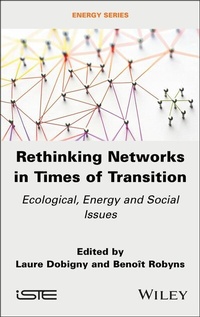
Rethinking Networks in Times of Transition
Description

The contemporary world is characterized by the interweaving of various networks, including biological, ecological, social, technological and energy-related networks. We are constantly engaged in interactions with these networks. In the context of energy and ecological and social transitions, it is essential to examine the positive or negative effects of these interactions. Additionally, it is crucial to explore the influence of the growing role that networks will play and the open or closed futures they will shape.
To address these issues, a multidisciplinary approach is essential, particularly between the technological sciences, humanities and life sciences. Rethinking Networks in Times of Transition analyzes and discusses four major themes: ecological networks in biodiversity and ecological transition; socio-technical changes related to energy networks; how social and controversy networks are transforming lifestyles, representations and modes of action; and finally, how academic networks can play a leading role in the transition
More details
Other editions
Additional editions
Persons
Laure Dobigny is Associate Professor in socio-anthropology of technology at the ETHICS Laboratory (ETH+ research team) at the Universite Catholique de Lille, France.
Benoît Robyns is Deputy Director of Research at JUNIA (Lille), Vice-President for Energy and Societal Transition at Universite Catholique de Lille, and a member of the Power Systems Team at L2EP, France.
Content
Introduction xvii Laure DOBIGNY, Sadia BENAMROUZ-VANNESTE and Benoît ROBYNS
Part 1 Ecological Networks 1
Chapter 1 Climate Crisis, Invasive Species and Biodiversity Collapse: Issues, Challenges and Opportunities for Macrophytes 3 Rossano BOLPAGNI
1.1 Introduction 3
1.2 The world of macrophytes 4
1.3 Macrophytes as engineering species 7
1.4 Macrophytes, the climate crisis and biological invasions 9
1.5 Macrophytes as nature-based solutions 12
1.6 Conclusions 14
1.7 References 15
Chapter 2 Reconciling Productivity, Maintaining Biodiversity and Human Well-being: How Will Tomorrow's Agriculture Solve this Equation? 19 Florian KLETTY
2.1 Introduction 19
2.2 Alternative agricultural practices and models 20
2.2.1 Agricultural practices 20
2.2.2 Agricultural models 22
2.3 Benefits of alternative practices and models 24
2.3.1 Biodiversity 24
2.3.2 Global environment 25
2.3.3 Farmers 25
2.3.4 Whole society 27
2.4 Limits, hinders and levers for transition 27
2.4.1 Time and uncertainty 27
2.4.2 Financial cost and subsidies 28
2.4.3 Complexity of ecological systems and knowledge 29
2.4.4 Customer support 29
2.4.5 Law and politics 30
2.5 Conclusion 30
2.6 Acknowledgments 31
2.7 References 31
Chapter 3 Conifers Reforestations: An Environmental Problem or a Possible Resource? 37 Kevin CIANFAGLIONE, Alessandro BOTTACCI, Silvano LANDI, Bartolomeo SCHIRONE, Franco PEDROTTI and Marcello DI BONITO
3.1 Introduction, aims and scopes 37
3.2 Critical appraisal of the present context 37
3.2.1 Analysis of the most commonly held beliefs 37
3.3 Discussion 40
3.3.1 How accurate are these claims? 40
3.3.2 Between the necessity of undertaking reforestations and the will to eliminate them lies a profound contradiction 40
3.3.3 Native or non-native, is that really the question? 43
3.3.4 Re-evaluating soil changes under conifer reforestation 51
3.3.5 Susceptibility to fires, climate change and pathogens 53
3.3.6 Renewal and biodiversity issues in conifer reforestation 56
3.3.7 Criticisms on the aesthetics of reforestation projects 60
3.3.8 From one extreme to another; considerations on the weak and strong points, between past and present 62
3.3.9 Research needs 66
3.4 Final considerations 67
3.5 Conclusions and outlook 71
3.6 Acknowledgments 73
3.7 References 73
Chapter 4 Urban Interstices: Small Spaces with Big Issues 87 Agathe DOUCHET and Sadia BENAMROUZ-VANNESTE
4.1 Introduction 87
4.2 Materials and methods 88
4.2.1 Site mapping, selection and context 88
4.2.2 Strategy and management methods for green urban interstices 89
4.2.3 Study of perceptions and uses of selected urban interstices 90
4.2.4 Temporal study of perception, uses and knowledge of biodiversity in selected urban interstices 91
4.3 Results 91
4.3.1 Site mapping, selection and contextualization 91
4.3.2 Strategy and management methods for urban interstices and nature in the city 92
4.3.3 User profiles, uses and perceptions of selected urban interstices 93
4.3.4 Temporal evolution of perception, uses and level of knowledge of biodiversity 95
4.4 Discussion 96
4.4.1 Social acceptability of changes in management and upkeeping practices of urban interstices 96
4.4.2 Interconnections between site utilization, perception, attractiveness and management practices 97
4.4.3 Impact of the site's visits 98
4.5 Conclusion 99
4.6 References 100
Chapter 5. From a Climate-Centered Vision to a Vivo-Centered Vision: A Paradigm Shift for a Genuine Socio-Ecological Transition? 103 Alice FOUILLOUZE
5.1 Introduction 103
5.2 A meta-crisis reduced to a molecule, CO 2 104
5.3 Toward an inevitable energy and material descent 106
5.4 Weak sustainability versus strong sustainability: two ways of conceiving sustainability 107
5.4.1 We maintain the current trajectory ("business as usual" approach) 108
5.4.2 We anticipate and prepare for this upcoming energy and material descent 108
5.5 The vivo-centered transition model 109
5.5.1 The principles of the vivo-centered transition 111
5.5.2 The vivo-centered transition, a model rooted in strong sustainability 113
5.5.3 The vivo-centered transition for a desirable ecology 114
5.6 Application of the vivo-centered transition: the case of the university ecosystem 115
5.6.1 A driving and committed governance 115
5.6.2 A resilient and regenerative campus 116
5.6.3 Conscious and engaged students, equipped to face the complex challenges of our time with compassion, integrity and competence 117
5.6.4 An ethical and sustainable research service for socio-ecological challenges 118
5.6.5 Employees and students at the heart of transition projects 118
5.6.6 The vivo-centered transition: a strategic asset for universities 119
5.7 Conclusion 119
5.8 Acknowledgments 120
5.9 References 120
Part 2 Energy Networks 125
Chapter 6 Electricity Transmission Networks, the Keystone of Neo-electrification at the Crossroads of Multiple Issues: Nuclear Power Generation and Conflictualization of European and French Energy Policies 127 Lucas LOPEZ
6.1 Introduction 127
6.2 From the first electrification to a neo-electrification 129
6.3 Neo-electrification, a potential source of conflict and opposition 132
6.4 Conclusion 136
Chapter 7 Is it Relevant to Question the Size of Power Grids? 139 Jonathan COIGNARD
7.1 Introduction 139
7.2 Relevance of size outside power systems 140
7.3 Measuring the size of the power system 143
7.4 Nonlinearities between grid size and payoffs 146
7.5 Conclusion 147
7.6 References 148
Chapter 8 The Characteristics and Role of Users' Network in the Appropriation of Complex Self-built Technology: Case-study of Locally Manufactured Wind Turbines in France 151 Baptiste BEGUINET
8.1 Introduction 151
8.2 A typology of French pilots 154
8.3 Technical appropriation 156
8.4 Conclusion 158
8.5 Acknowledgments 160
8.6 References 160
Chapter 9 Scripting Flexibility in Collective Self-Consumption: Local Limits, Users and Governance 163 Jessica ZAPHIROPOULO
9.1 Collective self-consumption and the challenge of flexibility 163
9.2 From typology to fieldwork: introducing the case studies 165
9.3 Theoretical ground: multi-level scripted flexibility 167
9.4 From regulation to practice: scripting flexibility in two CSC projects 168
9.4.1 Supply-side flexibility: technology and production design 168
9.4.2 Demand-side flexibility: community composition and engagement 171
9.4.3 Script evolution: the role of demand-side in project development 172
9.5 Flexibility beyond individual adaptation 174
9.6 Conclusion 176
9.7 References 177
Chapter 10 Collaborative Energy Management: A Novel Methodology to Reduce Both Energy Price and Environmental Impact of an Energy Community 179 Adrien BOSSU, Benoit DURILLON and Christophe SAUDEMONT
10.1 Introduction 179
10.2 Context 180
10.2.1 Evolution of the electrical grid 180
10.2.2 Objective 181
10.3 Methodology 181
10.3.1 Study case 181
10.3.2 Approach 182
10.3.3 First step: individual optimization 183
10.3.4 Second step: collective optimization 183
10.3.5 Assessing environmental impacts 184
10.3.6 Gain distribution 185
10.4 Simulation and results 186
10.4.1 Scenarios 186
10.4.2 Energy consumption results 186
10.4.3 Gain distribution results: focus on Scenario 1 187
10.5 Conclusion 190
10.6 References 190
Chapter 11 Dynamic Energy Allocation in a Local Community Integrating User Preferences 193 Amira DHORBANI, Dhaker ABBES, Kahina HASSAM and Benoît ROBYNS
11.1 Introduction 193
11.2 System description and problem formulation 196
11.2.1 Utility functions and constraints 197
11.2.2 Global constraints 201
11.3 Methodology 201
11.3.1 Rule-based rule description 202
11.4 Simulations and results 203
11.4.1 Physical parameters of different users 204
11.4.2 Results 206
11.5 Conclusion 213
11.6 Acknowledgments 214
11.7 References 214
Chapter 12 Awareness and Perception of Collective Self-Consumption in the University Community 217 Hanene BETTAIEB, Adrien BOSSU, Benoit DURILLON, Arnaud DAVIGNY, Christophe SAUDEMONT and Hervé BARRY
12.1 Introduction 217
12.2 Literature review 218
12.3 Methodology: field data collection method 220
12.4 Results and interpretations 222
12.4.1 Descriptive statistics 222
12.5 Conclusion 224
12.6 Acknowledgments 225
12.7 References 225
Part 3 Social and Controversy Networks 227
Chapter 13 Fracking in the UK: Dependent Stakeholders and Relational Legitimacy 229 Matthew O'Meara WALLIS
13.1 The social license to operate of fracking in the UK 229
13.2 Defining the local community stakeholder 230
13.3 Institutional legitimacy 231
13.4 Relational legitimacy 232
13.5 Degraded stakeholder relationships and relational legitimacy 232
13.6 The SLO in stakeholder relationships 235
13.7 Conclusions from findings: trust and justice in stakeholder relationships 237
13.8 Discussion 239
13.9 References 241
Chapter 14 Articulação: The Ecological Networking of the Brazilian Agroecological Movement 245 Sébastien CARCELLE and Mariana BENITEZ
14.1 Introduction 245
14.2 From ecological networks 246
14.2.1 Agroecosystems as complex networks 246
14.2.2 The coffee network 247
14.2.3 A way of thinking about the world 249
14.3 To agroecological articulations 249
14.3.1 A movement of movements 249
14.3.2 Articulation versus network 251
14.4 Conclusion: the ecological art of networking 252
14.5 Acknowledgements 253
14.6 References 253
Chapter 15 Toward an Ecology of Architectural Experimentation Beyond Environmental Regulatory Standards 257 Hector DOCARRAGAL MONTERO
15.1 Introduction 257
15.2 Genealogy of the regulations framework for architecture: between overabundance and transgression of environmental standards 259
15.3 Multicriteria analysis of experimental practices in architecture using CAST ethnographic method 262
15.4 From multicriteria analysis to comparative synthesis 267
15.5 Toward an ecology of "out-of-standard" experimentation in architecture? 272
15.6 References 273
Chapter 16 The Role of Social Media in the Climate Crisis: A Discourse Study of Environmental Conversations in France (2017-2022) 275 Albin WAGENER
16.1 Climate change in France 275
16.2 Discourse analysis: a corpus study 276
16.2.1 Discourse and corpus linguistics 276
16.2.2 Corpus extraction 278
16.3 Results 278
16.3.1 Semantic network 278
16.3.2 Narrative classes 280
16.3.3 Narrative interactions 281
16.3.4 Corpus variables 282
16.4 Discussion 283
16.4.1 Main conclusions 283
16.4.2 Perspectives 285
16.5 References 286
Chapter 17 Transitioning to Sustainability: An Emotional Odyssey 289 Cristina LONGO and Ishan JALAN
17.1 Introduction 289
17.2 The challenges of embracing the consumer-citizen role: a cognitive and rational decision-making perspective 289
17.3 Investigating the emotional dimensions of sustainable consumption 291
17.3.1 Negative emotions 292
17.3.2 Positive emotions 293
17.4 Unpacking the emotional complexity of sustainable consumption and fostering deeper sustainable practices: next steps 295
17.5 Concluding thoughts 297
17.6 References 298
Part 4 Networks of Universities in Transition 301
Chapter 18 Schools in Synergy for Sustainability: Experiences and Insights from Networks of Universities in Socioecological Transitions 303 Emmanuel D. DELOCADO, Philip Arnold P. TUAÑO andMa. Margarita Christina A. LACDAO-UMALI
18.1 Sustainability and universities 303
18.2 Institutionalization of sustainability in Philippine HEIs 304
18.2.1 Policy framework and institutionalization 305
18.2.2 Institutional initiatives 306
18.3 Case studies on networks of universities 307
18.3.1 Sustainable Development Solutions Network Philippines 307
18.3.2 ASEAN University Network on Ecological Education and Culture 309
18.3.3 Promotion of Sustainability in Postgraduate Education and Research (ProSPER.Net) 310
18.3.4 Philippine Human Development Network 311
18.3.5 Philippine Society for Public Administration 312
18.4 Challenges in networks of universities 313
18.4.1 Finding commonalities and synergies 313
18.4.2 Transitioning within universities 314
18.4.3 Sustaining the work of networks 314
18.4.4 Maintaining the relevance of networks 315
18.4.5 Finding and generating resources 316
18.5 Best practices in advancing networks 316
18.5.1 Mapping of strengths 316
18.5.2 Collaboration in special working groups 317
18.5.3 Network crossovers 317
18.5.4 Partnerships beyond university network members 317
18.6 Concluding remarks 318
18.7 Acknowledgments 318
18.8 References 319
Chapter 19 Better Together? Exploring What Can Be Achieved through Real-world Examples of Innovative Knowledge Exchange Partnerships between SMEs and Universities 321 Richard BULL, Ana Rita DOMINGUES, Muhammad MAZHAR and Gamze YAKAR-PRITCHARD
19.1 Introduction 321
19.2 Research themes: KE, sustainability and partnerships 322
19.3 Research method and context 324
19.4 Findings and discussion 325
19.4.1 SiE project 325
19.4.2 Insights and impacts 326
19.4.3 Physical actions 326
19.4.4 Awareness, engagement and strategy 327
19.4.5 Knowledge and capability 328
19.4.6 Monitoring resource use 328
19.4.7 Addressing barriers to decarbonization 329
19.5 Case studies 330
19.5.1 Case study 1: Murphy & Son Ltd 330
19.5.2 Case Study 2: Alpkit 330
19.6 Conclusions and recommendations 331
19.7 References 332
Chapter 20 Research for Energetic and Societal Transition: Experience of the Live TREE Program 335 Benoît ROBYNS
20.1 Introduction 335
20.2 University: the ideal place for research and implementation of energy and societal transition 336
20.2.1 Introduction 336
20.2.2 University convention for the climate 337
20.3 Demonstrators 338
20.4 Interdisciplinary research 341
20.4.1 Necessary interdisciplinary research 341
20.4.2 Example of research projects 341
20.4.3 Should we continue scientific research? 342
20.4.4 Societal impact of the research 343
20.4.5 From high-tech to low-tech... 344
20.5 Conclusion 345
20.6 Acknowledgments 345
20.7 References 346
Chapter 21 Socioecological Analysis of the Impact of the University Climate Agreement: What Prospects for Transition of the Catholic University of Lille 347 Kokou Kouzouahin SOMABE and Hervé BARRY
21.1 Socioecological Analysis of the Impact of the University Climate Convention: What Transition Perspectives for the Université Catholique de Lille (UCL)? 347
21.2 Presentation of the UCC 348
21.2.1 A tactical step toward the university's transition 348
21.2.2 A process of discussion and learning 348
21.2.3 A process for developing actions 350
21.2.4 Diversifying actions to achieve better results 354
21.3 Appreciation and impacts of the CUC according to delegates 355
21.3.1 Survey methodology 355
21.3.2 Delegates experiencing eco-anxiety 356
21.3.3 A majority of present delegates are engaged 357
21.3.4 Increased attention to sustainability by the CUC 358
21.3.5 Delegates remain optimistic 359
21.4 Conclusion 359
21.5 References 360
Chapter 22 What User Involvement in Sustainable Campuses? An Analysis of the Decision-making Processes of University Smart Buildings in the Lille Region (France) 363 Laure DOBIGNY, Mathilde SZUBA, Hervé BARRY and Anouk GERME-BARTIER
22.1 Introduction 363
22.2 Methodology 364
22.3 Case studies 365
22.3.1 Rizomm (Catholic University of Lille): a desire for co-design surpassed by a desire for innovation 365
22.3.2 Michel Falise (Catholic University of Lille): the choice of full automation 369
22.3.3 IUT Roubaix (University of Lille): users distanced by the technical expertise of designers 371
22.3.4 Sciences Po Lille: involvement users but limited decision-making power 375
22.4 Findings and discussion 378
22.4.1 University buildings: showcases for their institutions and imaginary of innovation 378
22.4.2 Include: who, when, how and why? 378
22.4.3 A question of temporality 379
22.4.4 The smart building: an intelligent building instead of users 380
22.5 Conclusion: inclusion by sensor or the automation in question 380
22.6 Acknowledgements 381
22.7 References 381
List of Authors 383
Index 387
Introduction
Our planet and society are governed by networks, whether biological, ecological, related to energy, transportation, climate or technology. We are continually engaged in interactions with these networks. In the context of energy or ecological and societal transitions, it is essential to examine the positive or negative effects of these interactions. Additionally, it is crucial to explore the influence of the growing role that networks will play and the futures they will shape, open or close.
To address these issues, a multidisciplinary approach is essential, particularly between the technological sciences, the humanities and life sciences. This book is organized around four major themes:
- Ecological networks: biodiversity and ecological transition.
- Energy networks: what socio-technical changes for what futures?
- Social and controversy networks: what dynamics are transforming lifestyles, representations and modes of action? Are multiple transitions/transformations at play?
- Networks of universities in transition: role, impact, difficulties, drivers?
Each theme constitutes a part of this book.
Part 1 deals with the ecological networks for biodiversity and ecological transition. Ecosystems are facing global changes, which is a major challenge for our future. These ecosystems have intrinsic dynamics that we need to integrate into the functioning of our society. It is therefore important to adapt our behaviors in order to preserve biodiversity. Ecosystems function through a multitude of connections between living organisms and their environment. Their protection thus requires a heuristic understanding of how these ecological networks work.
The five contributions of this part of the book in various domains and contexts converge around a central question: how can we rethink our relationship with the living world in environments transformed by human activity?
They all plead for a deeper reintegration of the living (human and non-human) into our political, social and spatial models. Only then can we start to move toward a more sustainable world. Each contribution challenges dominant paradigms and calls for human activity to be re-embedded within ecological realities. Whether considering freshwater ecosystems, agricultural landscapes, reforested areas, urban interstitial spaces or university institutions, these contributions reveal the richness and complexity of anthropized ecosystems. They are not only spaces to be restored through technical solution, but are also grounds for experimenting and understanding new forms of coexistence between humans' activities and the "living" or biodiversity.
First, in Chapter 1, Rossano Bolpagni, from the University of Parma, highlights the crucial role of macrophytes in freshwater ecosystems, emphasizing their importance as key contributors to both ecological functioning and resilience in the face of global pressures such as climate change and biological invasions. He argues that understanding the multifunctionality expressed by macrophytes is essential for any effective strategy aimed at preserving inland aquatic environments.
In Chapter 2, Florian Kletty, from the Catholic University of Lille, reminds us how intensive farming practices in temperate regions have significantly reshaped landscapes and severely impacted biodiversity, affecting ecosystem services and human well-being. In response to these challenges, alternative agricultural models exist, offering more sustainable approaches across multiple scales. This chapter explores both the potential benefits and the practical barriers to implementing such models, advocating for a holistic rethinking of agriculture that prioritizes sustainability.
In Chapter 3, Kevin Cianfaglione, from the Catholic University of Lille, and his co-authors from Università della Tuscia, Università di Camerino and Nottingham Trent University, examine the large-scale reforestation efforts carried out in Italy from the late 19th to the 20th century, which played a key role in restoring ecological and territorial balance in response to growing environmental degradation. Today, these forest formations are at the center of heated debates, caught between ideological criticisms and economic interests. This chapter argues for moving beyond these polarizations by acknowledging the historical, ecological and social significance of these landscapes, and by rethinking their management through a sustainable perspective.
In Chapter 4, Agathe Douchet and Sadia Benamrouz-Vanneste, from the Catholic University of Lille, examine how individuals perceive and use small urban interstices. Focusing on the sociological dimension, the study aims to assess how citizens and municipal staff perceive these urban areas, considering the temporal dynamics of this perception in relation to their level of knowledge about the biodiversity these places host. Despite their limited size, the findings emphasize the significant social importance of these informal green spaces, providing valuable insights for urban planners and green space managers looking to improve the perception and use of these spaces.
Finally, in Chapter 5, Alice Fouillouze, from the Catholic University of Lille, proposes in a rethink of socio-ecological transition strategies that goes beyond techno-solutionist approaches centered solely on CO² emissions to a vivo-centric approach. This contribution defends a model based on reducing unnecessary activities and reconnecting with life, within a paradigm of strong sustainability. The university is seen as a place to experiment with this transition by changing the way it operates, teaches and conducts research. The author advocates a model that calls for action and commitment, while at the same time being ethical, systemic and humanist.
Together, these contributions call for a holistic and transdisciplinary approach to the socio-ecological transition of our human-modified ecosystems, as a necessary condition for building a sustainable world.
Part 2 deals with the energy networks. What socio-technical changes for what futures? The objective of this part is to question, from a transdisciplinary perspective, the evolution and futures of energy networks. Through the increase in local renewable energy production, legislative changes (e.g. energy communities), the growing electrification of consumption (e.g. electric vehicles) and new technological possibilities (smart grids), these networks are moving toward decentralization, with increasing involvement of all stakeholders to enable more flexibility in both production and consumption. These changes cannot occur without considering the role of the user in these networks and the interactions between them. Indeed, by initiating long-term developments, these networks contribute to the (re)construction of social and spatial relationships as well as the representations related to energy. In particular, it is examined how these networks influence choices between alternatives, thus contributing to shaping possible futures.
In order to address both the technical and social challenges of the energy transition, the development of transdisciplinary approaches and indicators is therefore fundamental to make the transition sustainable both environmentally and socially, and to chart directions for the future of these networks.
In Chapter 6, Lucas Lopez, from Bordeaux Montaigne University, discusses the fact that electricity transmission networks are the keystone of neo-electrification and are at the crossroads of multiple issues, including nuclear electricity production and conflicting European and French energy policies.
In order to reconcile the power grid with a form of human scale that allows us to think collectively about sufficiency, Jonathan Coignard, from Grenoble Alpes University, questions the size of power grids in Chapter 7. He highlights the relevance and lessons to be learned from scale issues outside of the strict domain of power grids. Then, the concept of scale is defined specifically for the power grid. The implications of changing scales in the different dimensions of a power system are analyzed. Several research avenues are explored to imagine what a human-scale power grid might look like.
In Chapter 8, Baptiste Beguinet, from INSA Lyon, analyzes the characteristics and role of user networks in the appropriation of self-built complex technologies, using wind turbines manufactured locally in France as a case study. This characterizes French users constituting a network of people engaged in the manufacture of self-built wind turbines, by creating a typology with four profiles. Then, he underlines the core role of the network in the appropriation, through three key moments of a small wind turbine of the Piggott-type life cycle. Particular attention is given to the common representations of users and how new practices emerge, interwoven with the technology and infrastructure specific to the Piggott wind turbine.
Self-production and self-consumption are becoming more common in renewable energy use. In Chapter 9, Jessica Zaphiropoulo, from Grenoble Alpes University, considers collective self-consumption (CSC) and its local limits from a socio-technical approach to energy flexibility. She examines the challenges posed at a transcalar level by renewable energy in order to grasp the flexibility script embedded in the CSC framework. Then, two CSC projects are presented to understand how limits of renewable energy are "scripted" in the relation between demand and supply, giving a specific sense of local flexibility for each...
