

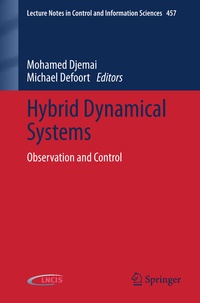
Hybrid Dynamical Systems
Observation and Control
Published on 13. October 2014
XVII, 332 pages
978-3-319-10795-0 (ISBN)
Description

This book is a collection of contributions defining the state of current knowledge and new trends in hybrid systems - systems involving both continuous dynamics and discrete events - as described by the work of several well-known groups of researchers.
Hybrid Dynamical Systems presents theoretical advances in such areas as diagnosability, observability and stabilization for various classes of system. Continuous and discrete state estimation and self-triggering control of nonlinear systems are advanced. The text employs various methods, among them, high-order sliding modes, Takagi-Sugeno representation and sampled-data switching to achieve its ends.
The many applications of hybrid systems from power converters to computer science are not forgotten; studies of flexible-joint robotic arms and - as representative biological systems - the behaviour of the human heart and vasculature, demonstrate the wide-ranging practical significance of control in hybrid systems. The cross-disciplinary origins of study in hybrid systems are evident.
Academic researchers and graduate students interested in hybrid and switched systems need look no further than Hybrid Dynamical Systems for a single source which will bring them up to date with work in this area from around the world.
Hybrid Dynamical Systems presents theoretical advances in such areas as diagnosability, observability and stabilization for various classes of system. Continuous and discrete state estimation and self-triggering control of nonlinear systems are advanced. The text employs various methods, among them, high-order sliding modes, Takagi-Sugeno representation and sampled-data switching to achieve its ends.
The many applications of hybrid systems from power converters to computer science are not forgotten; studies of flexible-joint robotic arms and - as representative biological systems - the behaviour of the human heart and vasculature, demonstrate the wide-ranging practical significance of control in hybrid systems. The cross-disciplinary origins of study in hybrid systems are evident.
Academic researchers and graduate students interested in hybrid and switched systems need look no further than Hybrid Dynamical Systems for a single source which will bring them up to date with work in this area from around the world.
More details
Series
Language
English
Place of publication
Cham
Switzerland
Publishing group
Springer International Publishing
Target group
Professional and scholarly
Product notice
Reflowable
Illustrations
XVII, 332 p. 74 illus., 30 illus. in color.
File size
9,95 MB
ISBN-13
978-3-319-10795-0 (9783319107950)
DOI
10.1007/978-3-319-10795-0
Schweitzer Classification
Other editions
Additional editions
Book
11/2014
Springer
€106.99
Shipment within 10-15 days
Persons
Mohamed Djemaï is currently full Professor at the University of Valenciennes, France. His research interests are in nonlinear control systems theory in general, with principal interest in Hybrid and variable structure systems, and sliding mode approach: in control, observation, fault detection and the analysis and modeling of hybrid dynamical systems.?He has applied his research to various industrial applications including power systems, robotics and vehicle. He has published more than 120 papers (including 40 journals) in his area of research.
Michael Defoort has been an Assistant Professor at the University of Valenciennes since 2009. For seven years, Michael Defoort's research interests include observer theory and nonlinear control with applications to multi-agent systems. He has established a new branch of the sliding mode control theory (i.e. integral sliding mode control) with applications in robotics. Since three years, he has extended his research activity in the Switched and Hybrid Dynamical Systems areas, with applications in self-triggering control. From 2007 to 2008, he was a Research Fellow with the Department of System Design Engineering, Keio University, Japan. He has been leading international collaborations with Keio University (Japan), Kyungpook National University (South Korea), University of L'Aquila (Italy) and Kaiserslautern University (Germany). He has published more than 55 papers (including 16 journals) in his area of research.
Michael Defoort has been an Assistant Professor at the University of Valenciennes since 2009. For seven years, Michael Defoort's research interests include observer theory and nonlinear control with applications to multi-agent systems. He has established a new branch of the sliding mode control theory (i.e. integral sliding mode control) with applications in robotics. Since three years, he has extended his research activity in the Switched and Hybrid Dynamical Systems areas, with applications in self-triggering control. From 2007 to 2008, he was a Research Fellow with the Department of System Design Engineering, Keio University, Japan. He has been leading international collaborations with Keio University (Japan), Kyungpook National University (South Korea), University of L'Aquila (Italy) and Kaiserslautern University (Germany). He has published more than 55 papers (including 16 journals) in his area of research.
Content
From the Contents: Hybrid Systems and Verification by Abstraction.- Observer Design for Discrete-time Switching Nonlinear Models.-Self-Triggered Robust Control of Nonlinear Stochastic Systems.- Nonlinear Observer for Autonomous Switching Systems with Jumps.
