

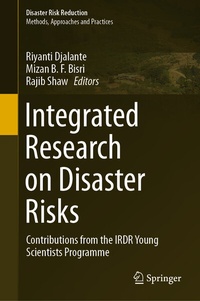
Integrated Research on Disaster Risks
Description

This book is a collection of works written by young scientists involved in the Integrated Disaster Risk Research (IRDR). Integrated Research on Disaster Risk (IRDR) is a decade-long research programme co-sponsored by the International Science Council (merged by International Council for Science (ICSU), the International Social Science Council (ISSC), and the United Nations Office for Disaster Risk Reduction (UNDRR). It is a global, multi-disciplinary approach to dealing with the challenges brought by natural disasters, mitigating their impacts, and improving related policy-making mechanisms. The book examines multidisciplinary research and actions related to disaster risk reduction internationally. The Integrated Research on Disaster Risk (IRDR) Young Scientists programme is:
A sub-programme within IRDR which promotes capacity building of young professionals and encourages them to undertake innovative and need-based research which makes science-policy and science-practice linkages stronger.IRDR Young Scientists Programme was started in late 2016. Currently, it is a community of 115 young researchers from over 40 countries after 3 batches of application.
IRDR network and partners provide academic advice and training courses, workshops, and programmes for IRDR young scientists.
IRDR young scientists contribute to innovative research in the field of disaster risk reduction and participate in conferences and/or social media as the ambassador of IRDR.
The book is of interest to researchers and scholars in the field of governance of sustainability and environmental governance. Postgraduate students will benefit this book within courses on environmental governance, on climate change governance, and on transformation and social change processes. Societal actorsin climate change adaptation and other environmental governance fields on local, national, and international levels can benefit from the focus on societally relevant findings in the past 10 years of research on adaptiveness.
More details
Other editions
Additional editions
Persons
Dr. Riyanti Djalante has over 10 years of scientific research and international professional experiences, in the field of development, governance, disaster risk reduction (DRR), climate change adaptation (CCA), resilience, and vulnerability. Dr. Djalante is an Academic Programme Officer at The United Nations University - Institute for the Advanced Study of Sustainability (UNU-IAS) Japan between 2017 and 2020. She coordinates research and policy development on Global Change and Resilience. For the IRDR, Dr. Djalante serves as the Scientific Committee Member, on DRR-CCA-SDGs working group. She is the Section Editor of the Progress in Disaster Science Journal by Elsevier and Editor of the Journal of Sustainability Science by Springer. Dr. Djalante is a Visiting Associate Professor at Keio University. She is a Lead Author of IPCC Assessment Report 6 and Special Report on impacts of 1.5-degree global warming, and UNEP Global Environmental Outlook 6. Dr. Djalante has also consulted international agencies on issues related to governance, DRR, and CCA. Her international work experiences encompass Indonesia, South East Asia, Australia, Japan, Germany, and the Netherlands.
Mizan B.F. Bisri is a JSPS-UNU Postdoctoral Fellow at the United Nations University Institute for the Advanced Study of Sustainability (UNU-IAS) and Integrated Research System for Sustainability Science (IR3S), the University of Tokyo. He received Ph.D. and M.A. in Political Science from Kobe University (Japan) as well as M.Sc. and B.Sc. in Urban and Regional Planning from Bandung Institute of Technology (ITB, Indonesia). Prior to joining UNU-IAS, he served as Disaster Monitoring and Analysis Officer at ASEAN Coordinating Centre for Humanitarian Assistance on Disaster Management (AHA Centre). In the past, he has worked for ITB, University of the Philippines, Asia Pacific Institute of Research (Japan), and served as Consultant for various organizations including agencies of Government of Indonesia, United Nations, and international organizations or NGOs. His research and professional interests are ranging from disaster management, disaster education, humanitarian studies and humanitarian operations, climate change adaptation, and urban planning.
Rajib Shaw is the Professor in Graduate School of Media and Governance in Keio University Shonan Fujisawa Campus (SFC). Earlier, he was the Executive Director of the Integrated Research on Disaster Risk (IRDR), a decade-long research programme co-sponsored by the International Council for Science (ICSU), the International Social Science Council (ISSC), and the United Nations International Strategy for Disaster Reduction (UNISDR). He is also the Senior Fellow of the Institute of Global Environmental Strategies (IGES) Japan and the Chairperson of SEEDS Asia and CWS Japan, two Japanese NGOs. Previously, he served as a Professor in the Graduate School of Global Environmental Studies of Kyoto University. His expertise includes community-based disaster risk management, climate change adaptation, urban risk management, and disaster and environmental education. Professor Shaw is the Chair of the United Nations Science Technology Advisory Group (STAG) for disaster risk reduction and also the Co-chair of the Asia Science Technology Academic Advisory Group (ASTAAG). He is the Editor of a book series on disaster risk reduction, published by Springer. Prof. Shaw has published more than 45 books and over 300 academic papers and book chapters.
