

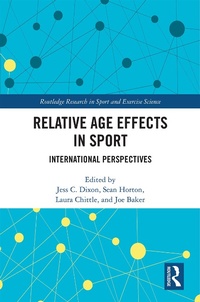
Relative Age Effects in Sport
International Perspectives
1st Edition
Published on 7. May 2020
182 pages
978-1-000-06942-6 (ISBN)
Description

Individual achievement in sport is often constrained by an athlete's age relative to the peers with whom they participate. A common practice within sport and educational domains is to group youth based on their chronological ages to help promote equal competition, age appropriate instruction, and ensure participant safety. While well intended, such grouping practices can often advantage relatively older children, while disadvantaging those who are relatively younger within the same age cohort. These phenomena are known as Relative Age Effects (RAEs).
Relative Age Effects in Sport: International Perspectives includes chapters from internationally recognized scholars who have examined RAEs from different perspectives (e.g., sport, mental health and wellbeing, youth development). This new volume assists in communicating and mobilizing knowledge and research about RAEs, focusing on developing feasible and attractive solutions that capture the attention of practitioners and policy makers from sport governing bodies and creating a resource that is accessible to professionals within the sport and academic communities.
Relative Age Effects in Sport: International Perspectives is key reading for academics and researchers in the fields of athlete development, talent identification, coaching education, health and wellbeing, mental health and related disciplines, whilst also of interest to sport industry professionals such as coaches and policy makers.
Relative Age Effects in Sport: International Perspectives includes chapters from internationally recognized scholars who have examined RAEs from different perspectives (e.g., sport, mental health and wellbeing, youth development). This new volume assists in communicating and mobilizing knowledge and research about RAEs, focusing on developing feasible and attractive solutions that capture the attention of practitioners and policy makers from sport governing bodies and creating a resource that is accessible to professionals within the sport and academic communities.
Relative Age Effects in Sport: International Perspectives is key reading for academics and researchers in the fields of athlete development, talent identification, coaching education, health and wellbeing, mental health and related disciplines, whilst also of interest to sport industry professionals such as coaches and policy makers.
More details
Series
Edition
1. Auflage
Language
English
Place of publication
London
United Kingdom
Publishing group
Taylor & Francis Ltd
Target group
College/higher education
Professional and scholarly
Illustrations
3 Tables, black and white; 21 Line drawings, black and white; 2 Halftones, black and white; 23 Illustrations, black and white
ISBN-13
978-1-000-06942-6 (9781000069426)
Copyright in bibliographic data and cover images is held by Nielsen Book Services Limited or by the publishers or by their respective licensors: all rights reserved.
Schweitzer Classification
Other editions
Additional editions
Book
05/2022
1st Edition
Routledge
€64.90
Shipment within 15-20 days
Book
07/2020
1st Edition
Routledge
€205.20
Shipment within 15-20 days
Persons
Jess C. Dixon is Head of the Department of Kinesiology and an Associate Professor of Sport Management at the University of Windsor, Canada. His primary research and scholarly interests are in the areas of strategic management in sport, executive leadership and human resource management in sport, and sport management pedagogy. He has also published extensively about relative age effects over the past decade. His research has been funded by the Social Sciences and Humanities Research Council of Canada (SSHRC), the Sport Canada Research Initiative (SCRI), and the North American Society for Sport Management (NASSM).
Sean Horton is a Professor in the Department of Kinesiology at the University of Windsor, Canada. Sean's research interests lie primarily in the area of skill acquisition and expert performance, both in young people and as individuals age, along with various psychosocial components of sport and physical activity participation. His research is funded by the Social Sciences and Humanities Research Council of Canada (SSHRC) and the Ontario Trillium Foundation.
Laura Chittle is a doctoral student in the Department of Kinesiology at the University of Windsor, Canada. She is funded by a Joseph-Armand Bombardier CGS Doctoral Scholarship, a Sport Canada Research Initiative Grant, and an Ontario Graduate Scholarship. Her previous work examined the moderating impact of academic timing on relative age effect patterns within intercollegiate sport, while her current dissertation studies pertain to evaluating the role that relative age has on athlete leadership development and positive youth development in sport.
Joe Baker is a Professor in the School of Kinesiology and Health Science at York University, Canada. His research examines the varying factors affecting skill acquisition and maintenance across the lifespan, from issues of high performance athlete development to predictors of successful aging. He has held visiting researcher positions at universities around the world and is the author/editor of 9 books, 4 journal special issues and more than 200 peer reviewed articles and book chapters. He is internationally recognized as a world leader on the science of athlete development.
Sean Horton is a Professor in the Department of Kinesiology at the University of Windsor, Canada. Sean's research interests lie primarily in the area of skill acquisition and expert performance, both in young people and as individuals age, along with various psychosocial components of sport and physical activity participation. His research is funded by the Social Sciences and Humanities Research Council of Canada (SSHRC) and the Ontario Trillium Foundation.
Laura Chittle is a doctoral student in the Department of Kinesiology at the University of Windsor, Canada. She is funded by a Joseph-Armand Bombardier CGS Doctoral Scholarship, a Sport Canada Research Initiative Grant, and an Ontario Graduate Scholarship. Her previous work examined the moderating impact of academic timing on relative age effect patterns within intercollegiate sport, while her current dissertation studies pertain to evaluating the role that relative age has on athlete leadership development and positive youth development in sport.
Joe Baker is a Professor in the School of Kinesiology and Health Science at York University, Canada. His research examines the varying factors affecting skill acquisition and maintenance across the lifespan, from issues of high performance athlete development to predictors of successful aging. He has held visiting researcher positions at universities around the world and is the author/editor of 9 books, 4 journal special issues and more than 200 peer reviewed articles and book chapters. He is internationally recognized as a world leader on the science of athlete development.
Content
1. Serendipity Strikes
2. The Relative Age Effect: Early Studies
3. Antecedents and Explanations of Relative Age Effects
4. Relative Age Effects Are Developmental! The Necessity of Looking at More Than One Time Point
5. Relative Age Effects in Female Athletes: Similarities and Differences Highlight the Nuances of This Effect... If You Know Where to Look
6. Relative Age Effects and Youth Development
7. Late Birthday Benefits: The 'Underdog Hypothesis'
8. Tackling an Age-Old Dilemma Among Student-Athletes: Academic Timing and the Relative Age Effect
9. The Relative Age Effect In Youth And Elite Sport: What Have We Learned After 20 Years of Research?
10. Approaches to Help Coaches and Talent Scouts Overcome the Relative Age Effect
11. Re-Balancing the Relative Age Effect Scales: Meta-Analytical Trends, Causes, and Corrective Adjustment Procedures as a Solution
12. Concluding Thoughts and Future Research on Relative Age Effects in Sport
2. The Relative Age Effect: Early Studies
3. Antecedents and Explanations of Relative Age Effects
4. Relative Age Effects Are Developmental! The Necessity of Looking at More Than One Time Point
5. Relative Age Effects in Female Athletes: Similarities and Differences Highlight the Nuances of This Effect... If You Know Where to Look
6. Relative Age Effects and Youth Development
7. Late Birthday Benefits: The 'Underdog Hypothesis'
8. Tackling an Age-Old Dilemma Among Student-Athletes: Academic Timing and the Relative Age Effect
9. The Relative Age Effect In Youth And Elite Sport: What Have We Learned After 20 Years of Research?
10. Approaches to Help Coaches and Talent Scouts Overcome the Relative Age Effect
11. Re-Balancing the Relative Age Effect Scales: Meta-Analytical Trends, Causes, and Corrective Adjustment Procedures as a Solution
12. Concluding Thoughts and Future Research on Relative Age Effects in Sport
