

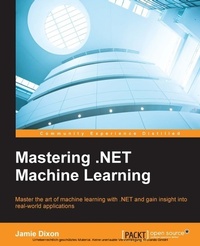
Mastering .NET Machine Learning
Use machine learning in your .NET applications
Published on 8. July 2025
358 pages
978-1-78588-119-0 (ISBN)
Description

Master the art of machine learning with .NET and gain insight into real-world applications
Key Features
Based on .NET framework 4.6.1, includes examples on ASP.NET Core 1.0
Set up your business application to start using machine learning techniques
Familiarize the user with some of the more common .NET libraries for machine learning
Implement several common machine learning techniques
Evaluate, optimize and adjust machine learning models
Book Description.Net is one of the widely used platforms for developing applications. With the meteoric rise of Machine learning, developers are now keen on finding out how can they make their .Net applications smarter. Also, .NET developers are interested into moving into the world of devices and how to apply machine learning techniques to, well, machines. This book is packed with real-world examples to easily use machine learning techniques in your business applications. You will begin with introduction to F# and prepare yourselves for machine learning using .NET framework. You will be writing a simple linear regression model using an example which predicts sales of a product. Forming a base with the regression model, you will start using machine learning libraries available in .NET framework such as Math.NET, Numl.NET and Accord.NET with the help of a sample application. You will then move on to writing multiple linear regressions and logistic regressions. You will learn what is open data and the awesomeness of type providers. Next, you are going to address some of the issues that we have been glossing over so far and take a deep dive into obtaining, cleaning, and organizing our data. You will compare the utility of building a KNN and Naive Bayes model to achieve best possible results. Implementation of Kmeans and PCA using Accord.NET and Numl.NET libraries is covered with the help of an example application. We will then look at many of issues confronting creating real-world machine learning models like overfitting and how to combat them using confusion matrixes, scaling, normalization, and feature selection. You will now enter into the world of Neural Networks and move your line of business application to a hybrid scientific application. After you have covered all the above machine learning models, you will see how to deal with very large datasets using MBrace and how to deploy machine learning models to Internet of Thing (IoT) devices so that the machine can learn and adapt on the fly. What you will learn
Write your own machine learning applications and experiments using the latest .NET framework, including .NET Core 1.0
Set up your business application to start using machine learning.
Accurately predict the future using regressions.
Discover hidden patterns using decision trees.
Acquire, prepare, and combine datasets to drive insights.
Optimize business throughput using Bayes Classifier.
Discover (more) hidden patterns using KNN and Naive Bayes.
Discover (even more) hidden patterns using K-Means and PCA.
Use Neural Networks to improve business decision making while using the latest ASP.NET technologies.
Explore "Big Data", distributed computing, and how to deploy machine learning models to IoT devices - making machines self-learning and adapting
Along the way, learn about Open Data, Bing maps, and MBrace
Who this book is forThis book is targeted at .Net developers who want to build complex machine learning systems. Some basic understanding of data science is required.
Key Features
Based on .NET framework 4.6.1, includes examples on ASP.NET Core 1.0
Set up your business application to start using machine learning techniques
Familiarize the user with some of the more common .NET libraries for machine learning
Implement several common machine learning techniques
Evaluate, optimize and adjust machine learning models
Book Description.Net is one of the widely used platforms for developing applications. With the meteoric rise of Machine learning, developers are now keen on finding out how can they make their .Net applications smarter. Also, .NET developers are interested into moving into the world of devices and how to apply machine learning techniques to, well, machines. This book is packed with real-world examples to easily use machine learning techniques in your business applications. You will begin with introduction to F# and prepare yourselves for machine learning using .NET framework. You will be writing a simple linear regression model using an example which predicts sales of a product. Forming a base with the regression model, you will start using machine learning libraries available in .NET framework such as Math.NET, Numl.NET and Accord.NET with the help of a sample application. You will then move on to writing multiple linear regressions and logistic regressions. You will learn what is open data and the awesomeness of type providers. Next, you are going to address some of the issues that we have been glossing over so far and take a deep dive into obtaining, cleaning, and organizing our data. You will compare the utility of building a KNN and Naive Bayes model to achieve best possible results. Implementation of Kmeans and PCA using Accord.NET and Numl.NET libraries is covered with the help of an example application. We will then look at many of issues confronting creating real-world machine learning models like overfitting and how to combat them using confusion matrixes, scaling, normalization, and feature selection. You will now enter into the world of Neural Networks and move your line of business application to a hybrid scientific application. After you have covered all the above machine learning models, you will see how to deal with very large datasets using MBrace and how to deploy machine learning models to Internet of Thing (IoT) devices so that the machine can learn and adapt on the fly. What you will learn
Write your own machine learning applications and experiments using the latest .NET framework, including .NET Core 1.0
Set up your business application to start using machine learning.
Accurately predict the future using regressions.
Discover hidden patterns using decision trees.
Acquire, prepare, and combine datasets to drive insights.
Optimize business throughput using Bayes Classifier.
Discover (more) hidden patterns using KNN and Naive Bayes.
Discover (even more) hidden patterns using K-Means and PCA.
Use Neural Networks to improve business decision making while using the latest ASP.NET technologies.
Explore "Big Data", distributed computing, and how to deploy machine learning models to IoT devices - making machines self-learning and adapting
Along the way, learn about Open Data, Bing maps, and MBrace
Who this book is forThis book is targeted at .Net developers who want to build complex machine learning systems. Some basic understanding of data science is required.
More details
Edition
Digital original
Language
English
Place of publication
Birmingham
United Kingdom
Target group
US School Grade: College Graduate Student
Edition type
Digital original
File size
14,17 MB
ISBN-13
978-1-78588-119-0 (9781785881190)
Copyright in bibliographic data and cover images is held by Nielsen Book Services Limited or by the publishers or by their respective licensors: all rights reserved.
Schweitzer Classification
Other editions
Additional editions
Book
03/2016
Packt Publishing
€69.50
Shipment within 3-4 weeks
Person
Dixon Jamie :
Jamie Dixon has been writing code for as long as he can remember and has been getting paid to do it since 1995. He was using C# and JavaScript almost exclusively until discovering F#, and now combines all three languages for the problem at hand. He has a passion for discovering overlooked gems in datasets and merging software engineering techniques to scientific computing. When he codes for fun, he spends his time using Phidgets, Netduinos, and Raspberry Pis or spending time in Kaggle competitions using F# or R. Jamie is a bachelor of science in computer science and has been an F# MVP since 2014. He is the former chair of his town's Information Services Advisory Board and is an outspoken advocate of open data. He is also involved with his local .NET User Group (TRINUG) with an emphasis on data analytics, machine learning, and the Internet of Things (IoT). Jamie lives in Cary, North Carolina with his wonderful wife Jill and their three awesome children: Sonoma, Sawyer, and Sloan. He blogs weekly at jamessdixon.wordpress.com and can be found on Twitter at @jamie_dixon.
Jamie Dixon has been writing code for as long as he can remember and has been getting paid to do it since 1995. He was using C# and JavaScript almost exclusively until discovering F#, and now combines all three languages for the problem at hand. He has a passion for discovering overlooked gems in datasets and merging software engineering techniques to scientific computing. When he codes for fun, he spends his time using Phidgets, Netduinos, and Raspberry Pis or spending time in Kaggle competitions using F# or R. Jamie is a bachelor of science in computer science and has been an F# MVP since 2014. He is the former chair of his town's Information Services Advisory Board and is an outspoken advocate of open data. He is also involved with his local .NET User Group (TRINUG) with an emphasis on data analytics, machine learning, and the Internet of Things (IoT). Jamie lives in Cary, North Carolina with his wonderful wife Jill and their three awesome children: Sonoma, Sawyer, and Sloan. He blogs weekly at jamessdixon.wordpress.com and can be found on Twitter at @jamie_dixon.
Content
Table of Contents
Welcome To Machine Learning Using The .NET Framework
Record Store Regression
More Record Store Regression
Police Traffic Stops: Barking Up the Wrong Tree?
Time Out: Obtaining, Cleaning, and Preparing Data
Record Store Redux: KNN and Bayes Classifier
Traffic Stops and Crash Location: KMeans and PCA
Time Out: REPL Driven Development
Record Store Returns: Neural Networks
Traffic Stops: Optimization
Welcome To Machine Learning Using The .NET Framework
Record Store Regression
More Record Store Regression
Police Traffic Stops: Barking Up the Wrong Tree?
Time Out: Obtaining, Cleaning, and Preparing Data
Record Store Redux: KNN and Bayes Classifier
Traffic Stops and Crash Location: KMeans and PCA
Time Out: REPL Driven Development
Record Store Returns: Neural Networks
Traffic Stops: Optimization
