
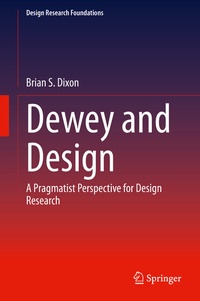
Dewey and Design
Description
Alles über E-Books | Antworten auf Fragen rund um E-Books, Kopierschutz und Dateiformate finden Sie in unserem Info- & Hilfebereich.
More details
Other editions
Additional editions
Person
Dr Brian Dixon (PhD; MA; BA)
is Course Director for MFA Design at the Belfast School of Art, Ulster University. His research interests cohere around: the relevance of practice-orientated philosophies (e.g. pragmatism) for design research; the roles of design in human spatial understanding; and design pedagogy. He holds a PhD in Information Design from University of the Arts London, combined with a practice background in visual communications. He has published widely, with his work appearing in major journals such as Design Issues, CoDesign and Design Management. He is currently co-investigator on the AHRC-funded Design Innovation and Land Assets project, which will feed into a broader arts and humanities based exploration of landscape decision-making in the UK.
Content
Preface.- Acknowledgements.- Chapter 1. Design, Pragmatism and Dewey.- Chapter 2. Valuing Experience.- Chapter 3. Knowing in Making.- Chapter 4. Making Things Meaningful.- Chapter 5. Making Things Better.- Chapter 6. Making as Remaking.- Chapter 7. Dewey's Pragmatism as a Philosophy for Design Research.- References.- Index.

System requirements
File format: PDF
Copy protection: Watermark-DRM (Digital Rights Management)
System requirements:
- Computer (Windows; MacOS X; Linux): Use the free software Adobe Reader, Adobe Digital Editions, or any other PDF viewer of your choice (see eBook Help).
- Tablet/Smartphone (Android; iOS): Install the free app Adobe Digital Editions or another reading app for eBooks, e.g., PocketBook (see eBook Help).
- E-reader: Bookeen, Kobo, Pocketbook, Sony, Tolino and many more (only limited: Kindle).
The file format PDF always displays a book page identically on any hardware. This makes PDF suitable for complex layouts such as those used in textbooks and reference books (images, tables, columns, footnotes). Unfortunately, on the small screens of e-readers or smartphones, PDFs are rather annoying, requiring too much scrolling.
This eBook uses Watermark-DRM, a „soft” copy protection. This means that there are no technical restrictions to prevent illegal distribution. However, there is a personalised watermark embedded in the eBook that can be used to identify the purchaser of the eBook in the event of misuse and to provide evidence for legal purposes.
For more information, see our eBook Help page.