

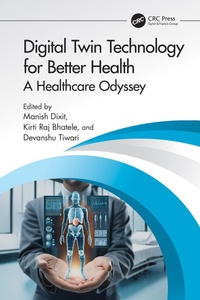
Digital Twin Technology for Better Health
A Healthcare Odyssey
1st Edition
Published on 1. August 2025
294 pages
978-1-040-40064-7 (ISBN)
Description

At a time when technology and healthcare are colliding to alter lives, Digital Twin Technology for Better Health: A Healthcare Odyssey throws open the revolutionary possibilities of digital twins in changing patient care, medical research, and healthcare operations. This book brings together the best of the best from healthcare, AI, and IT domains in providing a holistic and forward- looking study of one of the most innovative technologies of our times.
Digital twin technology generally refers to the development of virtual replicas of physical entities. The functioning of healthcare systems is being transformed using this technology. Its applications lie in personalized treatment plans, predicting diagnostics results, optimized workflows in hospitals, and aid in the drug discovery process. The book examines the principles of digital twin technology in healthcare and their application in the real world and future directions.
Features:
Foundations and evolution of digital twin technology
Applications in clinical care, including diagnosis, treatment, and patient monitoring
Insights into how digital twins are changing the face of healthcare operations and management
Case studies and practical examples illustrating real- world success stories
Critical discussions on data security, ethical considerations, and regulatory frameworks
Emerging trends and the integration of AI, IoT, and advanced analytics to enhance digital twin efficacy
Whether you are a healthcare professional, technologist, researcher, or policymaker, this book is an indispensable guide to the science of how digital twin technology can help deliver better health. It is one of the earliest comprehensive works in the field and not only fills the gap between technology and healthcare but also serves as a visionary roadmap for the future. Let's join in on this transition journey in healthcare toward the future, as digital twins promise to reshape the industry and change lives around the world.
Digital twin technology generally refers to the development of virtual replicas of physical entities. The functioning of healthcare systems is being transformed using this technology. Its applications lie in personalized treatment plans, predicting diagnostics results, optimized workflows in hospitals, and aid in the drug discovery process. The book examines the principles of digital twin technology in healthcare and their application in the real world and future directions.
Features:
Foundations and evolution of digital twin technology
Applications in clinical care, including diagnosis, treatment, and patient monitoring
Insights into how digital twins are changing the face of healthcare operations and management
Case studies and practical examples illustrating real- world success stories
Critical discussions on data security, ethical considerations, and regulatory frameworks
Emerging trends and the integration of AI, IoT, and advanced analytics to enhance digital twin efficacy
Whether you are a healthcare professional, technologist, researcher, or policymaker, this book is an indispensable guide to the science of how digital twin technology can help deliver better health. It is one of the earliest comprehensive works in the field and not only fills the gap between technology and healthcare but also serves as a visionary roadmap for the future. Let's join in on this transition journey in healthcare toward the future, as digital twins promise to reshape the industry and change lives around the world.
More details
Edition
1. Auflage
Language
English
Place of publication
London
United Kingdom
Publishing group
Taylor & Francis Ltd
Target group
College/higher education
Professional and scholarly
Illustrations
1 Tables, black and white; 16 Line drawings, black and white; 24 Halftones, black and white; 40 Illustrations, black and white
File size
28,05 MB
ISBN-13
978-1-040-40064-7 (9781040400647)
Copyright in bibliographic data and cover images is held by Nielsen Book Services Limited or by the publishers or by their respective licensors: all rights reserved.
Schweitzer Classification
Other editions
Additional editions
Manish Dixit | Kirti Raj Bhatele | Devanshu Tiwari
Digital Twin Technology for Better Health
A Healthcare Odyssey
Book
07/2025
1st Edition
CRC Press
€172.40
Shipment within 10-20 days
Persons
Dr. Manish Dixit is a distinguished professional in the field of Computer Science and Engineering, currently holding the position of Senior Professor and Head in the Department of Computer Science and Engineering at Madhav Institute of Technology & Science, Gwalior (Government College). With a career spanning 27 years, he has acquired a wealth of experience and expertise in various domains of computer science. His educational background includes a PhD in Computer Science & Engineering from Rajiv Gandhi Technological University, Bhopal, an M.E. in Communication Control & Networking, and a B.E. in Computer Technology. He has supervised a significant number of research projects, including guiding 9 PhD scholars in the field of Computer Science and Engineering. In addition, he has overseen the progress of 26 ME/MTech scholars and 200 BE/BTech students, demonstrating his commitment to fostering academic growth. A prolific researcher, Dr. Dixit has authored more than a hundred research papers, including 11 published in SCI-indexed journals, showcasing his profound involvement in advancing knowledge in the fields of Human-computer Interaction, Image Processing, Artificial Intelligence, and Computer Graphics. His remarkable career is further embellished with various accolades, including the IEEE Extreme Programming Award, his election as a Fellow of IETE, and Senior Member status in IEEE, which highlight his substantial contributions to professional organizations. Notably, he is currently serving as the Chairman of the IETE Gwalior Sub-Center and Vice-chair of the IEEE Madhya Pradesh section. In addition to his academic and research achievements, Dr. Dixit has organized and led numerous workshops, including an AICTE-sponsored Short Term Course on "Applications of Image Processing, Computer Vision and Intelligent Technologies in Pandemic," reflecting his commitment to knowledge dissemination and education. The other brief details regarding publications and experience are given in his resume, which is attached in the email.
Dr. Kirti Raj Bhatele is working as an Assistant Professor in the Department of CSE, Rustamji Institute of technology, Border Security Force Academy, Tekanpur, Gwalior, Madhya Pradesh, India since 2016. He has done PhD, M.Tech and B.E. in Information Technology. He has also done Post Graduate Diploma in Cyber Law from the National Law institute university, Bhopal, India. He has published 6 SCI/SCIE indexed publications along with many SCOPUS/ESCI indexed publications. He has also published more than 12 book chapters in the various edited books titles of the IGI Global publications, USA. He has also done two Patents and received research fellowships. The other brief details regarding publications are given in the resume, which is attached in the email.
Dr. Devanshu Tiwari has completed her PhD in the Computer science & Engineering discipline from the Rajiv Gandhi Technical University, Bhopal, and Madhya Pradesh, India. She also done M.Tech in CSE and B.E. in Information Technology from Rajiv Gandhi Technical University, Bhopal, and Madhya Pradesh, India. She has also done Post Graduate Diploma in Cyber Law from the National Law institute university, Bhopal, India. She has teaching and research experience of more than 10 years and published 4 SCI/SCIE indexed publications along with many SCOPUS/ESCI indexed publications. She has also published many book chapters in the various edited books titles of the IGI Global publications, USA. He has also done one Patent and received research fellowships. The other brief details regarding publications are given in the resume, which is attached in the email.
Dr. Kirti Raj Bhatele is working as an Assistant Professor in the Department of CSE, Rustamji Institute of technology, Border Security Force Academy, Tekanpur, Gwalior, Madhya Pradesh, India since 2016. He has done PhD, M.Tech and B.E. in Information Technology. He has also done Post Graduate Diploma in Cyber Law from the National Law institute university, Bhopal, India. He has published 6 SCI/SCIE indexed publications along with many SCOPUS/ESCI indexed publications. He has also published more than 12 book chapters in the various edited books titles of the IGI Global publications, USA. He has also done two Patents and received research fellowships. The other brief details regarding publications are given in the resume, which is attached in the email.
Dr. Devanshu Tiwari has completed her PhD in the Computer science & Engineering discipline from the Rajiv Gandhi Technical University, Bhopal, and Madhya Pradesh, India. She also done M.Tech in CSE and B.E. in Information Technology from Rajiv Gandhi Technical University, Bhopal, and Madhya Pradesh, India. She has also done Post Graduate Diploma in Cyber Law from the National Law institute university, Bhopal, India. She has teaching and research experience of more than 10 years and published 4 SCI/SCIE indexed publications along with many SCOPUS/ESCI indexed publications. She has also published many book chapters in the various edited books titles of the IGI Global publications, USA. He has also done one Patent and received research fellowships. The other brief details regarding publications are given in the resume, which is attached in the email.
Content
Chapter 1: Introduction to Digital twin technology
This chapter provides an overview of the book and introduces the concept of Digital twin in the context of healthcare. It sets the stage for the exploration of how Digital twin are transforming the healthcare industry.
Chapter 2: Digital Twin technology Fundamentals
In this chapter, readers will gain a thorough understanding of what Digital twin are and how they operate. It covers the fundamental principles and technologies that underpin Digital twin.
Chapter 3: Digital twin technology in Diagnostic Medicine
This chapter delves into the applications of Digital twin in the field of diagnostic medicine. It explores how Digital twin are being used to enhance the accuracy and efficiency of medical diagnoses.
Chapter 4: Treatment and Therapy with Digital twin technology
Readers will learn about the ways in which Digital twin are employed in the treatment and therapy of patients. The chapter discusses how Digital twin are personalized to optimize treatment plans.
Chapter 5: Healthcare Operations and Management
This chapter focuses on the optimization of healthcare operations using Digital twin technology. It covers areas such as hospital management, resource allocation, and supply chain logistics.
Chapter 6: Personalized Medicine and Drug Discovery
The chapter highlights the role of Digital twin technology in enabling personalized medicine and expedites drug discovery processes. It showcases how Digital twin technology are revolutionizing the pharmaceutical industry.
Chapter 7: Data Security and Ethical Considerations
Addressing critical concerns, this chapter discusses the importance of data security and ethical considerations in the use of Digital twin technology in healthcare. It explores privacy, consent, and regulatory compliance.
Chapter 8: Emerging Technologies in Digital Twin
This chapter aims to provide readers with a thorough understanding of the integration of IoT, AI, and data analytics into the digital twin framework, emphasizing the benefits, challenges, and potential future developments in healthcare
Chapter 9: The Future of Digital twin technology in Healthcare
Speculating on what the future holds, this chapter explores emerging trends and the potential for Digital twin technology to further transform the healthcare industry. It offers insights into ongoing research and development.
Chapter 10: Case Studies
By presenting a diverse range of case studies, this chapter provides a clear understanding of how digital twin technology is transforming healthcare across various domains. These practical examples offer insights into the tangible benefits and outcomes achieved through the implementation of digital twins, making the concept more accessible and relatable to the readers.
Chapter 11: Conclusion and Key findings
The final chapter summarizes the key findings and takeaways from the book. It provides a concise overview of the main points discussed and reinforces the significance of Digital twin in healthcare.
This chapter provides an overview of the book and introduces the concept of Digital twin in the context of healthcare. It sets the stage for the exploration of how Digital twin are transforming the healthcare industry.
Chapter 2: Digital Twin technology Fundamentals
In this chapter, readers will gain a thorough understanding of what Digital twin are and how they operate. It covers the fundamental principles and technologies that underpin Digital twin.
Chapter 3: Digital twin technology in Diagnostic Medicine
This chapter delves into the applications of Digital twin in the field of diagnostic medicine. It explores how Digital twin are being used to enhance the accuracy and efficiency of medical diagnoses.
Chapter 4: Treatment and Therapy with Digital twin technology
Readers will learn about the ways in which Digital twin are employed in the treatment and therapy of patients. The chapter discusses how Digital twin are personalized to optimize treatment plans.
Chapter 5: Healthcare Operations and Management
This chapter focuses on the optimization of healthcare operations using Digital twin technology. It covers areas such as hospital management, resource allocation, and supply chain logistics.
Chapter 6: Personalized Medicine and Drug Discovery
The chapter highlights the role of Digital twin technology in enabling personalized medicine and expedites drug discovery processes. It showcases how Digital twin technology are revolutionizing the pharmaceutical industry.
Chapter 7: Data Security and Ethical Considerations
Addressing critical concerns, this chapter discusses the importance of data security and ethical considerations in the use of Digital twin technology in healthcare. It explores privacy, consent, and regulatory compliance.
Chapter 8: Emerging Technologies in Digital Twin
This chapter aims to provide readers with a thorough understanding of the integration of IoT, AI, and data analytics into the digital twin framework, emphasizing the benefits, challenges, and potential future developments in healthcare
Chapter 9: The Future of Digital twin technology in Healthcare
Speculating on what the future holds, this chapter explores emerging trends and the potential for Digital twin technology to further transform the healthcare industry. It offers insights into ongoing research and development.
Chapter 10: Case Studies
By presenting a diverse range of case studies, this chapter provides a clear understanding of how digital twin technology is transforming healthcare across various domains. These practical examples offer insights into the tangible benefits and outcomes achieved through the implementation of digital twins, making the concept more accessible and relatable to the readers.
Chapter 11: Conclusion and Key findings
The final chapter summarizes the key findings and takeaways from the book. It provides a concise overview of the main points discussed and reinforces the significance of Digital twin in healthcare.
