

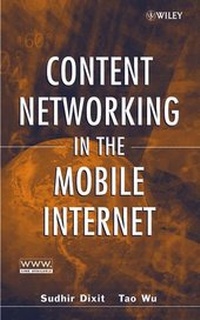
Content Networking in the Mobile Internet
Description

Reviews / Votes
"...an integrated view of both content and wirelesstechnologies, filling the gap between the material taught at theuniversity and expertise needed to succeed in industry."(International Journal of General Systems, June 2005) "...this essential handbook is strongly recommended foracademic and corporate engineering libraries." (E-STREAMS,March 2005) "...the book is professionally written. It will be of realhelp to people with an interest in content delivery applications."(Computing Reviews.com, March 8, 2005)More details
Other editions
Additional editions

Persons
Content
ACRONYMS.
1 CONTENT NETWORKING IN THE MOBILE INTERNET (Sudhir Dixit and Tao Wu).
1.1 Introduction.
1.2 Content Networking in the Mobile Internet.
1.3 Book Overview.
1.4 Concluding Remarks.
2 MOBILE INTERNET ARCHITECTURE OVERVIEW (Harri Holma and Antti Toskala).
2.1 Introduction.
2.2 Standardization Framework.
2.3 System Architecture and Core Network.
2.4 WCDMA Radio Access Network.
2.4.5 Evolution of WCDMA.
2.6 IS-95 Radio Access.
2.7 GSM/EDGE and WCDMA Operator Performance.
2.8 GSM/EDGE and WCDMA End-User Performance.
References.
3 PROTOCOLS FOR THE WEB AND THE MOBILE INTERNET (Mitri Abou-Rizk).
3.1 Introduction.
3.2 History of the World Wide Web.
3.3 The Web Today.
3.4 The Future Web.
3.5 HyperText Transfer Protocol.
3.6 Wireless Access Protocol (WAP).
References.
4 CONTENT CACHING AND MULTICAST (Dan Li).
4.1 Web-Based Applications.
4.2 Scalable Content Delivery via Multicast and Caching.
4.3 IP Multicast and Reliable Multicast.
4.4 Application Layer Multicast.
4.5 Web Proxy Caching.
4.6 Summary.
References.
5 CHARACTERIZING WEB WORKLOAD OF MOBILE CLIENTS (Atul Adya, Paramvir Bahl, and Lili Qiu).
5.1 Overview of Web Workload Characterization.
5.2 Overview of Previous Work.
5.3 Server Architecture and Data Gathering.
5.4 Characterizing Web Browsing Workload.
5.5 Characterizing Notification Workload.
5.6 Correlation between Web Browsing and Notification.
5.7 Comparison between Workload of Wireline Web and Mobile Web.
5.8 Summary.
References.
6 ACME: A NEW MOBILE CONTENT DELIVERY ARCHITECTURE (Tao Wu, Sadhna Ahuja, and Sudhir Dixit).
6.1 Introduction.
6.2 Mobile Content Delivery Techniques and Related Work.
6.3 ACME Performance Analysis.
6.4 Exploiting User Interest Correlation with ACME.
6.5 ACME in Radio Resource Management.
6.6 Conclusions.
References.
7 CONTENT ADAPTATION FOR THE MOBILE INTERNET (Stephane Coulombe, Oskari Koskimies, and Guido Grassel).
7.1 Motivation for Adaptation.
7.2 Multimedia Content Types.
7.3 Types of Adaptation.
7.4 Methods of Adaptation.
7.5 Capabilities and Metadata.
7.6 Adaptation Architectures.
7.7 Application Scenarios.
7.8 Standardization and Future Work.
References.
8 CONTENT SYNCHRONIZATION (Ganesh Sivaraman).
8.1 Introduction.
8.2 Why Mobile Devices Need Synchronization.
8.3 Fundamental Principles of Synchronization.
8.4 Adoption of Synchronization for Mobile Devices.
8.5 Synchronization Standard.
8.6 Summary.
References.
9 MULTIMEDIA STREAMING IN MOBILE WIRELESS NETWORKS (Sanjeev Verma, Muhammad Mukarram bin Tariq, Takeshi Yoshimura, and Tao Wu).
9.1 Introduction.
9.2 QoS Issues for Streaming Applications.
9.3 Streaming Media Codecs.
9.4 End-to-End Architecture to Provide Streaming Services in Wireless Environments.
9.5 Protocols for Streaming Media Delivery.
9.6 3GPP Packet-Switched Streaming Service.
9.7 Multimedia Services in Mobile and Wireless Environments.
9.8 Conclusions.
References.
10 MULTICAST CONTENT DELIVERY FOR MOBILES (Rod Walsh, Antti-Pentti Vainio, and Janne Aaltonen).
10.1 Introduction.
10.2 Multicast Overview.
10.3 The Generic IP Multicast System.
10.4 IP Datacast (IPDC).
10.5 Multicast in Third-Generation Cellular (MBMS).
10.6 Multicast Content Delivery for Mobiles in Summary and in the Future.
References.
11 SECURITY AND DIGITAL RIGHTS MANAGEMENT FOR MOBILE CONTENT (Deepa Kundur, Heather Yu, and Ching-Yung Lin).
11.1 Introduction to Information Security and DRM Technologies.
11.2 MPEG Intellectual Property Management and Protection.
11.3 Emerging Technologies and Applications.
References.
12 CHARGING FOR MOBILE CONTENT (David Banjo).
12.1 Introduction.
12.2 Fixed-Line Telephony Charging.
12.3 Mobile Telephony Charging.
12.4 Aspects Pertinent to Mobile Content Charging.
12.4.5 Roaming.
12.4.6 Multiple Access.
12.4.7 Source of Charging Records.
12.4.8 Multiple Servers Involved in Delivery.
12.5 Charging Concepts and Mechanisms.
12.6 Charging Interfaces.
12.7 Charging Information.
12.8 Charging Architecture and Scenarios.
12.9 Summary.
References.
13 ALGORITHMS AND INFRASTRUCTURES FOR LOCATION-BASED SERVICES (Gang Wu, Xia Gao, and Keisuke Suwa).
13.1 Introduction.
13.2 Taxonomy of Location.
13.3 Location Estimation Media.
13.4 Location Estimation Algorithms.
13.5 Location Estimation Systems.
13.6 Location Services Based on Cellular Systems.
References.
14 FIXED AND MOBILE WEB SERVICES (Michael Mahan).
14.1 Web Services Introduction.
14.2 Web Services Foundation Technologies.
14.3 Conclusion.
References.
INDEX.
