

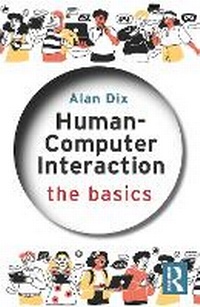
Human-Computer Interaction
The Basics
Will be published approx. on 22. September 2026
162 pages
E-Book
978-1-040-56451-6 (ISBN)
Description

Digital technology shapes our daily lives, from smartphones to autonomous cars, and Human-Computer Interaction (HCI) focuses on understanding and enhancing how we interact with these systems. Human-Computer Interaction: The Basics provides a concise and accessible introduction to the foundational principles, practical applications, and contemporary challenges of this dynamic and diverse field.
This book begins by exploring key topics such as understanding the human context in which systems are deployed, applying design and evaluation methods, and building and deploying human-focused software. Later chapters examine the social and ethical implications of digital technology and underlying theory and research, incorporating insights from psychological and social science perspectives. For those aiming to understand how the systems around them have been designed, or are seeking guidance to improve design processes, this book offers valuable insights to support the creation of better, more effective systems.
An essential read for newcomers and first-year students, this book is ideal for those undertaking or considering courses related to HCI, including interaction design, user experience (UX) design, user interface design, and human-centered systems, as well as interdisciplinary fields like the digital humanities. It also offers insights and inspiration for more experienced readers.
This book begins by exploring key topics such as understanding the human context in which systems are deployed, applying design and evaluation methods, and building and deploying human-focused software. Later chapters examine the social and ethical implications of digital technology and underlying theory and research, incorporating insights from psychological and social science perspectives. For those aiming to understand how the systems around them have been designed, or are seeking guidance to improve design processes, this book offers valuable insights to support the creation of better, more effective systems.
An essential read for newcomers and first-year students, this book is ideal for those undertaking or considering courses related to HCI, including interaction design, user experience (UX) design, user interface design, and human-centered systems, as well as interdisciplinary fields like the digital humanities. It also offers insights and inspiration for more experienced readers.
More details
Series
Language
English
Place of publication
London
United Kingdom
Publishing group
Taylor & Francis Ltd
Target group
Primary & secondary/elementary & high school
College/higher education
Illustrations
3 Line drawings, black and white; 3 Illustrations, black and white
ISBN-13
978-1-040-56451-6 (9781040564516)
Copyright in bibliographic data and cover images is held by Nielsen Book Services Limited or by the publishers or by their respective licensors: all rights reserved.
Schweitzer Classification
Other editions
Additional editions

Book
approx. 09/2026
1st Edition
The Basics
€111.50
Not yet published
Book
approx. 09/2026
1st Edition
Routledge
€25.00
Not yet published
Person
Alan Dix is Professor Emeritus at Cardiff Metropolitan University and at Swansea University. He started his academic career as a mathematician and was part of the British team to the International Mathematical Olympiad in 1978. However, he is best known for his work in human-computer interaction (HCI), including writing one of the key textbooks in the area. He was elected to the ACM SIGCHI Academy in 2013 and is a Fellow of the Learned Society of Wales. Outside academia, Alan has been co-founder of two dot-com era tech companies, developed intelligent lighting and worked in local government and even submarine design.
In every role, Alan seeks to understand and innovate in all aspects where people and technology meet. He has often been prescient in recognising the implications of digital technology, in 1990 writing the first paper on privacy within the HCI literature, in 1992 predicting the potential danger of ethnic, gender and socio-economic bias in black-box machine learning algorithms, and in 1995 the first journal paper on mobile HCI.
Alan writes and talks extensively on the connections between computers, artificial intelligence and human issues, both in terms of individual user interfaces and also social implications. This has included leading the algorithmic social justice theme within the UK Not-Equal programme and participating in the European TANGO project on synergistic human-AI decision making.
His other books include Artificial Intelligence: humans at the heart of algorithms (second edition published in June 2025), Human-Computer Interaction (with Janet Finlay, Gregory Abowd and Russell Beale), one of the key international textbooks in the area; TouchIT: Understanding Design in a Physical-Digital World (with Steve Gill, Devina Ramduny-Ellis and Jo Hare) on the design of physical-digital products; and Statistics for HCI: Making Sense of Quantitative Data. He is also completing two books in the for CRC/Taylor \& Francis AI for Everything series, AI for Social Justice (with Clara Crivellaro) and AI for HCI.
In every role, Alan seeks to understand and innovate in all aspects where people and technology meet. He has often been prescient in recognising the implications of digital technology, in 1990 writing the first paper on privacy within the HCI literature, in 1992 predicting the potential danger of ethnic, gender and socio-economic bias in black-box machine learning algorithms, and in 1995 the first journal paper on mobile HCI.
Alan writes and talks extensively on the connections between computers, artificial intelligence and human issues, both in terms of individual user interfaces and also social implications. This has included leading the algorithmic social justice theme within the UK Not-Equal programme and participating in the European TANGO project on synergistic human-AI decision making.
His other books include Artificial Intelligence: humans at the heart of algorithms (second edition published in June 2025), Human-Computer Interaction (with Janet Finlay, Gregory Abowd and Russell Beale), one of the key international textbooks in the area; TouchIT: Understanding Design in a Physical-Digital World (with Steve Gill, Devina Ramduny-Ellis and Jo Hare) on the design of physical-digital products; and Statistics for HCI: Making Sense of Quantitative Data. He is also completing two books in the for CRC/Taylor \& Francis AI for Everything series, AI for Social Justice (with Clara Crivellaro) and AI for HCI.
Content
1. Introduction
2. Users and Context
3. Design
4. Evaluation
5. Implementation and Deployment
6. Social, Ethical and Political Implications
7. Fundamental Theories
8. Research Methods
2. Users and Context
3. Design
4. Evaluation
5. Implementation and Deployment
6. Social, Ethical and Political Implications
7. Fundamental Theories
8. Research Methods
