

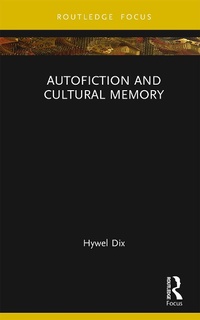
Autofiction and Cultural Memory
1st Edition
Published on 22. December 2022
124 pages
978-1-000-85428-2 (ISBN)
Description

Autofiction and Cultural Memory breaks new ground in autofiction research by showing how it gives postcolonial writers a means of bearing witness to past cultural or political struggles, and hence of contributing to new forms of cultural memory.
Most discussion of autofiction has treated it as an individualistic form, dealing with the personal growth of its authors. In doing so, it privileges narratives of private development over those of social commitment and accords with Western concepts of ownership and authorship. By contrast, Hywel Dix shows how a variety of writers outside the Western world have used the techniques of autofiction in a different way, placing themselves on the side lines of their own stories to show solidarity with struggles against imperialism and tyranny.
Drawing on examples from Algeria, Ethiopia, the Caribbean, the Americas, India and Turkey, Dix presents autofiction as a form which combines the life stories of authors with the collective struggles of their societies to restore to view historical injustices that have been marginalised and forgotten. By contributing to new forms of cultural memory, autofiction raises important questions about what we choose to remember and what we value in the present. This book will be of interest to anyone working in postcolonial studies, world literature, trauma studies, autobiography, life writing or social justice.
Most discussion of autofiction has treated it as an individualistic form, dealing with the personal growth of its authors. In doing so, it privileges narratives of private development over those of social commitment and accords with Western concepts of ownership and authorship. By contrast, Hywel Dix shows how a variety of writers outside the Western world have used the techniques of autofiction in a different way, placing themselves on the side lines of their own stories to show solidarity with struggles against imperialism and tyranny.
Drawing on examples from Algeria, Ethiopia, the Caribbean, the Americas, India and Turkey, Dix presents autofiction as a form which combines the life stories of authors with the collective struggles of their societies to restore to view historical injustices that have been marginalised and forgotten. By contributing to new forms of cultural memory, autofiction raises important questions about what we choose to remember and what we value in the present. This book will be of interest to anyone working in postcolonial studies, world literature, trauma studies, autobiography, life writing or social justice.
Reviews / Votes
'Autofiction and Cultural Memory offers an excellent overview of recent thinking about the nature of autofiction and advances a persuasive argument. Drawing on a varied range of sources, Dix proposes a unique approach that will be useful for both literary study and interdisciplinary approaches to cultural memory. This is a key text for both experts and new scholars.'Professor Timothy C. Baker, University of Aberdeen
'Reversing the polarity of autofiction from individual to society, Hywel Dix'sAutofiction and Cultural Memory shows how a form once understood to be concerned with the self becomes a way of telling collective stories and broadening cultural memory for contemporary writers from postcolonial cultures.'
James Harker, Bard College Berlin
More details
Series
Edition
1. Auflage
Language
English
Place of publication
London
United Kingdom
Publishing group
Taylor & Francis Ltd
Target group
College/higher education
Professional and scholarly
Product notice
Reflowable
ISBN-13
978-1-000-85428-2 (9781000854282)
Copyright in bibliographic data and cover images is held by Nielsen Book Services Limited or by the publishers or by their respective licensors: all rights reserved.
Schweitzer Classification
Other editions
Additional editions
Hywel Dix
Autofiction and Cultural Memory
Book
08/2024
1st Edition
Routledge
€33.00
Shipment within 10-20 days
Hywel Dix
Autofiction and Cultural Memory
Book
12/2022
1st Edition
Routledge
€71.70
Shipment within 10-20 days
Person
Hywel Dix is Professor of English at Bournemouth University. His research interests include modern and contemporary literature, critical cultural theory, authorial careers and autofiction. His publications include The Late-Career Novelist (2017) and Autofiction in English (2018).
Content
Introduction
1. On Autofiction and Cultural Memory
2. How the Author Became: Precursors and Preludes
3. The Author as Minor Character: Alternative Perspectives
4. The Poetics of Exile and Return
5. Autofiction Once, Twice, Three Times Removed
Conclusion
References
Index
1. On Autofiction and Cultural Memory
2. How the Author Became: Precursors and Preludes
3. The Author as Minor Character: Alternative Perspectives
4. The Poetics of Exile and Return
5. Autofiction Once, Twice, Three Times Removed
Conclusion
References
Index
