

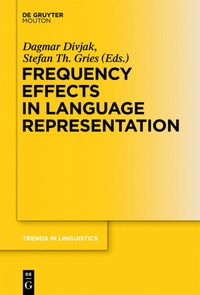
Frequency Effects in Language Representation
Volume 2
1st Edition
Published on 31. August 2012
VII, 282 pages
978-3-11-027407-3 (ISBN)
Description

The volume explores the relationship between well-studied aspects of language (constructional alternations, lexical contrasts and extensions and multi-word expressions) in a variety of languages (Dutch, English, Russian and Spanish) and their representation in cognition as mediated by frequency counts in both text and experiment. The state-of-the-art data collection (ranging from questionnaires to eye-tracking) and analysis (from simple chi-squared to random effects regression) techniques allow to draw theoretical conclusions from (mis)matches between different types of empirical data. The sister volume focuses on language learning and processing.
More details
Other editions
Additional editions
Book
08/2012
1st Edition
De Gruyter Mouton
€189.95
Shipment within 7-9 days
Persons
Dagmar Divjak, University of Sheffield, UK; Stefan T. Gries, University of California, USA.
Content
1 - Preface [Seite 5]
2 - Introduction [Seite 9]
3 - Things going unnoticed - A usage-based analysis of go-constructions [Seite 19]
4 - The Locative Alternation and the Russian 'empty' prefixes: A case study of the verb gruzit' 'load' [Seite 59]
5 - Alternation biases in corpora vs. picture description experiments: DO-biased and PD-biased verbs in the Dutch dative alternation [Seite 95]
6 - A unified lexicon and grammar? Compositional and non-compositional phrases in the lexicon [Seite 135]
7 - Measuring Mental Entrenchment of Phrases with Perceptual Identification, Familiarity Ratings, and Corpus Frequency Statistics [Seite 173]
8 - Figurative extensions of word meaning: How do corpus data and intuition match up? [Seite 203]
9 - Conversion and the lexicon: Comparing evidence from corpora and experimentation [Seite 243]
10 - As lexical as it gets: The role of co-occurrence of antonyms in a visual lexical decision experiment [Seite 263]
11 - Subject index [Seite 289]
2 - Introduction [Seite 9]
3 - Things going unnoticed - A usage-based analysis of go-constructions [Seite 19]
4 - The Locative Alternation and the Russian 'empty' prefixes: A case study of the verb gruzit' 'load' [Seite 59]
5 - Alternation biases in corpora vs. picture description experiments: DO-biased and PD-biased verbs in the Dutch dative alternation [Seite 95]
6 - A unified lexicon and grammar? Compositional and non-compositional phrases in the lexicon [Seite 135]
7 - Measuring Mental Entrenchment of Phrases with Perceptual Identification, Familiarity Ratings, and Corpus Frequency Statistics [Seite 173]
8 - Figurative extensions of word meaning: How do corpus data and intuition match up? [Seite 203]
9 - Conversion and the lexicon: Comparing evidence from corpora and experimentation [Seite 243]
10 - As lexical as it gets: The role of co-occurrence of antonyms in a visual lexical decision experiment [Seite 263]
11 - Subject index [Seite 289]
