

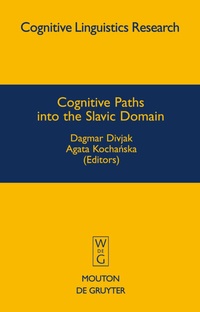
Cognitive Paths into the Slavic Domain
Description

The volume presents an overview of recent cognitive linguistic research on Slavic languages. Slavic languages, with their rich inflectional morphology in both the nominal and the verbal system, provide an important testing ground for a linguistic theory that seeks to motivate linguistic structure.
Therefore, the volume touches upon a wide range of phenomena: it addresses issues related to the semantics of grammatical case, tense, aspect, voice and word order, it looks into grammaticalization and language change and discusses sound symbolism. At the same time, the analyses presented address a variety of theoretically important issues. Take for example the role of virtual entities in language or that of iconic motivation in grammar, the importance of metaphor for grammaticalization or that of subjectification for motivating synchronic polysemy and diachronic language change, as well as the myriad of patterns available to encode events in a non-canonical way or to convey the speaker's epistemic stance with respect to the communicated content. In addition, the analyses are couched in a variety of cognitive linguistic frameworks, such as cognitive grammar, mental space theory, construction grammar, frame semantics, grammaticalization theory, as well as prototype semantics.
All in all, the analyses presented in this volume enrich the understanding of established aspects of the cognitive model of language and may serve as catalysts for their further development and refinement, making the volume a worthwhile read for Slavic and cognitive linguists alike.
More details
Other editions
Additional editions
Persons
Content
- Frontmatter
- Table of contents
- Why cognitive linguists should care about the Slavic languages and vice versa
- Nominative and instrumental variation of adjectival predicates with the Russian copula byt': reference time, limitation, and focalization
- Why double marking in the Macedonian dativus sympatheticus?
- What makes Russian bi-aspectual verbs special?
- Perfectives, imperfectives and the Croatian present tense
- Conflicting epistemic meanings of the Polish aspectual variants in past and in future uses: are they a vagary of grammar?
- Conjunctions, verb forms, and epistemic stance in Polish and Serbian predictive conditionals
- Degrees of event integration. A binding scale for [VFIN VINF] structures in Russian
- The 'impersonal' impersonal construction in Polish. A Cognitive Grammar analysis
- A Frame Semantic account of morphosemantic change: the case of Old Czech verící
- A prototype account of the development of delimitative po- in Russian
- The rise of an epistemic pragmatic marker in Balkan Slavic: an exploratory study of nesto
- Iconicity and linear ordering of constituents within Polish NPs
- Discourse-aspectual markers in Czech sound symbolic expressions: Towards a systematic analysis of sound symbolism
- Backmatter
