

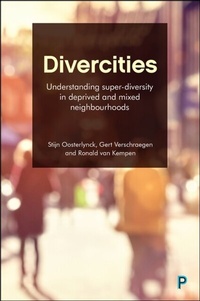
Divercities
Understanding Super-Diversity in Deprived and Mixed Neighbourhoods
Policy Press
1st Edition
Published on 19. December 2018
256 pages
978-1-4473-3819-2 (ISBN)
Description

How do people deal with diversity in deprived and mixed urban neighbourhoods? This edited collection provides a comparative international perspective on superdiversity in cities, with explicit attention given to social inequality and social exclusion on a neighbourhood level.
Although public discourses on urban diversity are often negative, this book focuses on how residents actively and creatively come and live together through micro-level interactions. By deliberately taking an international perspective on the daily lives of residents, the book uncovers the ways in which national and local contexts shape living in diversity.
The book will be a valuable resource for researchers and students of poverty, segregation and social mix, conviviality, the effects of international migration, urban and neighbourhood policies and governance, multiculturality, social networks, social cohesion, social mobility, and super-diversity.
Although public discourses on urban diversity are often negative, this book focuses on how residents actively and creatively come and live together through micro-level interactions. By deliberately taking an international perspective on the daily lives of residents, the book uncovers the ways in which national and local contexts shape living in diversity.
The book will be a valuable resource for researchers and students of poverty, segregation and social mix, conviviality, the effects of international migration, urban and neighbourhood policies and governance, multiculturality, social networks, social cohesion, social mobility, and super-diversity.
Reviews / Votes
"This book is significant and valuable because it goes beyond conventional debates about migration and urban insecurity. It focuses on the ways in which people live with diversity, moving beyond simply celebrating or bemoaning `multiculturalism'. And it does so with the help of cases drawn from beyond the usual suspects, in and beyond Europe." - Allan Cochrane, The Open University"This book provides a timely and international comparative analysis of diversity and crucially shows that diversity does not deserve its negative connotation. Everyone concerned about diversity in contemporary cities should read this book." - Maarten van Ham, Delft University of Technology
More details
Edition
First Edition
Language
English
Place of publication
Bristol
United Kingdom
Publishing group
Bristol University Press
Target group
Professional and scholarly
Illustrations
Not illustrated
ISBN-13
978-1-4473-3819-2 (9781447338192)
DOI
https://doi.org/10.51952/9781447338192
Copyright in bibliographic data and cover images is held by Nielsen Book Services Limited or by the publishers or by their respective licensors: all rights reserved.
Schweitzer Classification
Other editions
Additional editions

Divercities
Understanding Super-Diversity in Deprived and Mixed Neighbourhoods
Book
01/2020
1st Edition
Policy Press
€42.40
Shipment within 15-20 days

Divercities
Understanding Super-Diversity in Deprived and Mixed Neighbourhoods
Book
12/2018
1st Edition
Policy Press
€107.90
Shipment within 15-20 days
Divercities
Understanding Super-Diversity in Deprived and Mixed Neighbourhoods
E-Book
12/2018
1st Edition
Policy Press
€47.99
Available for download
Persons
Stijn Oosterlynck is Associate Professor in Urban Sociology at the University of Antwerp. His research is concerned with local social innovation and welfare state restructuring, the political sociology of urban development, urban renewal and community building and new forms of solidarity in diversity.
Gert Verschraegen is Associate Professor in Sociology at the University of Antwerp. His research is concerned with numerical governance, Europeanization, science and society, (social) innovation, cultural diversity in cities and the sociology of human rights and asylum.
The late Ronald van Kempen was Professor of Urban Geography at Utrecht University. His research focused on urban spatial segregation, urban diversity, housing, urban governance and its effects on neighbourhoods and residents, social exclusion, and minority ethnic groups.
Gert Verschraegen is Associate Professor in Sociology at the University of Antwerp. His research is concerned with numerical governance, Europeanization, science and society, (social) innovation, cultural diversity in cities and the sociology of human rights and asylum.
The late Ronald van Kempen was Professor of Urban Geography at Utrecht University. His research focused on urban spatial segregation, urban diversity, housing, urban governance and its effects on neighbourhoods and residents, social exclusion, and minority ethnic groups.
Content
1. Introduction: Living with Diversity in Deprived and Mixed Neighbourhoods. Stijn Oosterlynck, Gert Verschraegen and Ronald van Kempen
2. Diversity on the doorstep: living in socially and ethnically heterogeneous residential buildings in Geneva. Maxime Felder
3. Neighbourhood diversity in London: local perspectives and practices. Jamie Kesten and Tatiana Moreira de Souza
4. "Others" in diversified neighborhoods: What does social cohesion mean in diversified neighborhoods? A case-study in Istanbul. Ayda Eraydin
5. Nurturing solidarity in diversity: complementary currencies as a transformative practice in Ghent, Belgium. Anika Depraetere, Bart Van Bouchaute, Stijn Oosterlynck and Joke Vandenabeele
6. Interculturalism as Conservative Multiculturalism? New generations from an immigrant background in Milan, Italy, and the challenge to categories and boundaries. Eduardo Barberis
7. Bringing inequality closer. A comparative outlook at socially diverse neighborhoods in Chicago and Santiago de Chile. Javier Ruiz-Tagle
8. Ambiguities of vertical multiethnic coexistence in the city of Athens. Living together but unequally... Between Conflicts and Encounters. Dimitris Balampanidis and Panagiotis Bourlessas
9. Beyond the middle classes: Neighbourhood choice and satisfaction in the hyper-diverse contexts. Anouk K. Tersteeg and Ympkje Albeda
10. Living with diversity or living with difference? International perspectives on everyday perceptions of the social composition of diverse neighbourhoods. Katrin Grossmann, Georgia Alexandri, Maria Budnik, Annegret Haase, Christian Haid, Christoph Hedtke, Katharina Kullmann and Galia Shokry
2. Diversity on the doorstep: living in socially and ethnically heterogeneous residential buildings in Geneva. Maxime Felder
3. Neighbourhood diversity in London: local perspectives and practices. Jamie Kesten and Tatiana Moreira de Souza
4. "Others" in diversified neighborhoods: What does social cohesion mean in diversified neighborhoods? A case-study in Istanbul. Ayda Eraydin
5. Nurturing solidarity in diversity: complementary currencies as a transformative practice in Ghent, Belgium. Anika Depraetere, Bart Van Bouchaute, Stijn Oosterlynck and Joke Vandenabeele
6. Interculturalism as Conservative Multiculturalism? New generations from an immigrant background in Milan, Italy, and the challenge to categories and boundaries. Eduardo Barberis
7. Bringing inequality closer. A comparative outlook at socially diverse neighborhoods in Chicago and Santiago de Chile. Javier Ruiz-Tagle
8. Ambiguities of vertical multiethnic coexistence in the city of Athens. Living together but unequally... Between Conflicts and Encounters. Dimitris Balampanidis and Panagiotis Bourlessas
9. Beyond the middle classes: Neighbourhood choice and satisfaction in the hyper-diverse contexts. Anouk K. Tersteeg and Ympkje Albeda
10. Living with diversity or living with difference? International perspectives on everyday perceptions of the social composition of diverse neighbourhoods. Katrin Grossmann, Georgia Alexandri, Maria Budnik, Annegret Haase, Christian Haid, Christoph Hedtke, Katharina Kullmann and Galia Shokry
