

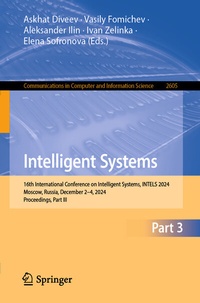
Intelligent Systems
Description

The three-volume set CCIS 2603, 2604 and 2605 constitutes the refereed proceedings of the 16th International Conference on Intelligent Systems, INTELS 2024, held in Moscow, Russia, during December 2-4, 2024.
The 72 papers included in these proceedings were carefully reviewed and selected from 140 submissions. They focus on areas of intelligent systems and artificial intelligence and their application to sustainable development and new challenges to the society.
More details
Other editions
Additional editions
Persons
Content
.- The Use of Neural Networks Based on the YOLO Architecture to Automatically Determine Indicators of Crop Growth Using Photographs Taken from UAVs.
.- Residues Control for Perishables in Retail through Dynamic Pricing.
.- Control Algorithm for Reducing the In uence of External Load on the Steering Drive System.
.- Software Framework for EEG Signals Analysis Using Machine Learning Methods.
.- A Review on Facial Expression Recognition Approaches, Datasets and Technologies.
.- An Open Source Laboratory Information Management System for Biobank Optimization in a Robotic Environment.
.- Methods of objects recognition system enhancement in computer vision.
.- Reconstruction derivatives from values of functions belonging to Nikolskii-Besov classes of mixed smoothness in domains of a certain kind.
.- A neural network approach to longitudinal vehicle acceleration control.
.- Algorithms of ECG time series processing in EDF-format.
.- On homogeneous observers for linear systems.
.- Intelligent Systems for Urban Planning: Well-being and Residents' Perception.
.- The principle of trajectories separation for the optimal control problem in a feedback system.
.- Fault Detection and Isolation for USV with INS using genetic algorithm.
.- The Necessity of Using Technical Analogues of Thinking and Consciousness for the Creation of AGI.
.- Solving boundary value problems based on a fractional di erential equation of di usion type with arbitrary values of the orders of the derivatives.
.- Automation systems for scienti c calculations for multiscale modeling of composite materials.
.- Automated generation of educational video material.
.- Application of stochastic Petri nets in a network-centric approach to the organization of the emergency response process.
.- A Self-Organization Intelligent Model in Network-Centric Systems Based on Coalition-Structural Synthesis.
.- The Mathematical Model Identi cation Problem and its Solving by Symbolic Regression.
.- Hierarchal Compromise in Decision Making.
