

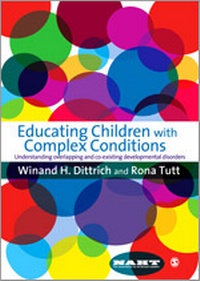
Educating Children with Complex Conditions
Understanding Overlapping & Co-existing Developmental Disorders
1st Edition
Published on 18. September 2008
128 pages
978-1-84920-840-6 (ISBN)
Description

'This is an important contribution to the field of SEN. By putting the child into a context, the authors recognize that each child is unique and cannot be reduced to a simple diagnosis. Highly recommended' - SEN Magazine
'In just over 100 pages this book gives the clearest account I have yet read of 'overlapping and co-existing conditions'....All professionals working with children with complex conditions will find it both interesting and practical' - Special
'The book is written in an easily digestible form, and provides insight into overlapping conditions as well as advice on support to those working to meeting the needs of pupils with these complex disorders' - SNIP
'Many have tried but few have succeeded in bringing together the varying threads of special educational needs into a concise and proactive format. I know, having tried and failed myself. Here at last Dittrich and Tutt have created a fascinating account of the current SEN world and have succeeded, in my opinion, in demystifying and explaining the significance of specific SEN terms, while illustrating that overlap is more the norm than the exception. Well researched and written with both clarity and experience, the authors stress that there really is no such thing as a SEN child, but that some children are in essence more interesting in their learning and behaviour style than others.' Fintan O'Regan, Author and Consultant
There are growing numbers of children displaying the symptoms of more than one condition or disorder, and this has led to those involved in education needing to understand which conditions commonly overlap or co-exist, and how to meet children's more complex needs.
By bringing together some of the latest research on how the brain learns with what is known about identifying developmental disorders that appear to have a common biological basis, this book covers:
- what is known about a common group of disorders, (including ADHD, autistic spectrum disorders, dyslexia, dyscalculia and dyspraxia)
- how to recognise when a child may have more than one condition
- what teaching approaches and strategies might be most relevant
Written in a non-technical style, the book blends together scientific knowledge from different disciplines and translates it into practical terms for school leaders, practitioners in the field of
special educational needs and disabilities, and students following courses in higher education.
'In just over 100 pages this book gives the clearest account I have yet read of 'overlapping and co-existing conditions'....All professionals working with children with complex conditions will find it both interesting and practical' - Special
'The book is written in an easily digestible form, and provides insight into overlapping conditions as well as advice on support to those working to meeting the needs of pupils with these complex disorders' - SNIP
'Many have tried but few have succeeded in bringing together the varying threads of special educational needs into a concise and proactive format. I know, having tried and failed myself. Here at last Dittrich and Tutt have created a fascinating account of the current SEN world and have succeeded, in my opinion, in demystifying and explaining the significance of specific SEN terms, while illustrating that overlap is more the norm than the exception. Well researched and written with both clarity and experience, the authors stress that there really is no such thing as a SEN child, but that some children are in essence more interesting in their learning and behaviour style than others.' Fintan O'Regan, Author and Consultant
There are growing numbers of children displaying the symptoms of more than one condition or disorder, and this has led to those involved in education needing to understand which conditions commonly overlap or co-exist, and how to meet children's more complex needs.
By bringing together some of the latest research on how the brain learns with what is known about identifying developmental disorders that appear to have a common biological basis, this book covers:
- what is known about a common group of disorders, (including ADHD, autistic spectrum disorders, dyslexia, dyscalculia and dyspraxia)
- how to recognise when a child may have more than one condition
- what teaching approaches and strategies might be most relevant
Written in a non-technical style, the book blends together scientific knowledge from different disciplines and translates it into practical terms for school leaders, practitioners in the field of
special educational needs and disabilities, and students following courses in higher education.
Reviews / Votes
'This is an important contribution to the field of SEN. By putting the child into a context, the authors recognize that each child is unique and cannot be reduced to a simple diagnosis. Highly recommended' - SEN MagazineAll prices
More details
Language
English
Place of publication
London
United Kingdom
Target group
Professional and scholarly
File size
1,99 MB
ISBN-13
978-1-84920-840-6 (9781849208406)
Copyright in bibliographic data and cover images is held by Nielsen Book Services Limited or by the publishers or by their respective licensors: all rights reserved.
Schweitzer Classification
Other editions
Additional editions
Winand H. Dittrich | Rona Tutt
Educating Children with Complex Conditions
Understanding Overlapping & Co-existing Developmental Disorders
Book
09/2008
1st Edition
SAGE Publications Ltd
€221.35
Shipment within 15-20 days
Winand H. Dittrich | Rona Tutt
Educating Children with Complex Conditions
Understanding Overlapping & Co-existing Developmental Disorders
Book
09/2008
1st Edition
SAGE Publications Ltd
€92.90
Shipment within 15-20 days
Persons
Dr Rona Tutt OBE has taught pupils of all ages in state and independent, day and residential, mainstream and special schools. She has been a winner of the Leadership in Teaching Award, received an Outstanding Reviewer Award for her work on the International Journal of Educational Management and an OBE for her services to special needs education. She is a Past President of the National Association of Head Teachers (NAHT) and continues to be involved in their work, particularly in the field of SEND.
Since moving on from headship, Rona she has been in constant demand as a speaker, reviewer, writer and judge. She has been on the Expert Reference Group of the Autism Education Trust (AET) since its inception and was the Interim Chair of Hertfordshire's All-Age Autism Partnership Board from April 2015- March 2016. In the same year, she was asked to be on the Strategic Advisory Group for 'Kids,' a charity for disabled young people and their families and to be their writer for the DfE- funded project Making it Personal, which is known as MIP3. She represents NAHT on the Special Education Consortium (SEC) (an umbrella group for over 30 organisations involved in SEN & disability); the Joint Unions Group on SEN Issues; and the National SEND Forum (NSENDF).
Rona is vice chair of governors at two schools, one is a secondary school for pupils who have moderate learning difficulties (MLD), autism, and speech, language and communication needs (SLCN). The other is an all-age school for profoundly deaf pupils, where many pupils have British Sign Language (BSL) as their first language rather than English. Having trained originally as a Teacher of the Deaf, Rona is working through her exams in BSL and learning about deaf culture.
Rona is the author of: 'Every Child Included,' (2007); she co-authored 'Educating Children with Complex Conditions - understanding overlapping and co-existing developmental disorders (Dittrich and Tutt 2008); wrote 'Partnership Working to Support Special Educational Needs and Disabilities in 2010; co-authored How Successful Schools Work - The Impact of Innovative School Leadership (Tutt and Williams 2012) and 'The SEND Code of Practice: 0-25 years' (Tutt and Williams 2015).
Since moving on from headship, Rona she has been in constant demand as a speaker, reviewer, writer and judge. She has been on the Expert Reference Group of the Autism Education Trust (AET) since its inception and was the Interim Chair of Hertfordshire's All-Age Autism Partnership Board from April 2015- March 2016. In the same year, she was asked to be on the Strategic Advisory Group for 'Kids,' a charity for disabled young people and their families and to be their writer for the DfE- funded project Making it Personal, which is known as MIP3. She represents NAHT on the Special Education Consortium (SEC) (an umbrella group for over 30 organisations involved in SEN & disability); the Joint Unions Group on SEN Issues; and the National SEND Forum (NSENDF).
Rona is vice chair of governors at two schools, one is a secondary school for pupils who have moderate learning difficulties (MLD), autism, and speech, language and communication needs (SLCN). The other is an all-age school for profoundly deaf pupils, where many pupils have British Sign Language (BSL) as their first language rather than English. Having trained originally as a Teacher of the Deaf, Rona is working through her exams in BSL and learning about deaf culture.
Rona is the author of: 'Every Child Included,' (2007); she co-authored 'Educating Children with Complex Conditions - understanding overlapping and co-existing developmental disorders (Dittrich and Tutt 2008); wrote 'Partnership Working to Support Special Educational Needs and Disabilities in 2010; co-authored How Successful Schools Work - The Impact of Innovative School Leadership (Tutt and Williams 2012) and 'The SEND Code of Practice: 0-25 years' (Tutt and Williams 2015).
Content
Defining Overlapping and Co-Existing Conditions
The Brain, Developmental Disorders and Their Effect on Learning
Fitting Labels to Children and Children to Labels
Dealing With Different Disorders in the Classroom
Environmental Issues and Therapeutic Approaches
A Consideration of Complex Conditions
The Brain, Developmental Disorders and Their Effect on Learning
Fitting Labels to Children and Children to Labels
Dealing With Different Disorders in the Classroom
Environmental Issues and Therapeutic Approaches
A Consideration of Complex Conditions
