

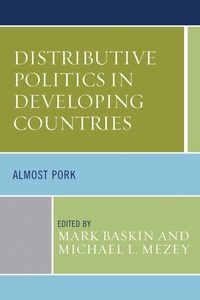
Distributive Politics in Developing Countries
Almost Pork
Lexington Books (Publisher)
1st Edition
Published on 23. October 2014
286 pages
978-0-7391-8069-3 (ISBN)
Description

This book explores the increasing use of Constituency Development Funds (CDFs) in emerging democratic governments in Africa, Asia, the Caribbean, and Oceania. CDFs dedicate public money to benefit parliamentary constituencies through allocations and/or spending decisions influenced by Members of Parliament (MPs). The contributors employ the term CDF as a generic term although such funds have a different names, such as electoral development funds (Papua New Guinea), constituency development catalyst funds (Tanzania), or Member of Parliament Local Area Development Fund (India), etc.
In some ways, the funds resemble the ad hoc pork barrel policy-making employed in the U.S. Congress for the past 200 years. However, unlike earmarks, CDFs generally become institutionalized in the government's annual budget and are distributed according to different criteria in each country. They enable MPs to influence programs in their constituencies that finance education, and build bridges, roads, community centers, clinics and schools. In this sense, a CDF is a politicized form of spending that can help fill in the important gaps in government services in constituencies that have not been addressed in the government's larger, comprehensive policy programs.
This first comprehensive treatment of CDFs in the academic and development literatures emerges from a project at the State University of New York Center for International Development. This project has explored CDFs in 19 countries and has developed indicators on their emergence, operations, and oversight. The contributors provide detailed case studies of the emergence and operations of CDFs in Kenya, Uganda, Jamaica, and India, as well as an analysis of earmarks in the U.S. Congress, and a broader analysis of the emergence of the funds in Africa. They cover the emergence, institutionalization, and accountability of these funds; analyze key issues in their operations; and offer provisional conclusions of what the emergence and operations of these funds say about the democratization of politics in developing countries and current approaches to international support for democratic governance in developing countries.
In some ways, the funds resemble the ad hoc pork barrel policy-making employed in the U.S. Congress for the past 200 years. However, unlike earmarks, CDFs generally become institutionalized in the government's annual budget and are distributed according to different criteria in each country. They enable MPs to influence programs in their constituencies that finance education, and build bridges, roads, community centers, clinics and schools. In this sense, a CDF is a politicized form of spending that can help fill in the important gaps in government services in constituencies that have not been addressed in the government's larger, comprehensive policy programs.
This first comprehensive treatment of CDFs in the academic and development literatures emerges from a project at the State University of New York Center for International Development. This project has explored CDFs in 19 countries and has developed indicators on their emergence, operations, and oversight. The contributors provide detailed case studies of the emergence and operations of CDFs in Kenya, Uganda, Jamaica, and India, as well as an analysis of earmarks in the U.S. Congress, and a broader analysis of the emergence of the funds in Africa. They cover the emergence, institutionalization, and accountability of these funds; analyze key issues in their operations; and offer provisional conclusions of what the emergence and operations of these funds say about the democratization of politics in developing countries and current approaches to international support for democratic governance in developing countries.
More details
Edition
1. Auflage
Language
English
Place of publication
New York
United States
Publishing group
Bloomsbury Publishing Plc
Target group
Professional and scholarly
Illustrations
30 Graphs, 37 Tables
ISBN-13
978-0-7391-8069-3 (9780739180693)
Copyright in bibliographic data and cover images is held by Nielsen Book Services Limited or by the publishers or by their respective licensors: all rights reserved.
Schweitzer Classification
Other editions
Additional editions
Book
10/2014
Lexington Books
€138.40
Shipment within 10-20 days
Persons
Mark Baskin is research professor of political science at Rockefeller College of Public Affairs and Policy at the University at Albany and senior fellow at the State University of New York Center for International Development at the State University of New York.
Michael L. Mezey is professor of political science at DePaul University in Chicago.
Michael L. Mezey is professor of political science at DePaul University in Chicago.
Content
Chapter 1: Introduction: Are Constituency Development Funds a Policy Tool? Mark Baskin
Chapter 2: Why CDFs in Africa? Representation vs. Constituency Service, Joel D. Barkan and Robert Mattes
Chapter 3: Money for Small Things: Experience and Lessons of Kenya's Constituency Development Fund, David Ndii
Chapter 4: In Name Only: Uganda's Constituency Development Fund, Nelson Kasfir and Steven Hippo Twebaze
Chapter 5: Earmarks in the United States, Diana Evans
Chapter 6: Drug Dons and the Development of Executive Driven Bi-Partisan CDF's in Jamaica, Horace Bartilow
Chapter 7: Constituency Needs, Constitutional Propriety and Clientelist Patronage: Constituency Development Funds in India, Harry Blair
Conclusion: Constituency Development Funds and the Role of the Representative, Michael Mezey
Chapter 2: Why CDFs in Africa? Representation vs. Constituency Service, Joel D. Barkan and Robert Mattes
Chapter 3: Money for Small Things: Experience and Lessons of Kenya's Constituency Development Fund, David Ndii
Chapter 4: In Name Only: Uganda's Constituency Development Fund, Nelson Kasfir and Steven Hippo Twebaze
Chapter 5: Earmarks in the United States, Diana Evans
Chapter 6: Drug Dons and the Development of Executive Driven Bi-Partisan CDF's in Jamaica, Horace Bartilow
Chapter 7: Constituency Needs, Constitutional Propriety and Clientelist Patronage: Constituency Development Funds in India, Harry Blair
Conclusion: Constituency Development Funds and the Role of the Representative, Michael Mezey
