

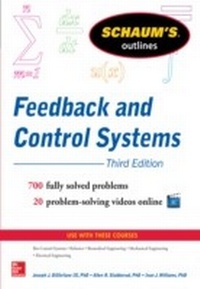
Schaum’s Outline of Feedback and Control Systems, 2nd Edition
1st Edition
Published on 18. November 2013
770 pages
978-0-07-183076-8 (ISBN)
Description

Tough Test Questions? Missed Lectures? Not Enough Time? Fortunately for you, theres Schaum's. This all-in-one-package includes more than 700 fully solved problems, examples, and practice exercises to sharpen your problem-solving skills. Plus, you will have access to 20 detailed videos featuring instructors who explain the most commonly tested problems--it's just like having your own virtual tutor! You'll find everything you need to build confidence, skills, and knowledge for the highest score possible. More than 40 million students have trusted Schaum's to help them succeed in the classroom and on exams. Schaum's is the key to faster learning and higher grades in every subject. Each Outline presents all the essential course information in an easy-to-follow, topic-by-topic format. You also get hundreds of examples, solved problems, and practice exercises to test your skills. This Schaum's Outline gives you 700 fully solved problems Extra practice on topics such as differential equations and linear systems, transfer functions, block diagram algebra, and more Support for all major textbooks for feedback and control systems courses Fully compatible with your classroom text, Schaum's highlights all the important facts you need to know. Use Schaums to shorten your study time--and get your best test scores! Schaum's Outlines--Problem Solved.
More details
Other editions
Additional editions
Joseph Distefano
Schaum's Outline of Feedback and Control Systems
Book
12/2013
3rd Edition
McGraw-Hill Professional
€38.70
Shipment within 15-20 days
Content
- Cover
- SCHAUM'S outline of Feedback and Control Systems, Third Edition
- Copyright Page
- Preface
- Contents
- Chapter 1: INTRODUCTION
- 1.1 Control Systems: What They Are
- 1.2 Examples of Control Systems
- 1.3 Open-Loop and Closed-Loop Control Systems
- 1.4 Feedback
- 1.5 Characteristics of Feedback
- 1.6 Analog and Digital Control Systems
- 1.7 The Control Systems Engineering Problem
- 1.8 Control System Models or Representations
- Chapter 2: CONTROL SYSTEMS TERMINOLOGY
- 2.1 Block Diagrams: Fundamentals
- 2.2 Block Diagrams of Continuous (Analog) Feedback Control Systems
- 2.3 Terminology of the Closed-Loop Block Diagram
- 2.4 Block Diagrams of Discrete-Time (Sampled-Data, Digital) Components, Control Systems, and Computer-Controlled Systems
- 2.5 Supplementary Terminology
- 2.6 Servomechanisms
- 2.7 Regulators
- Chapter 3: DIFFERENTIAL EQUATIONS, DIFFERENCE EQUATIONS, AND LINEAR SYSTEMS
- 3.1 System Equations
- 3.2 Differential Equations and Difference Equations
- 3.3 Partial and Ordinary Differential Equations
- 3.4 Time Variability and Time Invariance
- 3.5 Linear and Nonlinear Differential and Difference Equations
- 3.6 The Differential Operator D and the Characteristic Equation
- 3.7 Linear Independence and Fundamental Sets
- 3.8 Solution of Linear Constant-Coefficient Ordinary Differential Equations
- 3.9 The Free Response
- 3.10 The Forced Response
- 3.11 The Total Response
- 3.12 The Steady State and Transient Responses
- 3.13 Singularity Functions: Steps, Ramps, and Impulses
- 3.14 Second-Order Systems
- 3.15 State Variable Representation of Systems Described by Linear Differential Equations
- 3.16 Solution of Linear Constant-Coefficient Difference Equations
- 3.17 State Variable Representation of Systems Described by Linear Difference Equations
- 3.18 Linearity and Superposition
- 3.19 Causality and Physically Realizable Systems
- Chapter 4: THE LAPLACE TRANSFORM AND THE z-TRANSFORM
- 4.1 Introduction
- 4.2 The Laplace Transform
- 4.3 The Inverse Laplace Transform
- 4.4 Some Properties of the Laplace Transform and Its Inverse
- 4.5 Short Table of Laplace Transforms
- 4.6 Application of Laplace Transforms to the Solution of Linear Constant-Coefficient Differential Equations
- 4.7 Partial Fraction Expansions
- 4.8 Inverse Laplace Transforms Using Partial Fraction Expansions
- 4.9 The z-Transform
- 4.10 Determining Roots of Polynomials
- 4.11 Complex Plane: Pole-Zero Maps
- 4.12 Graphical Evaluation of Residues
- 4.13 Second-Order Systems
- Chapter 5: STABILITY
- 5.1 Stability Definitions
- 5.2 Characteristic Root Locations for Continuous Systems
- 5.3 Routh Stability Criterion
- 5.4 Hurwitz Stability Criterion
- 5.5 Continued Fraction Stability Criterion
- 5.6 Stability Criteria for Discrete-Time Systems
- Chapter 6: TRANSFER FUNCTIONS
- 6.1 Definition of a Continuous System Transfer Function
- 6.2 Properties of a Continuous System Transfer Function
- 6.3 Transfer Functions of Continuous Control System Compensators and Controllers
- 6.4 Continuous System Time Response
- 6.5 Continuous System Frequency Response
- 6.6 Discrete-Time System Transfer Functions, Compensators and Time Responses
- 6.7 Discrete-Time System Frequency Response
- 6.8 Combining Continuous-Time and Discrete-Time Elements
- Chapter 7: BLOCK DIAGRAM ALGEBRA AND TRANSFER FUNCTIONS OF SYSTEMS
- 7.1 Introduction
- 7.2 Review of Fundamentals
- 7.3 Blocks in Cascade
- 7.4 Canonical Form of a Feedback Control System
- 7.5 Block Diagram Transformation Theorems
- 7.6 Unity Feedback Systems
- 7.7 Superposition of Multiple Inputs
- 7.8 Reduction of Complicated Block Diagrams
- Chapter 8: SIGNAL FLOW GRAPHS
- 8.1 Introduction
- 8.2 Fundamentals of Signal Flow Graphs
- 8.3 Signal Flow Graph Algebra
- 8.4 Definitions
- 8.5 Construction of Signal Flow Graphs
- 8.6 The General Input-Output Gain Formula
- 8.7 Transfer Function Computation of Cascaded Components
- 8.8 Block Diagram Reduction Using Signal Flow Graphs and the General Input-Output Gain Formula
- Chapter 9: SYSTEM SENSITIVITY MEASURES AND CLASSIFICATION OF FEEDBACK SYSTEMS
- 9.1 Introduction
- 9.2 Sensitivity of Transfer Functions and Frequency Response Functions to System Parameters
- 9.3 Output Sensitivity to Parameters for Differential and Difference Equation Models
- 9.4 Classification of Continuous Feedback Systems by Type
- 9.5 Position Error Constants for Continuous Unity Feedback Systems
- 9.6 Velocity Error Constants for Continuous Unity Feedback Systems
- 9.7 Acceleration Error Constants for Continuous Unity Feedback Systems
- 9.8 Error Constants for Discrete Unity Feedback Systems
- 9.9 Summary Table for Continuous and Discrete-Time Unity Feedback Systems
- 9.10 Error Constants for More General Systems
- Chapter 10: ANALYSIS AND DESIGN OF FEEDBACK CONTROL SYSTEMS: OBJECTIVES AND METHODS
- 10.1 Introduction
- 10.2 Objectives of Analysis
- 10.3 Methods of Analysis
- 10.4 Design Objectives
- 10.5 System Compensation
- 10.6 Design Methods
- 10.7 The w-Transform for Discrete-Time Systems Analysis and Design Using Continuous System Methods
- 10.8 Algebraic Design of Digital Systems, Including Deadbeat Systems
- Chapter 11: NYQUIST ANALYSIS
- 11.1 Introduction
- 11.2 Plotting Complex Functions of a Complex Variable
- 11.3 Definitions
- 11.4 Properties of the Mapping P(s) or P(z)
- 11.5 Polar Plots
- 11.6 Properties of Polar Plots
- 11.7 The Nyquist Path
- 11.8 The Nyquist Stability Plot
- 11.9 Nyquist Stability Plots of Practical Feedback Control Systems
- 11.10 The Nyquist Stability Criterion
- 11.11 Relative Stability
- 11.12 M- andN-Circles
- Chapter 12: NYQUIST DESIGN
- 12.1 Design Philosophy
- 12.2 Gain Factor Compensation
- 12.3 Gain Factor Compensation Using M-Circles
- 12.4 Lead Compensation
- 12.5 Lag Compensation
- 12.6 Lag-Lead Compensation
- 12.7 Other Compensation Schemes and Combinations of Compensators
- Chapter 13: ROOT-LOCUS ANALYSIS
- 13.1 Introduction
- 13.2 Variation of Closed-Loop System Poles: The Root-Locus
- 13.3 Angle and Magnitude Criteria
- 13.4 Number of Loci
- 13.5 Real Axis Loci
- 13.6 Asymptotes
- 13.7 Breakaway Points
- 13.8 Departure and Arrival Angles
- 13.9 Construction of the Root-Locus
- 13.10 The Closed-Loop Transfer Function and the Time-Domain Response
- 13.11 Gain and Phase Margins from the Root-Locus
- 13.12 Damping Ratio from the Root-Locus for Continuous Systems
- Chapter 14: ROOT-LOCUS DESIGN
- 14.1 The Design Problem
- 14.2 Cancellation Compensation
- 14.3 Phase Compensation: Lead and Lag Networks
- 14.4 Magnitude Compensation and Combinations of Compensators
- 14.5 Dominant Pole-Zero Approximations
- 14.6 Point Design
- 14.7 Feedback Compensation
- Chapter 15: BODE ANALYSIS
- 15.1 Introduction
- 15.2 Logarithmic Scales and Bode Plots
- 15.3 The Bode Form and the Bode Gain for Continuous-Time Systems
- 15.4 Bode Plots of Simple Continuous-Time Frequency Response Functions and Their Asymptotic Approximations
- 15.5 Construction of Bode Plots for Continuous-Time Systems
- 15.6 Bode Plots of Discrete-Time Frequency Response Functions
- 15.7 Relative Stability
- 15.8 Closed-Loop Frequency Response
- 15.9 Bode Analysis of Discrete-Time Systems Using the w-Transform
- Chapter 16: BODE DESIGN
- 16.1 Design Philosophy
- 16.2 Gain Factor Compensation
- 16.3 Lead Compensation for Continuous-Time Systems
- 16.4 Lag Compensation for Continuous-Time Systems
- 16.5 Lag-Lead Compensation for Continuous-Time Systems
- 16.6 Bode Design of Discrete-Time Systems
- Chapter 17: NICHOLS CHART ANALYSIS
- 17.1 Introduction
- 17.2 db Magnitude-Phase Angle Plots
- 17.3 Construction of db Magnitude-Phase Angle Plots
- 17.4 Relative Stability
- 17.5 The Nichols Chart
- 17.6 Closed-Loop Frequency Response Functions
- Chapter 18: NICHOLS CHART DESIGN
- 18.1 Design Philosophy
- 18.2 Gain Factor Compensation
- 18.3 Gain Factor Compensation Using Constant Amplitude Curves
- 18.4 Lead Compensation for Continuous-Time Systems
- 18.5 Lag Compensation for Continuous-Time Systems
- 18.6 Lag-Lead Compensation
- 18.7 Nichols Chart Design of Discrete-Time Systems
- Chapter 19: INTRODUCTION TO NONLINEAR CONTROL SYSTEMS
- 19.1 Introduction
- 19.2 Linearized and Piecewise-Linear Approximations of Nonlinear Systems
- 19.3 Phase Plane Methods
- 19.4 Lyapunov's Stability Criterion
- 19.5 Frequency Response Methods
- Chapter 20: INTRODUCTION TO ADVANCED TOPICS IN CONTROL SYSTEMS ANALYSIS AND DESIGN
- 20.1 Introduction
- 20.2 Controllability and Observability
- 20.3 Time-Domain Design of Feedback Systems (State Feedback)
- 20.4 Control Systems with Random Inputs
- 20.5 Optimal Control Systems
- 20.6 Adaptive Control Systems
- APPENDIX A: Some Laplace Transform Pairs Useful for Control Systems Analysis
- APPENDIX B: Some z-Transform Pairs Useful for Control Systems Analysis
- REFERENCES AND BIBLIOGRAPHY
- APPENDIX C: SAMPLE Screens from the Companion Interactive Outline
- INDEX
