

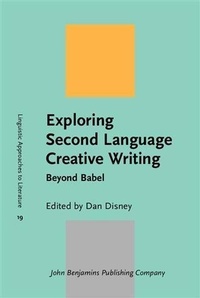
Exploring Second Language Creative Writing
Beyond Babel
1st Edition
Published on 26. June 2014
V, 157 pages
978-90-272-7035-1 (ISBN)
Description

Exploring Second Language Creative Writing continues the work of stabilizing the emerging Creative Writing (SL) discipline. In unique ways, each essay in this book seeks to redefine a tripartite relationship between language acquisition, literatures, and identity. All essays extend B.B. Kachru's notion of "bilingual creativity" as an enculturated, shaped discourse (a mutation of the Sapir-Whorf hypothesis). Creative Writing (SL), a new subfield to emerge from Stylistics, extends David Hanauer's Poetry as Research (2010); situating a suite of methodologies and interdisciplinary pedagogies, researchers in this book mobilize theories from Creativity Studies, TESOL, TETL, Translation Studies, Linguistics, Cultural Studies, and Literary Studies. Changing the relationship between L2 writers and canonized literary artefacts (from auratic to dialogic), each essay in this text is essentially Freirean; each chapter explores dynamic processes through which creative writing in a non-native language engages material and phenomenological modes toward linguistic pluricentricity and, indeed, emancipation.
More details
Other editions
Additional editions
Book
06/2014
John Benjamins Publishing Co
€100.70
Shipment within 10-15 days
Person
Content
- Exploring Second Language Creative Writing
- Editorial page
- Title page
- LCC data
- Table of contents
- Introduction
- Appreciating the beauty of second language poetry writing
- 1. On the beauty of second language writing
- 2. Writing poetry within the ESL composition classroom
- 3. Can second language learners actually write poetry?
- 4. New ways of seeing
- 5. Repositioning the second language literacy instruction
- Learner and writer voices
- 1. Writers in search of a voice: Second language writing and the search for self
- 2. A reading-to-writing cycle: Reading as a writer
- 2.1 Choice
- 2.2 Articulation
- 3. Application: Writing as a reader and finding a second language voice
- 3.1 Two voices, two identities, one self
- 3.2 Language as metaphor
- 3.3 Personifying home and language
- 3.4 Monologue and dialogue
- 3.5 Words, names and wordplay
- 3.6 Language patterns and repetition
- 4. Learner writer reflections on creativity and the second language writing process
- 4.1 Reflections on language learning processes
- 4.2 Reflections on creative processes
- 5. Second language writer voices and a creative writing pedagogy
- "Is this how it's supposed to work?"
- 1. Creative writing and identity-acquisition
- 2. Observations on observing
- 3. A line is a line is a line?
- 4. Image and figuration
- 5. Conclusions
- Literary translation as a creative practice in L2 writing pedagogies
- 1. Creativity and learning
- 2. Creativity and literary translation
- 3. The role of translation in the L2 classroom
- 4. The creative translation workshop as a tool for language learning
- 5. The live creative translation workshop
- 6. The virtual creative translation workshop
- 7. Conclusion
- Process and product, means and ends
- 1. Why teach Creative Writing in English in the non-native speaking context?
- 2. Whose territory would Creative Writing in English in the non-native speaking context be?
- 3. On the Confucian heritage context for teaching and learning
- 4. Rectifying orthodoxies for a creative agenda
- 5. Macao stories and Creative Writing at the University of Macau
- 6. ASM and the Publishing Agenda
- 7. Poetry and poetry translation/response
- 8. What future for a creative inter-discipline?
- Curriculum as cultural critique
- 1. A sense of dispossession: The political, cultural and linguistic situations of Hong Kong
- 2. The aim of a critical pedagogy: Language as a field of thought
- 3. Creative writing pedagogy: Cultural critique and culture as resource
- Co-constructing a community of creative writers
- 1. Theorizing social learning and identity construction
- 2. Contextualizing Bruneian society and culture: Bilingualism and bilingual creativity
- 3. L2 Creative writing community: Co-construction of knowledges and identities
- 4. Conclusions
- References
- Notes on contributors
- Name index
- Subject index
