

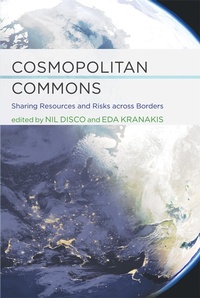
Cosmopolitan Commons
Description

With the advent of modernity, the sharing of resources and infrastructures rapidly expanded beyond local communities into regional, national, and even transnational space—nowhere as visibly as in Europe, with its small-scale political divisions. This volume views these shared resource spaces as the seedbeds of a new generation of technology-rich bureaucratic and transnational commons. Drawing on the theory of cosmopolitanism, which seeks to model the dynamics of an increasingly interdependent world, and on the tradition of commons scholarship inspired by the late Elinor Ostrom, the book develops a new theory of "cosmopolitan commons” that provides a framework for merging the study of technology with such issues as risk, moral order, and sustainability at levels beyond the nation-state.
After laying out the theoretical framework, the book presents case studies that explore the empirical nuances: airspace as transport commons, radio broadcasting, hydropower, weather forecasting and genetic diversity as information commons, transboundary air pollution, and two "capstone” studies of interlinked, temporally layered commons: one on overlapping commons within the North Sea for freight, fishing, and fossil fuels; and one on commons for transport, salmon fishing, and clean water in the Rhine.
Contributors Håkon With Andersen, Nil Disco, Paul N. Edwards, Arne Kaijser, Eda Kranakis, Kristiina Korjonen-Kuusipuro, Tiago Saraiva, Nina Wormbs
More details
Other editions
Additional editions
Persons
Eda Kranakis is Professor of History at the University of Ottawa and the author of Constructing a Bridge: An Exploration of Engineering Culture, Design, and Research in Nineteenth-Century France and America (MIT Press, 1997).
Nil Disco is Senior Researcher in the Department of Science, Technology, and Policy Studies at the University of Twente.
Eda Kranakis is Professor of History at the University of Ottawa and the author of Constructing a Bridge: An Exploration of Engineering Culture, Design, and Research in Nineteenth-Century France and America (MIT Press, 1997).
Eda Kranakis is Professor of History at the University of Ottawa and the author of Constructing a Bridge: An Exploration of Engineering Culture, Design, and Research in Nineteenth-Century France and America (MIT Press, 1997).
Paul N. Edwards is Professor in the School of Information and the Department of History at the University of Michigan. He is the author of The Closed World: Computers and the Politics of Discourse in Cold War America (1996) and a coeditor (with Clark Miller) of Changing the Atmosphere: Expert Knowledge and Environmental Governance (2001), both published by the MIT Press.
Tiago Saraiva is Associate Professor in the Department of History at Drexel University and Associated Researcher at the Institute of Social Sciences of the University of Lisbon.
Nil Disco is Senior Researcher in the Department of Science, Technology, and Policy Studies at the University of Twente.
Nil Disco is Senior Researcher in the Department of Science, Technology, and Policy Studies at the University of Twente.
Eda Kranakis is Professor of History at the University of Ottawa and the author of Constructing a Bridge: An Exploration of Engineering Culture, Design, and Research in Nineteenth-Century France and America (MIT Press, 1997).
